
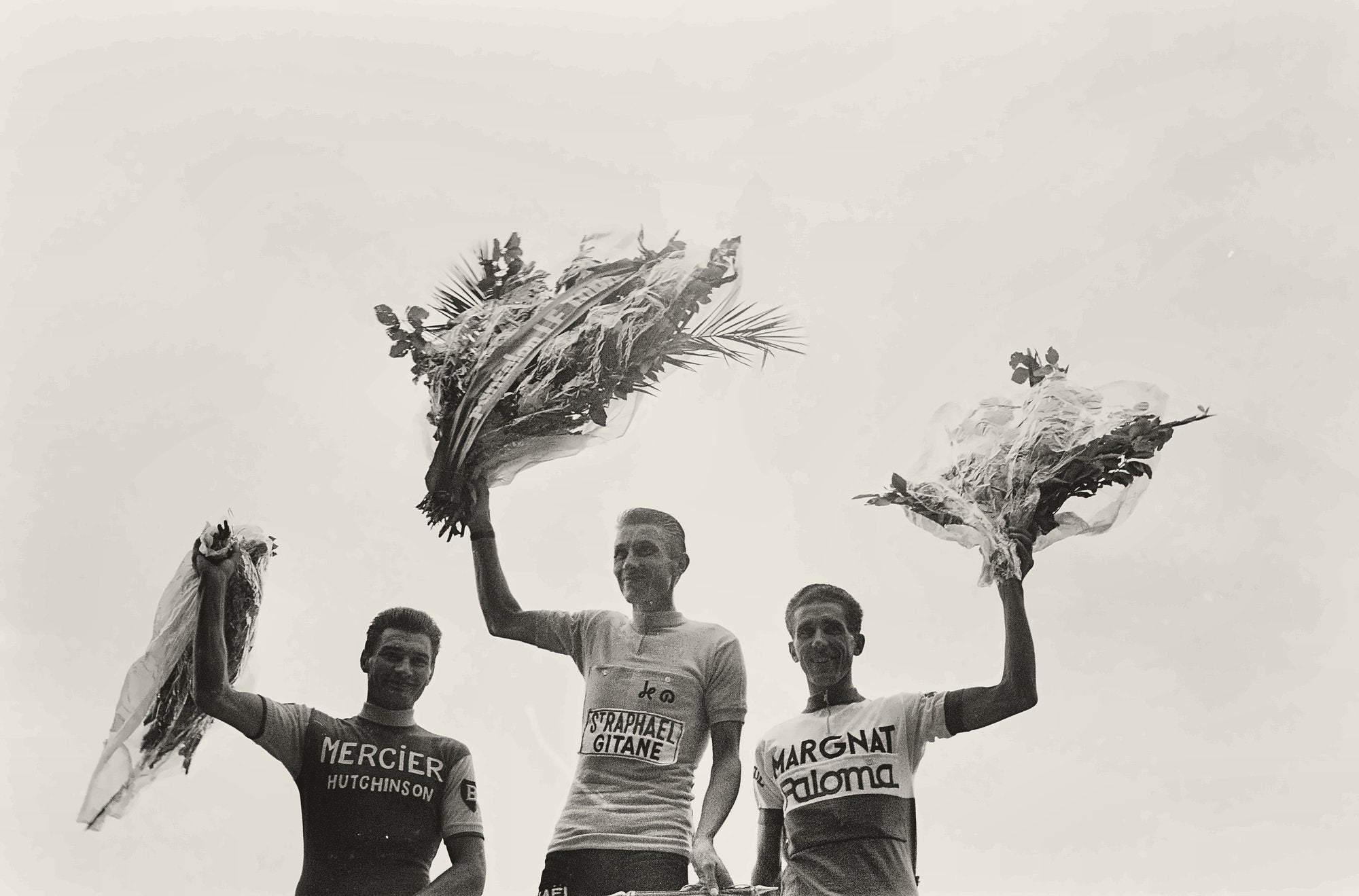
Seconds between Jacques Anquetil and Raymond Poulidor in Paris on 14 July 1964, after more than four and a half thousand kilometres of racing.
Two Frenchmen
Anquetil was born in 1934 near Rouen, in Normandy. He won the Tour at his first attempt, in 1957, at twenty-three, and then three times in a row from 1961. His nickname, Monsieur Chrono, came from the time trials.
Poulidor was two years younger, the son of small farmers outside the hamlet of Masbaraud-Mérignat, where the Creuse meets the Haute-Vienne. He rode his whole career for one team, Mercier. In May 1964 he won the Vuelta a España by thirty-three seconds.
Anquetil had won the Giro d'Italia that year. He came to the Tour trying to win both in the same season, which only Fausto Coppi had done before him.
Monaco
The ninth stage finished in Monaco, and the riders had to cross the line twice. Poulidor forgot the extra lap and sprinted on the first crossing. Anquetil won the stage on the second, and with it a minute of bonus.
The next day Anquetil won the time trial. Poulidor had a flat tyre and finished thirty-six seconds behind him.
Andorra
The race had one rest day, in Andorra. It is reported that a clairvoyant writing in France-Soir had predicted Anquetil would be killed before the race left the Pyrenees, and that the prediction troubled him. On the rest day he went with Géminiani, his director, to a lamb barbecue organised by Radio Andorra, and was photographed eating.
On the next stage he was dropped on the first climb, the Envalira, and reached the top about four minutes down. He caught the leading group on the descent, in thick fog. Poulidor had trouble with a wheel, had to change bikes, fell during the change, and finished more than two and a half minutes behind Anquetil.
The following day Poulidor won alone at Luchon. Anquetil then won the time trial of the seventeenth stage and took the yellow jersey. Going into the Puy de Dôme, Poulidor was fifty-six seconds behind.
Elbow to elbow
The twentieth stage, on 12 July, ran from Brive to the top of the Puy de Dôme, a volcano ten kilometres from Clermont-Ferrand. Julio Jiménez won it. The race for the yellow jersey was behind him.
Anquetil and Poulidor climbed side by side for almost the whole way up. They could feel each other's breath on their bare arms, and at times they banged elbows. Poulidor had the wrong gearing for the climb.
In the last kilometre Anquetil cracked. Poulidor pulled away, slowly, and took back forty-two seconds. Anquetil kept the yellow jersey by fourteen seconds.
Poulidor said later that he had no memory of their elbows touching. There is a photograph that shows they did.
Fourteen seconds
After the stage, it is reported, Anquetil asked Géminiani how much time he had lost. Géminiani told him fourteen seconds. Anquetil answered that this was thirteen more than he needed.
Paris
The last day, 14 July, ended with a time trial from Versailles into Paris. Anquetil won it. The final margin was fifty-five seconds, at the time the smallest in the history of the Tour.
Federico Bahamontes, the Spanish climber who had won the Tour in 1959, was third, four minutes and forty-four seconds down. He also won the mountains classification, for the sixth time.
It was Anquetil's fifth Tour. No rider had won five before him. He was also the first since Coppi to win the Giro and the Tour in the same year.
Eight podiums
Poulidor rode fourteen Tours and finished twelve. He was second in 1964, 1965 and 1974, and third in 1962, 1966, 1969, 1972 and 1976, the last at forty. He won seven stages. He never wore the yellow jersey for a single day.
Anquetil beat him in the Tour every time, and Poulidor remained the more popular of the two. He said himself that the more unlucky he was, the more the public liked him, and the more money he earned.
Anquetil died of stomach cancer in Rouen in November 1987, at fifty-three. Poulidor died in November 2019, at eighty-three. In 2021 his grandson, Mathieu van der Poel, won a stage of the Tour, took the yellow jersey, and dedicated both to him.