
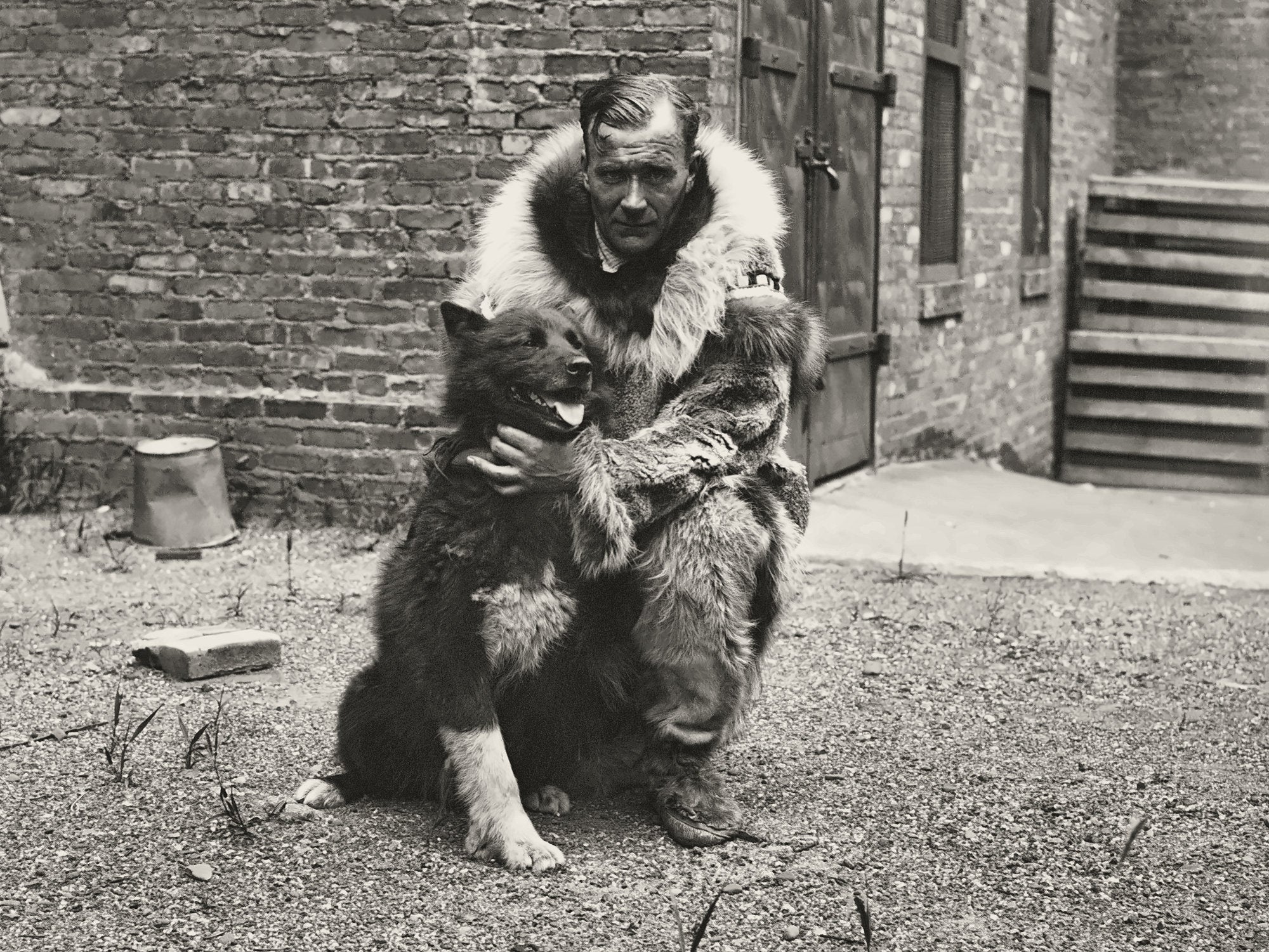
The miles, about eighty five kilometres, that Gunnar Kaasen drove with Balto in the lead, from Bluff to Front Street in Nome, on the last leg of the 1925 serum run.
Bluff
The antitoxin left Nenana on 27 January 1925. It was three hundred thousand units in glass vials, wrapped in quilts inside a metal cylinder, a package of just over twenty pounds. Twenty mushers and about one hundred and fifty dogs took it on in relay towards Nome, six hundred and seventy four miles away. Leonhard Seppala and Togo carried it back across Norton Sound to Golovin.
On 1 February Charlie Olson drove it the twenty five miles from Golovin to the roadhouse at Bluff through a gale. He arrived at about half past seven in the evening with frostbitten hands. Gunnar Kaasen, who was waiting there, had thought he might stop for the night.
Kaasen was born in northern Norway in 1882 and had gone to America in 1903 to mine for gold. He stayed in Nome as a musher. For this leg he had thirteen dogs, all of them Seppala's reserves.
Balto
Balto was born around 1919 in Seppala's kennels in Nome. He was named after Samuel Balto, a Sámi member of Fridtjof Nansen's Greenland expedition of 1888. He was black, with white feet and a white bib.
Seppala had him neutered at six months and considered him second rate. He was used to haul freight on short runs. There is no record of Seppala using him as a leader before 1925.
Seppala had chosen Fox to lead Kaasen's team. Kaasen put Balto in front alongside him.
The storm
On 1 February the doctor in Nome, Curtis Welch, had ordered the relay to stop until the blizzard passed. Winds of eighty miles an hour were reported. Kaasen waited until ten at night for the storm to ease. It got worse, and he left into a headwind.
He drove through the night, over drifts and river overflow around Topkok Mountain. The visibility was so poor that he could not always see the dogs harnessed closest to the sled. He passed the village of Solomon by two miles without realising it, and with it the message telling him to wait.
Crossing Bonanza Flat, the wind turned the sled over and the serum cylinder was buried in the snow. Kaasen searched for it on his hands and knees, with bare hands, and got frostbite.
Point Safety
He reached Point Safety ahead of schedule, in the early hours of 2 February. Ed Rohn was to take the final stretch into Nome. Rohn believed the relay had stopped at Solomon, and he was asleep.
Kaasen did not wake him. He said the cabin was dark and that he did not want to lose time while a fresh team was made ready. Others, Rohn among them, believed he wanted the credit for himself and Balto.
Front Street
Kaasen reached Front Street in Nome at half past five in the morning on 2 February 1925 and handed the serum to Welch. Not a single ampoule was broken. The antitoxin was thawed and ready by noon.
The photographs and film of Kaasen and Balto in Nome were made hours later, after the sun had risen. They are reconstructions.
The run was headline news in New York, Washington, San Francisco and Cleveland. The mushers received letters of commendation from President Calvin Coolidge. The H. K. Mulford Company, which made the antitoxin, gave every musher of the first relay a medal, and gave Kaasen one thousand dollars.
Central Park
The producer Sol Lesser signed Kaasen, Balto and the team. A short film, Balto's Race to Nome, came out in 1925 and is now lost.
The statue, by Frederick Roth, was unveiled in Central Park in December 1925, about ten months after the run. Balto had posed for it and was there at the unveiling. The inscription is dedicated to the spirit of the sled dogs of the relay, gives the distance as six hundred miles, and ends with three words: endurance, fidelity, intelligence.
Seppala wrote that he resented the statue. In March 1927 he claimed that Fox, not Balto, had led Kaasen's team, and that Fox's name was less newsworthy. Togo had been left out of most of the news at the time.
Cleveland
Kaasen sued Lesser for unpaid wages, and Lesser sold the contract to a vaudeville circuit. By February 1927 Balto and six of his teammates were in the back room of a dime museum in Los Angeles, chained to a sled, with little exercise and their ribs showing.
George Kimble, a businessman from Cleveland, saw them there. The owner asked two thousand dollars, then agreed to fifteen hundred. The Cleveland Balto Committee, led by Judge James B. Ruhl, announced its appeal on 1 March 1927. By 10 March the fund had reached two thousand two hundred and forty five dollars and eighty eight cents. All seven dogs were bought.
The city held a parade for them on 19 March, and they went to live at the Brookside Zoo. Balto died on 14 March 1933, at about fourteen. A second appeal raised the fifty dollars needed to mount him for the Cleveland Museum of Natural History, where he is still on display. In 2023 his genome was sequenced and published in Science. It found no evidence of wolf ancestry.