
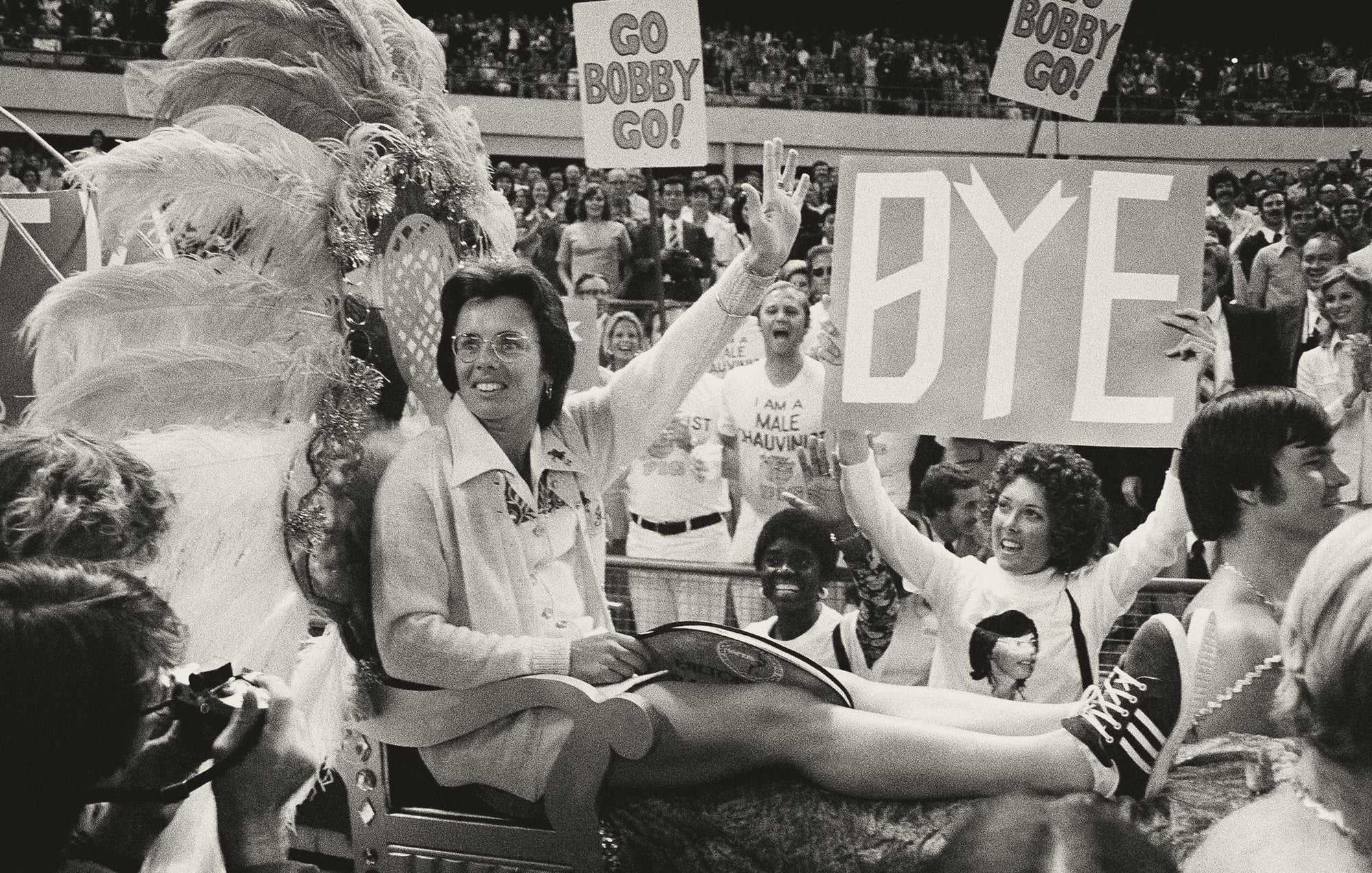
Straight sets: 6-4, 6-3, 6-3. The margin matters because the entire premise of the event was that it would not be close.
Riggs
Bobby Riggs won Wimbledon in 1939 and was world number one as an amateur. By 1973 he was fifty-five and had reinvented himself as a hustler and self-declared male chauvinist, arguing publicly that the women's game was inferior enough that he could beat its best players.
On 13 May 1973 he beat Margaret Court, then the world's leading woman, 6-2 6-1. The result was treated as evidence for his argument.
King
Billie Jean King was twenty-nine and the best player in the world. In June 1973 she had led the founding of the Women's Tennis Association, and had told the US Open that the women would not compete unless prize money was equal.
The US Open equalised in 1973. It was the first of the four majors to do so; Wimbledon did not follow until 2007.
20 September 1973
The match was held at the Houston Astrodome. King was carried in on a litter by four men dressed as ancient Egyptians; Riggs arrived in a rickshaw pulled by models. He presented her with a large sweet, she presented him with a piglet.
Attendance was 30,472, still the largest crowd to watch a tennis match. The US television audience is generally put around fifty million, worldwide around ninety.
The tennis
King played long points and moved Riggs from side to side rather than trying to overpower him. He tired visibly in the second set and his serve deteriorated.
She won 6-4, 6-3, 6-3.
What she said
King has been consistent for fifty years about why it mattered: not the prize money, but the consequences of losing. Her stated view is that defeat would have damaged the women's tour for a generation and confirmed the argument being made against it.
What is fair to Riggs
He was fifty-five, he had beaten Court fair and square, and there is no credible evidence for the recurring claim that he threw the match to settle gambling debts. He and King became friends and spoke the night before he died in 1995.
Why it goes on a wall
Because it is one of the few sporting events where the result actually decided something outside sport, and the person carrying that weight was the one who had chosen to pick it up.
Losing was not an option.