
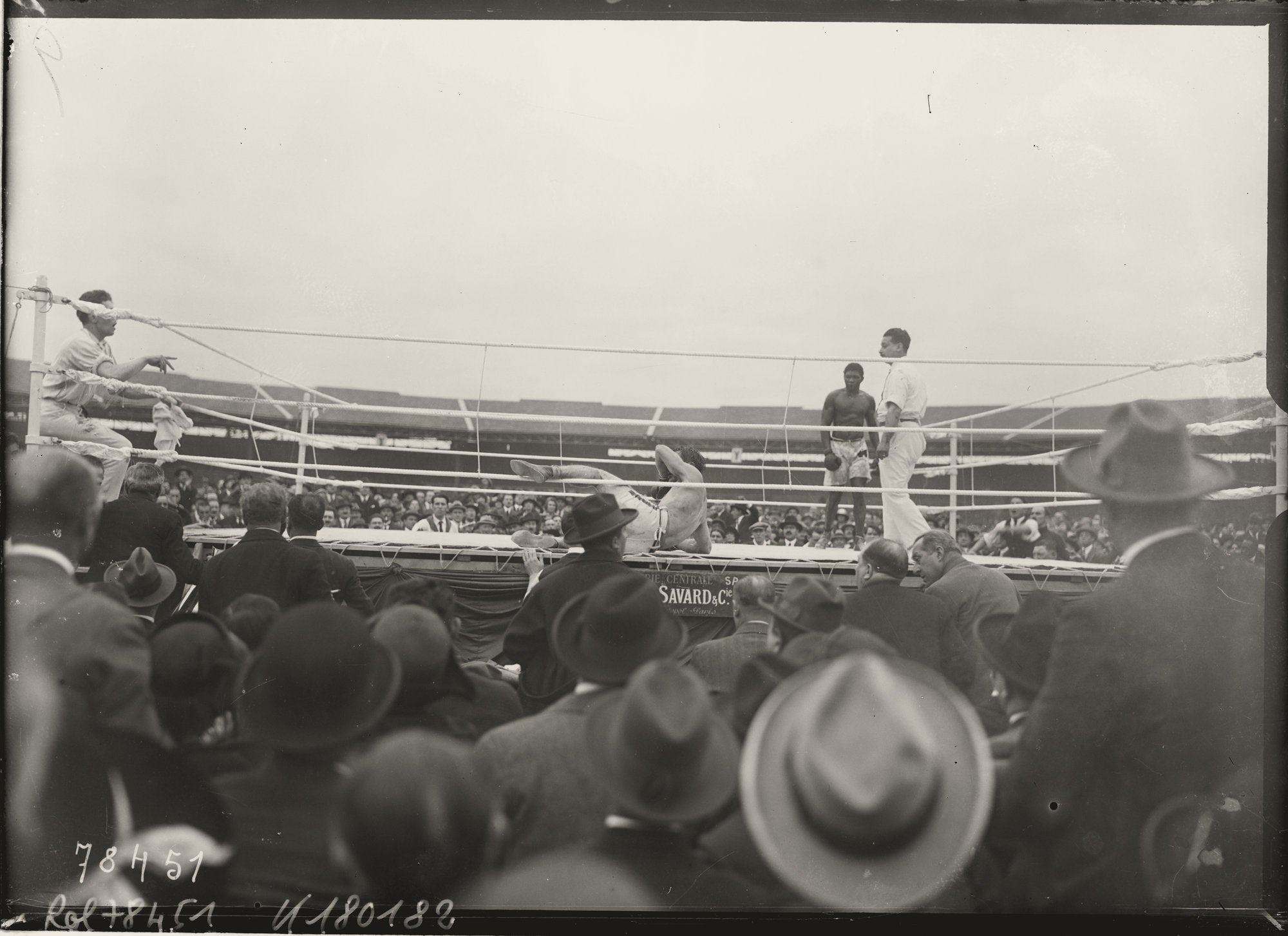
The year Battling Siki knocked out Georges Carpentier in Paris and became the first African world champion in boxing.
Before the ring
Born Amadou Fall in Saint-Louis, Senegal, around 1897, he came to France as a boy and served in the French army during the First World War, receiving decorations for bravery.
24 September 1922
Siki fought Carpentier, France's most popular sportsman, for the world light heavyweight title at the Buffalo velodrome in Montrouge.
Contemporary accounts describe an arrangement for Siki to lose. Whatever the understanding, he knocked Carpentier out in the sixth round.
The referee first ruled a disqualification against Siki. The crowd's reaction was strong enough that the ruling was reversed and the knockout confirmed.
Paris
Coverage of Siki in the French press of the period was routinely and explicitly racist, treating him as an exotic spectacle rather than a champion.
He responded by being conspicuous: tailored clothes, nightlife, and a widely reported lion cub.
Dublin, 17 March 1923
Siki defended the title against Mike McTigue in Dublin on Saint Patrick's Day, during the Irish Civil War, with fighting audible in the city.
He lost a twenty-round decision that was disputed almost everywhere outside Ireland.
America
He moved to the United States in 1923 and fought frequently at a declining level.
On 15 December 1925 he was shot dead in the Hell's Kitchen district of New York. The case was never solved.
Return
He was buried in Flushing Cemetery, New York. In 1993 his remains were repatriated to Senegal.
Why it goes on a wall
Because the fight was supposed to be a formality and he refused to play the part written for him, in a city and a decade that had no intention of letting him keep what he won.
Battling Siki.