
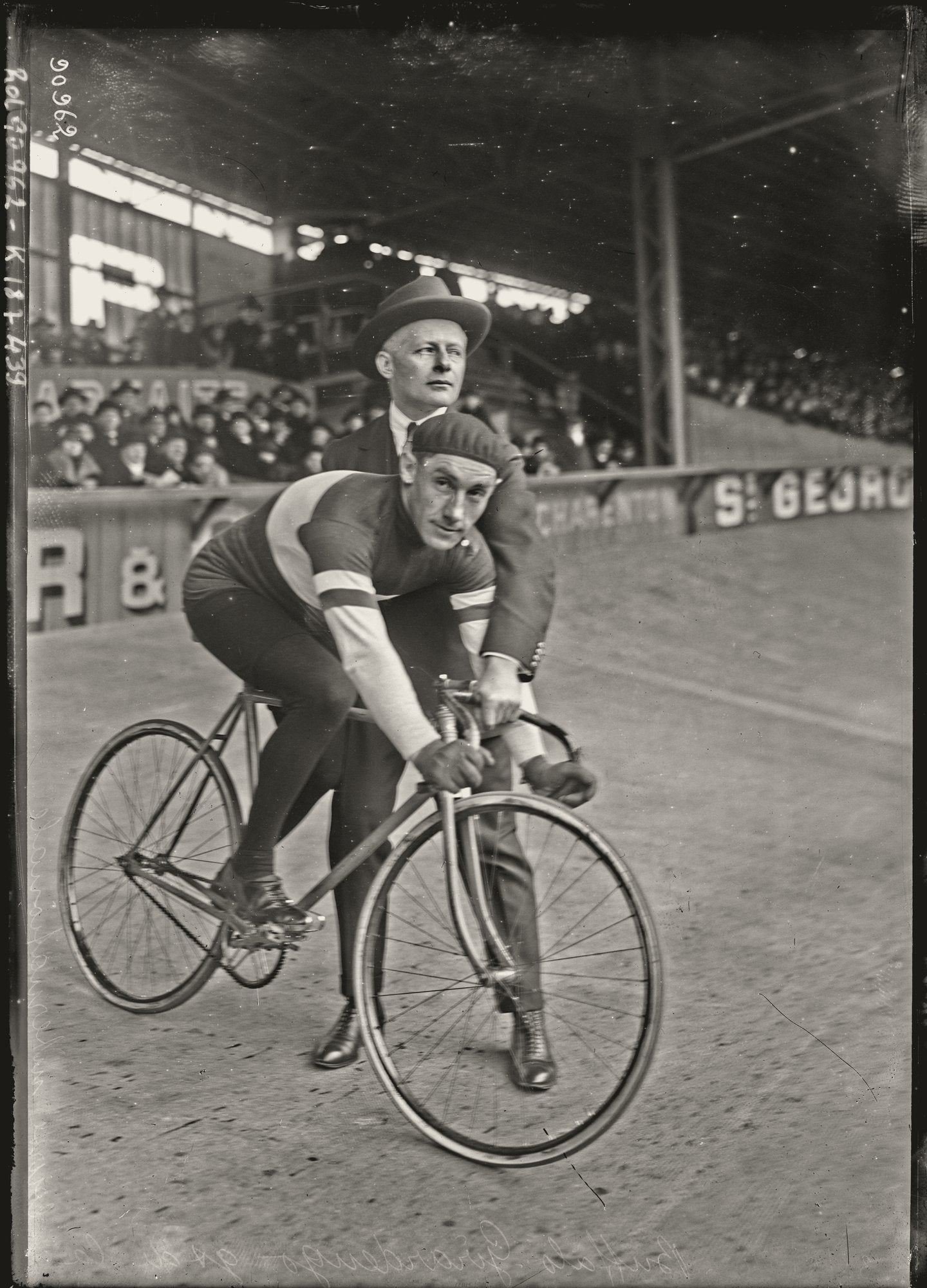
Novi Ligure is a small town in the south of Piedmont, out on the plain where the land has not yet begun to climb toward the sea. In the Twenties the express trains running between Turin and Genoa were not timetabled to stop there. Some of them stopped anyway, slowing to the platform for about as long as it takes to say a name aloud, because the man who lived in the town was Costante Girardengo, and by then the country had folded a little of its daily habit around him. The story returns in several versions and has almost certainly grown in the retelling. What lies underneath is plain. For a stretch of years an Italian on a bicycle was treated as a public fact, a monument that happened to be alive and still pedalling.
He was born in Novi in 1893, in modest circumstances, at a time when a bicycle was a serious possession and racing one was closer to labour than to play. He turned professional while still young. By the end of the First War he was the finest rider in the country, and he held that place long enough that an entire generation came of age unable to picture the sport without him at the front of it. They called him the little man of Novi, which was both a plain description and a kind of affection.
The word they had to invent
There had been strong riders in Italy before him, men who won important races and were carried shoulder-high through their home streets. None of them had made the language reach for a new word. Girardengo did. He was the first to be called Campionissimo: the champion of champions, a superlative laid on top of a superlative, as though the ordinary highest rank could no longer hold him. The title would later pass to Fausto Coppi, who came from the hills a short way to the east, out of the same province, and whom many people now picture first when the word is spoken. But it was made for Girardengo. It fit him before it fit anyone.
Milano-Sanremo
The race that came to belong to him ran from Milan down to the Ligurian coast at Sanremo, close to three hundred kilometres covered in a single day, set off in the raw of early spring. It started in the cold flat air of Lombardy and finished beside the sea, and somewhere in the middle the road climbed to the Passo del Turchino, the pass that let the race over the last range of hills and down toward the water. It was often up there, in the cold of the high ground, that the winner was quietly settled long before the coast came into view. The whole thing was hard and unglamorous, decided as much by cold and hunger as by pure speed. The men were on their machines for the better part of a day, ten hours and more when the weather turned against them. The newspaper that printed the results had also invented the race, laid out on the pink pages that carried the sport into every town, so that the reading and the racing grew up together and fed one another.
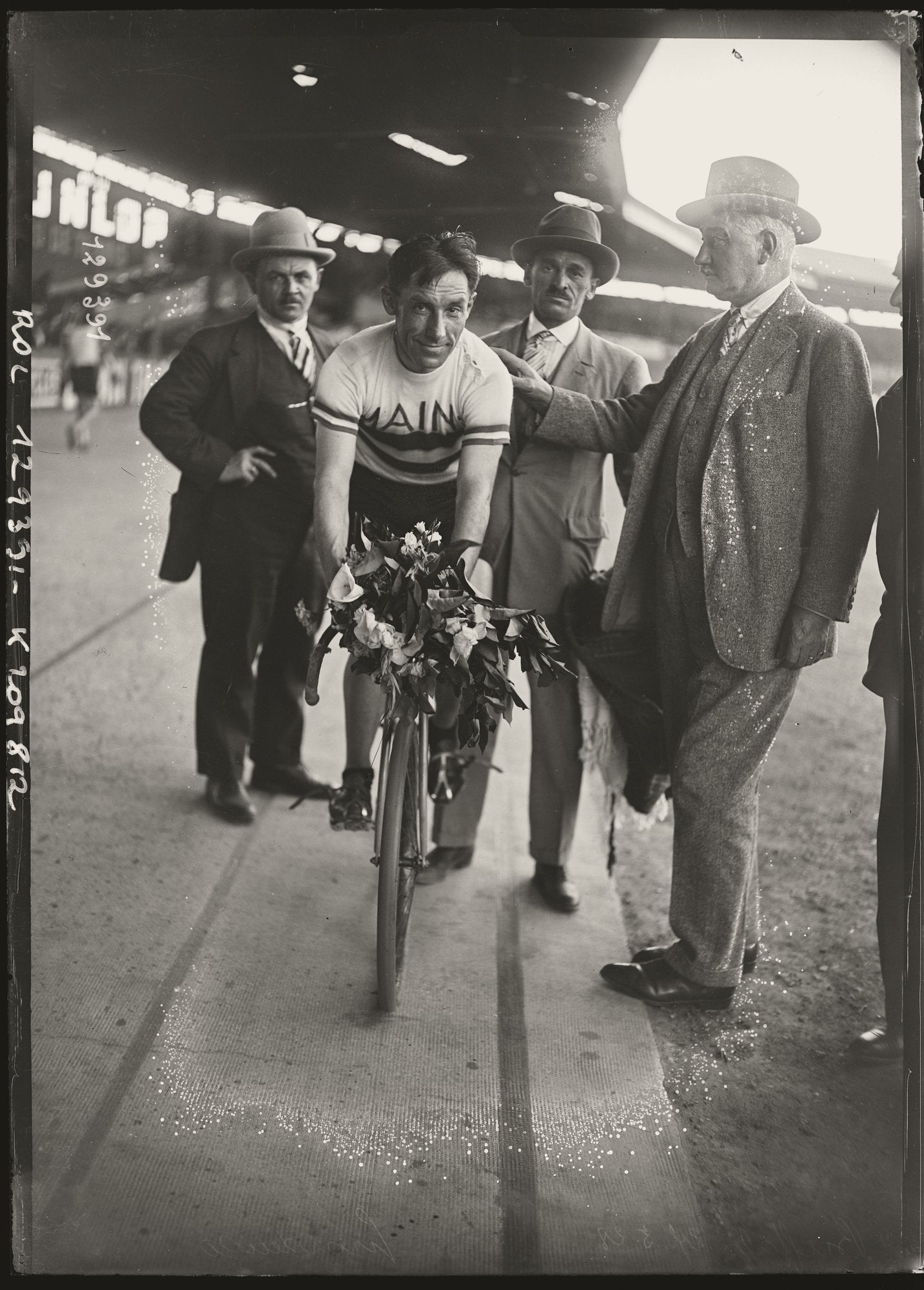
Girardengo won it six times. No rider of his years won it as often. He was small and light in the saddle, a climber who kept just enough finish to take a sprint at the end of a long day, and on the roads above the water he was very difficult to hold. He won the country's great tour by stages as well, more than once, and the national championship over and over, nine times, by the count usually given. For a period his winning stopped registering as a run of separate events and started to feel like the settled order of the world, the ending known before the men had set out.
The roads he actually rode
The roads themselves were not what they later became. Much of the racing was done on dirt and broken stone, in dust when the weather was dry and in a paste of mud when it rained. A man carried his own spare tubes wound across his chest and mended his own machine at the roadside when it failed, losing minutes he then had to win back alone into the wind. Wheels were wooden-rimmed, and the brakes were an afterthought on the descents. A rider who cracked far from the line had no car to fall into and no crew of helpers to shelter behind. To win a long race in those years was to survive it first. Girardengo survived more of them than anyone.
A passion where a pastime had been
The harder thing to weigh is what he did to the sport around him. Before Girardengo, cycling in Italy was in large part a pastime, run for the men who could get their hands on a machine and followed closely only by those near it. During the years of his command it turned into something a whole country did together from a distance: read about in the pink pages, argued over in bars and across kitchen tables, followed by people who would never own a racing bicycle and did not need to. Results came slowly, carried by telegraph and chalked up on boards outside the newspaper offices, where people gathered in the evening to learn how the day had gone. A win was known before any photograph of it could reach them. The regime then settling over the country was glad enough to have a national champion to point at; sporting strength suited the picture it wanted to paint of itself, and it made what use of him it could. Children raced under his name in the streets. The men who came after him rode into a house he had built and heated.
There is a pull, in a story like this, to make the man larger than the roads he actually rode. It is worth resisting. He was a rider of rare gift who arrived exactly when his country was ready to lose its head over the sport, and the two things met and multiplied one another. A good deal of the rest was added afterward, by people who needed the tale to mean more than a column of results.
The rival who came up behind
Nothing of that length holds forever. In the middle of the Twenties a younger rider named Alfredo Binda began to beat him, a climber of unusual smoothness who would go on to win everything Girardengo had won and a good deal more. The older man did not simply stand aside; he kept winning for years alongside the newcomer, and the two of them drew the crowds precisely because the outcome had stopped being certain. But the direction of things had turned. The sport had found its next standard-bearer, and Girardengo, who had been the whole story, became part of a longer one. The race down to the sea would be won, in time, by Coppi as well, and by others who had grown up on tales of what the little man of Novi had done on those same roads.
The schoolmate who became a bandit
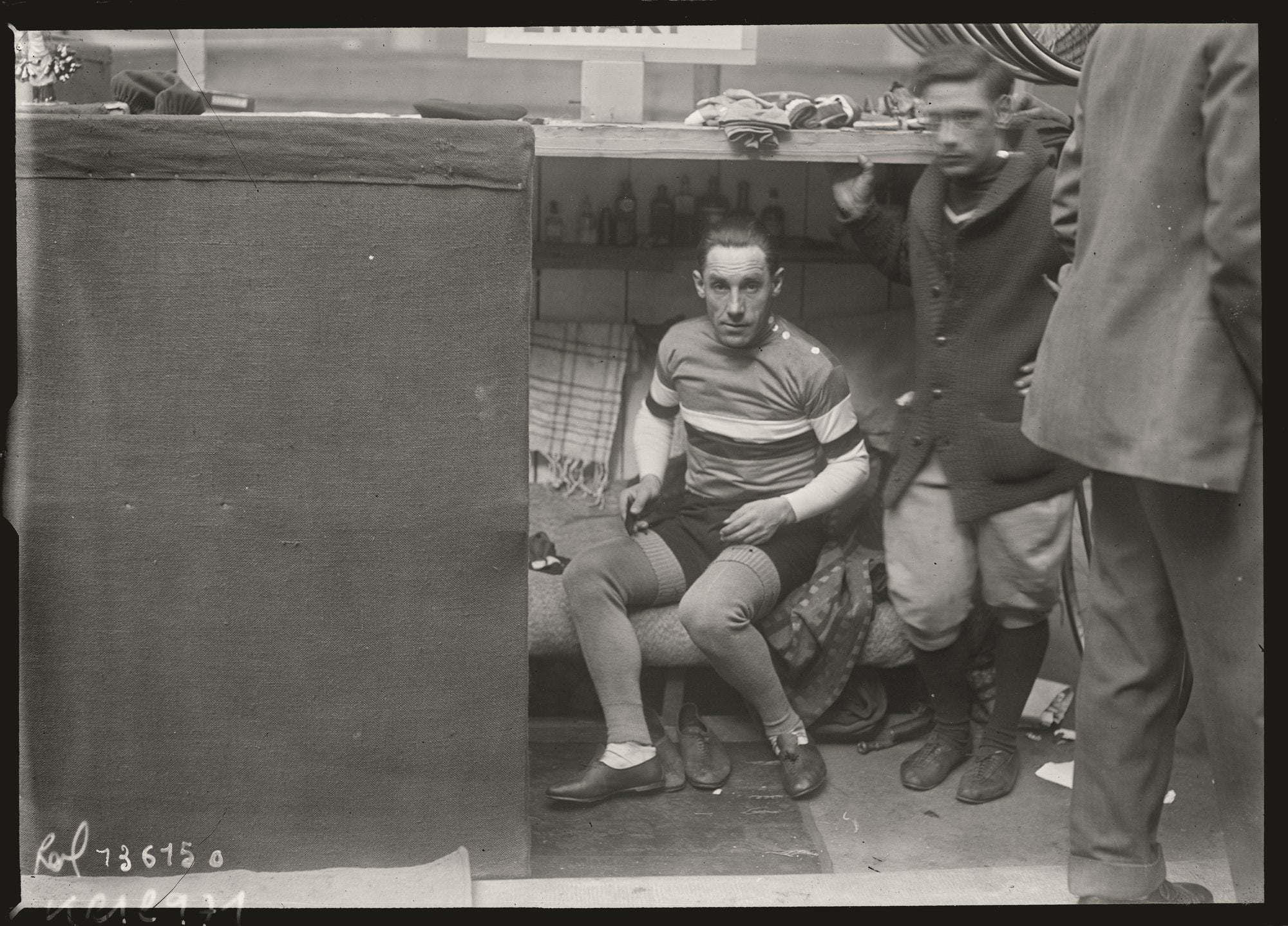
Not all of it happened on a bicycle. In the poor streets of Novi, Girardengo had known a boy named Sante Pollastri. They came out of the same few lanes and, for a time, the same childhood. Then their lives moved as far apart as two lives can. One became the most admired man in the country. The other became a bandit, wanted for the killing of policemen, driven out of Italy and across France, where at last he was caught and shut away for many years. He came out an old man, long after the manhunt that had carried his name across two borders, into a world that had mostly moved on without him.
The friendship, by the accounts that survive, did not simply stop when the roads forked. The two are said to have kept some thread between them, and it is here that the facts grow thin and the legend takes their place. There are tellings in which the men meet again in France, and tellings in which the champion is somehow near the moment of the arrest, versions that cannot all be true together. Decades after both were dead the pair was set to music, the racer and the outlaw who had come from a single town, and the song planted in the common memory a bond that the record can only partly bear out. What is firm is very small. They knew each other as boys; they became, in the same years, the two most famous men their town produced, one out of the front page and one out of the crime reports. The rest is a ballad, and a ballad keeps what suits it.
The long coming-down
Girardengo rode on into the Thirties, past his best years, still dangerous on the right day and no longer the certainty he had once been. Riders who had grown up chanting his name were beating him now. He stepped away from racing in the middle of the decade and stayed near the sport afterward, lending his name to the bicycles other men would ride and turning up at the races as an older presence. He lived a long time, long enough to watch his own fame settle into history and be overtaken, long enough that the boys who had slowed the trains for him were old themselves before he died.
He had stood at the start of something. The sport he left behind had become a national devotion with its own saints and its own feast days, and the men who wrote its later chapters were working inside a passion he had done more than anyone to light. The first of a line is the easiest to forget once the line runs long. Those who follow get measured against a standard, and the one who set the standard slips quietly into the background of his own invention.
What stays
Novi Ligure kept him. The name stayed on the town after the winning was over, worn smooth by use, handed to people who had never seen him turn a pedal and had the whole thing from a father or a grandfather who had. A champion becomes, at the last, a story told by someone who was there to someone who was not, and the telling is the place he goes on living.
There is a print of him somewhere on a wall, with a number on it that reads at first like a misprint and is not: the tally of the races down to the sea that he made his own. Most people who pass it will know none of it: not the trains that broke their schedule for him, not the word coined to carry his name, not the schoolmate who finished on the other side of the law. They will see a small man on an old bicycle, and a figure above him that looks too high for one rider. In Novi Ligure the fast trains keep their timetable now, and stop only where they are told.