
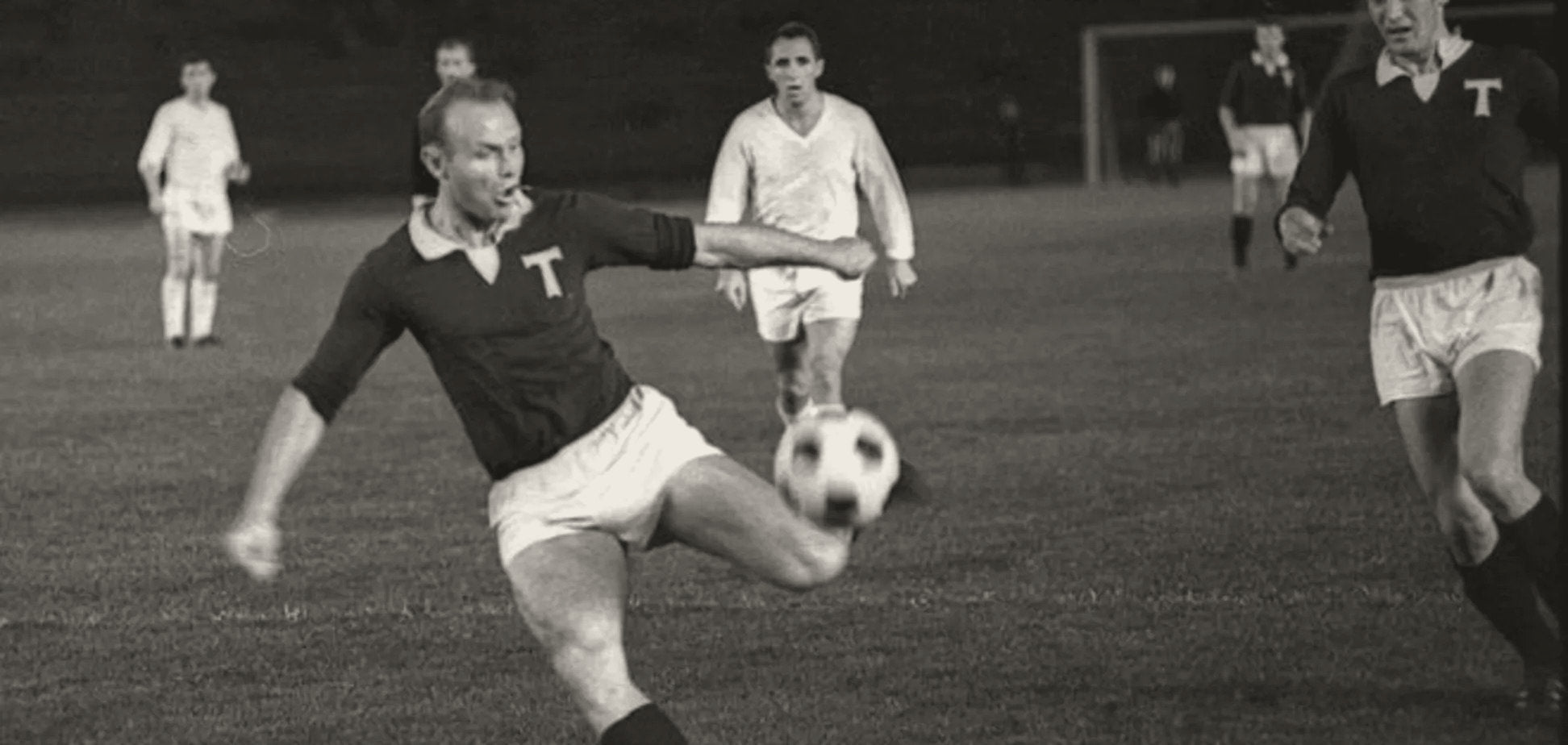
Twelve years, handed down three weeks before a World Cup, to the best footballer in the country. He served five of them.
The player
Streltsov scored a hat-trick on his international debut at seventeen. He won Olympic gold with the Soviet Union in Melbourne in 1956. By 1958 he was twenty, and the comparison being made was with Pele, who was the same age and about to announce himself in Sweden.
He played for Torpedo Moscow, the works team of an automobile plant, which in the Soviet league meant the least politically connected club of the major sides.
The clubs that wanted him
CSKA was the army's team. Dynamo Moscow belonged to the ministry of internal affairs. In the Soviet system a transfer to either was not really a negotiation.
Streltsov refused both, repeatedly and without much diplomacy. The reported exchange with a government minister, in which he made clear he had no intention of moving, is the kind of thing that gets remembered because of what came afterwards.
May 1958
He attended a party at a dacha outside Moscow with two Torpedo teammates. A complaint of rape was made the following day. He was arrested and charged.
The honest position on the facts is that they cannot now be established. The investigation moved with unusual speed. The confession has been questioned, including claims that he was told it would let him travel to the World Cup. There is testimony that the complainant sought to withdraw the case. Serious historians of Soviet football disagree with each other about what happened, and this print does not pretend to settle it.
What is documented is the sentence: twelve years of corrective labour, and a public campaign in the press to accompany it.
The camps
He served five years, in the Gulag system, and did heavy labour. He was released in 1963 at twenty-five, and then kept out of the top division until 1965 by a separate administrative decision.
The Soviet Union went to the 1958 World Cup without him and lost in the quarter-final.
What he did afterwards
He returned to Torpedo, heavier and much slower, and rebuilt his game around passing and positioning rather than acceleration.
He won the Soviet league in 1965. He was named Soviet footballer of the year in 1967 and 1968. Torpedo's stadium in Moscow now carries his name.
Why it goes on a wall
Because it is the sharpest example in the sport of what a state can do to a career, and of what was left over when it had finished.
Twelve years, five served, and two footballer of the year awards on the other side of it.