
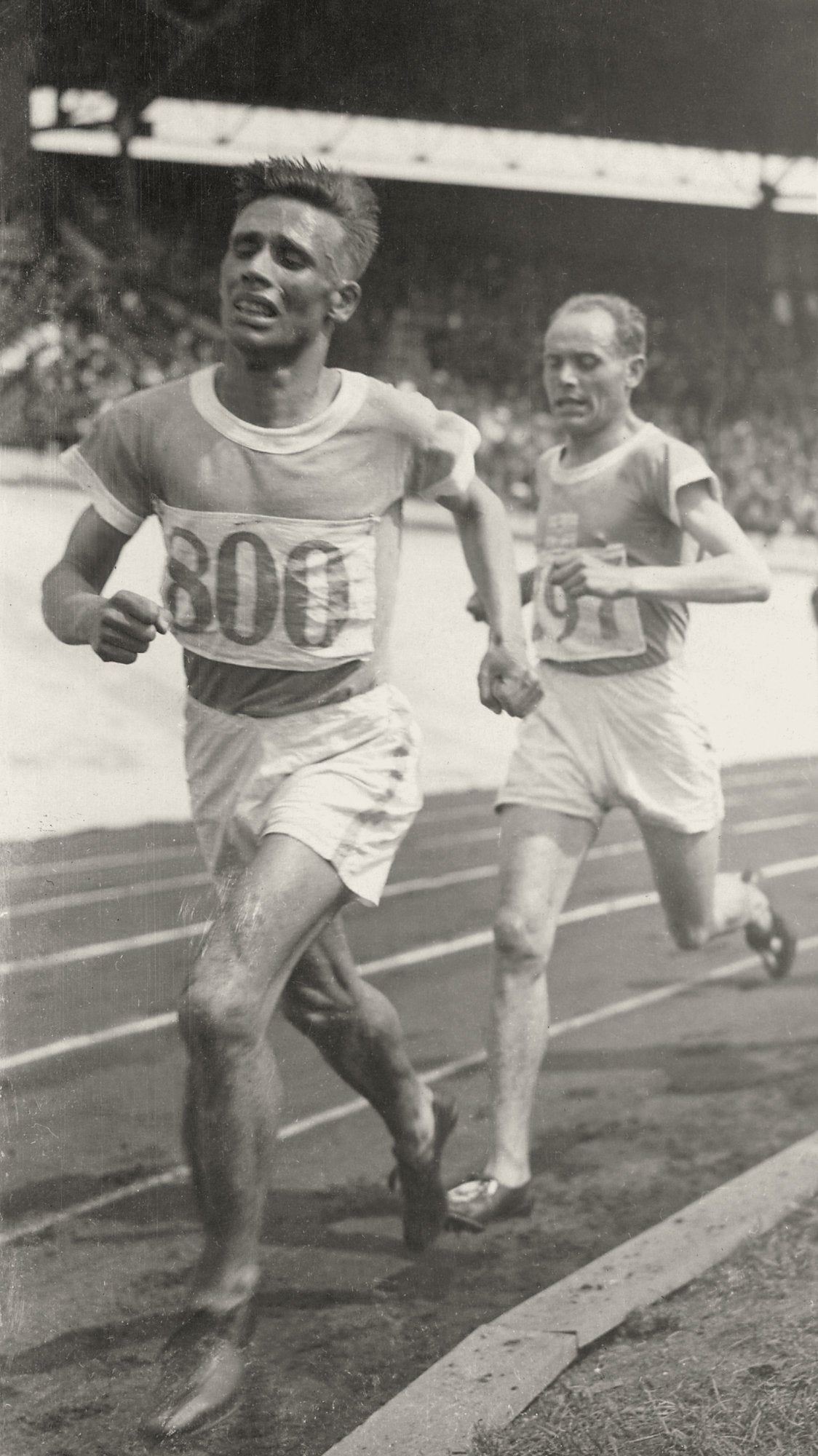
The years between Kolehmainen's first Olympic titles in 1912 and the end of Finnish dominance around the Berlin Games of 1936.
Kolehmainen
Hannes Kolehmainen won the 5000 metres, 10000 metres and individual cross country at Stockholm in 1912, competing for a Finland that was not yet an independent state.
He won the marathon at Antwerp in 1920.
Nurmi and the watch
Paavo Nurmi won nine Olympic gold medals and three silvers across 1920, 1924 and 1928, and set world records at distances from 1500 metres to 20 kilometres.
His method was even pacing, monitored with a stopwatch carried in his hand during the race and thrown aside on the last lap. He raced the clock rather than the field.
At Paris in 1924 he won the 1500 metres and the 5000 metres with roughly an hour between the finals.
Ritola
Ville Ritola won four individual and one team gold at Paris in 1924, plus silvers, and a further gold at Amsterdam in 1928.
He had emigrated to the United States and trained there, which made his relationship with the Finnish athletics establishment, and with Nurmi, complicated.
The system, not the weather
The explanation usually offered at the time was climate and temperament.
The more accurate account is organisational: a dense network of local sports clubs, national attention on athletics as a marker of identity for a newly independent country, and a training culture built on volume and measurement.
The end
Nurmi was declared a professional by the IAAF in 1932 and barred from the Los Angeles Olympic marathon, a decision still disputed.
By 1936 the rest of the world had adopted the same methods, and the margin closed.
Why it goes on a wall
Because the interesting part is not that a small country won. It is that it won by treating running as a problem to be calculated rather than a test to be endured, and everyone else copied it afterwards.
The Flying Finns.