
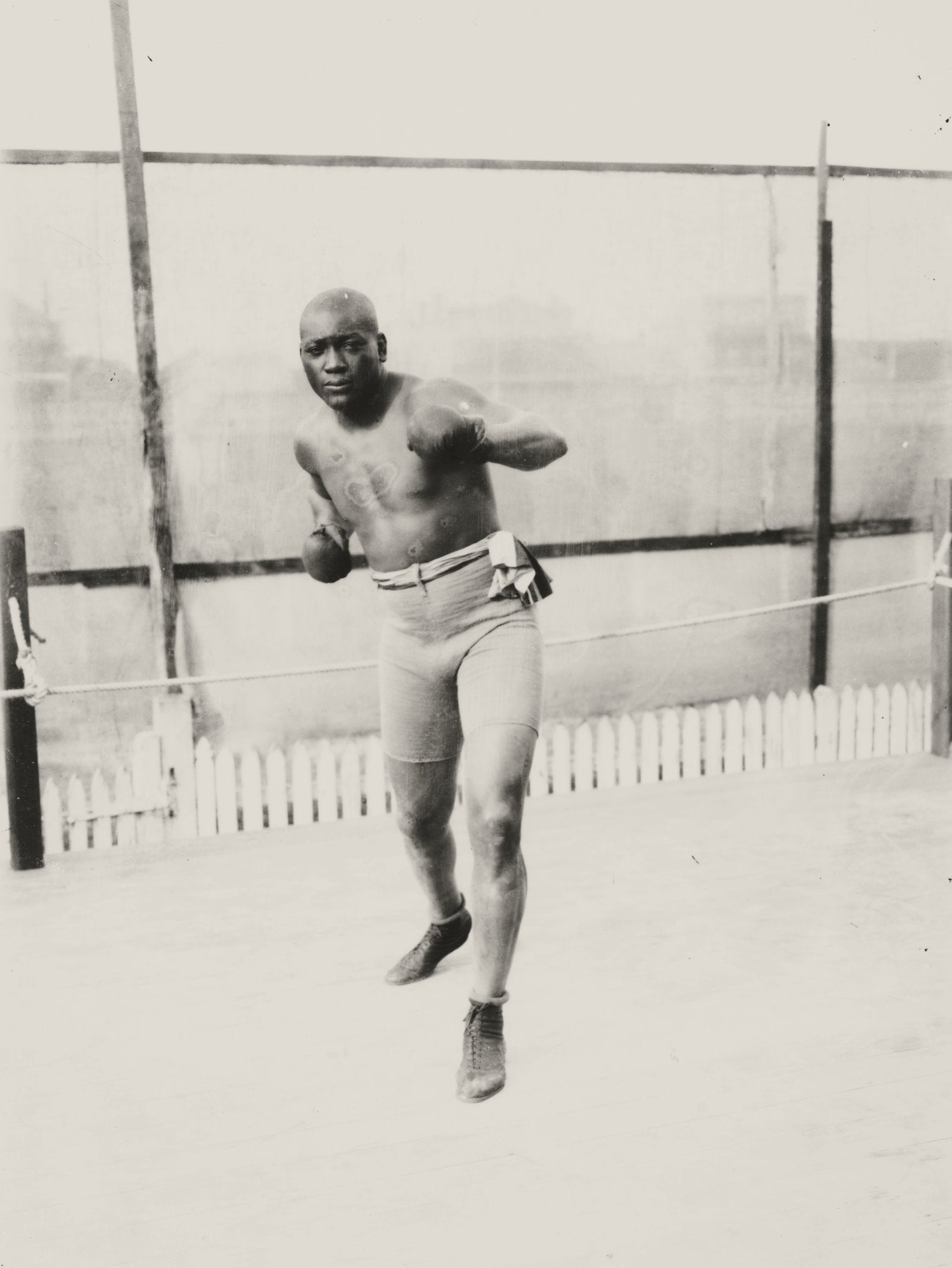
On 26 December 1908 in Sydney, Jack Johnson defeated Tommy Burns to become the first Black world heavyweight champion. Police stopped the fight in the fourteenth round; the filmed record was cut before the finish.
The great white hope
The search for a white challenger capable of taking the title became an organised commercial and political project.
James J. Jeffries, undefeated and six years retired, was persuaded to return, and stated openly that he was fighting for his race.
Reno, 4 July 1910
Johnson dominated and stopped Jeffries in the fifteenth round.
Riots followed in cities across the United States. Most of those killed were Black Americans attacked by white mobs. Several states and cities banned the exhibition of fight films afterwards.
The Mann Act
Unable to remove him in the ring, federal prosecutors charged Johnson under the Mann Act, legislation aimed at coerced prostitution, in connection with his relationship with a white woman.
He was convicted by an all-white jury in 1913 and fled the United States, living in Europe, Mexico and elsewhere for seven years.
Havana, 1915
Johnson lost the title to Jess Willard in the twenty-sixth round in Havana.
He later said he had thrown the fight in exchange for leniency. The available evidence does not support it, and most historians reject the claim.
After
He returned to the United States in 1920 and served ten months. He continued to fight exhibitions into his sixties and died in a car crash in North Carolina in 1946.
The pardon
A posthumous presidential pardon was issued in May 2018.
Why it goes on a wall
Because the record is unambiguous. He was the best heavyweight in the world and the machinery of an entire country was turned on him for it, and it took a hundred and five years for the paperwork to admit it.
Jack Johnson.