
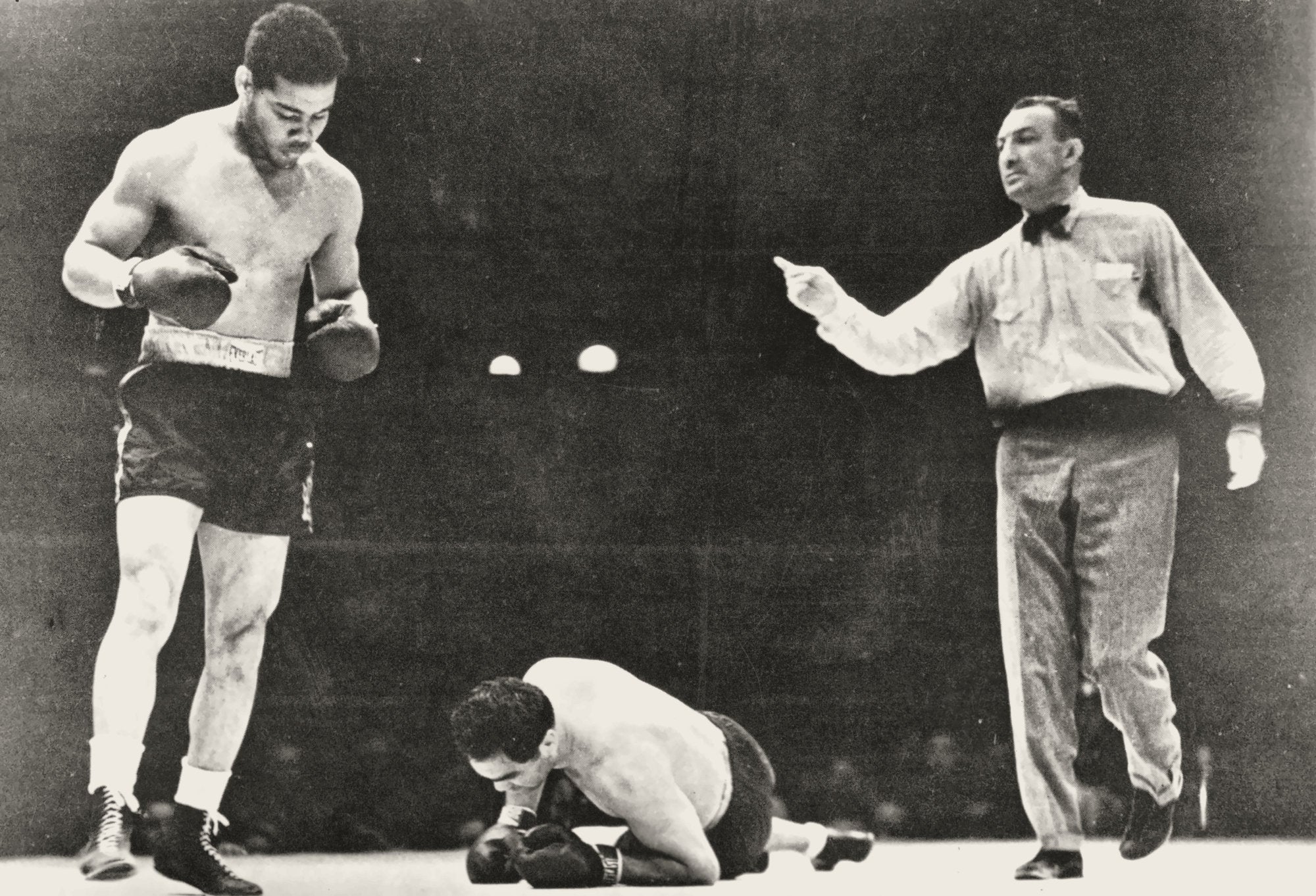
Seconds that the rematch lasted, at Yankee Stadium on 22 June 1938, from the first bell to the stoppage.
Detroit
Joe Louis was born in Alabama in May 1914. In 1926, after the family had been frightened by a gang of Ku Klux Klan men, they moved north to Detroit. He turned professional in Chicago on 4 July 1934 and won all twelve of his fights that year.
Professional boxing was not officially segregated, but many white Americans did not want a Black heavyweight champion.
Yankee Stadium, 1936
By June 1936 Louis was unbeaten, and Max Schmeling was meant to be the last step before a title fight. Schmeling had been world heavyweight champion from 1930 to 1932, and is still the only man to have won that title on a foul. He was thirty, many thought he was finished, and he went in as a ten to one underdog.
Schmeling studied films of Louis and saw that he dropped his left hand after a jab. In the fourth round a counter right put Louis down for the first time in his professional career. In the twelfth, with Schmeling well ahead on the scorecards, a right to the body and another to the jaw finished it. The referee, Arthur Donovan, counted Louis out.
Langston Hughes was at the fight. He wrote that he walked down Seventh Avenue afterwards and saw grown men crying.
Berlin
Hitler sent flowers and a message of congratulation to Schmeling's wife, the Czech actress Anny Ondra. Nazi officials presented the victory of a German over an African American as proof of Aryan superiority, and the government ordered parades and rallies in his honour. Speaking to a German reporter after the fight, Schmeling said that knowing the Führer and his people were thinking of him had given him the strength to win.
He never joined the Nazi party. He kept his American manager, Joe Jacobs, who was Jewish, despite pressure to drop him. In the same years he was on friendly terms with Hitler and other senior figures in the government.
Chicago
The win made Schmeling the leading contender for the title held by James J. Braddock. A fight between them was planned and never took place. Braddock's camp signed with Louis instead, for more money, and amid concern that a German champion might never be allowed to defend the title against Americans.
On 22 June 1937, in Chicago, Braddock knocked Louis down in the first round. Louis knocked him out in the eighth. Schmeling watched from ringside. Louis said afterwards that he did not want to be called champion until he had beaten Schmeling.
The rematch
The second fight was set for 22 June 1938, a year to the day after Chicago, at Yankee Stadium. By then Germany had annexed Austria. Schmeling arrived in New York with a Nazi party publicist, who issued statements that a Black man could not beat him and that his purse would pay for German tanks. A few weeks earlier Louis had visited the White House, where, according to the New York Times, Roosevelt told him: "Joe, we need muscles like yours to beat Germany."
Seventy thousand people came. Announcers described the fight on radio in English, German, Spanish and Portuguese.
Schmeling walked to the ring under rubbish thrown from the stands. Louis drove him onto the ropes, and a punch to the body made him cry out in pain. A right hook put Schmeling down, and he rose at three. Three punches to the jaw put him down again, and he rose at two. The third knockdown came near the centre of the ring. His trainer, Max Machon, threw in the towel and Donovan ended the fight.
Schmeling had thrown two punches.
Harlem
Schmeling spent ten days in hospital in New York, where doctors found cracked vertebrae in his back. His camp said the body punch had been an illegal blow to the kidneys. They never filed a formal complaint.
In his autobiography he described the ambulance ride through Harlem that night, with crowds dancing and bands that had left the nightclubs and bars playing in the streets.
The mainstream American press was on Louis's side, and still wrote about him in openly racist language.
Afterwards
The regime stopped presenting Schmeling as a national hero. In November 1938, during Kristallnacht, he hid two Jewish boys in his room at the Excelsior hotel in Berlin, and said he was ill so that no one would come in. It became known only long after the war. He was drafted, trained as a paratrooper and was wounded in the right knee on the first day of the Battle of Crete, in May 1941.
Louis held the title until 1949 and defended it twenty five times. In January 1942 he enlisted in the army, which sent him to a segregated cavalry unit and then used him for exhibitions rather than combat. Asked about joining a segregated army, he said there were many things wrong with America, but that Hitler would not fix them.
Schmeling helped him with money in his later years. Louis died on 12 April 1981 and was buried at Arlington National Cemetery. Schmeling paid part of the cost of the funeral and was a pallbearer. He died on 2 February 2005, at ninety nine.