
The year the bare-knuckle era ended, when Sullivan lost the heavyweight championship to James J. Corbett under Queensberry rules.
The first sports celebrity
Sullivan, born in Boston in 1858 to Irish immigrant parents, became champion in 1882 by beating Paddy Ryan.
He toured extensively, offering money to anyone who could survive a set number of rounds with him, and became the first American athlete to earn very large sums from personal fame.
What bare-knuckle actually meant
Under London Prize Ring rules a round ended when a man went to the ground. There was no fixed number of rounds. Bouts were frequently illegal and staged at short notice in remote locations.
Richburg, 1889
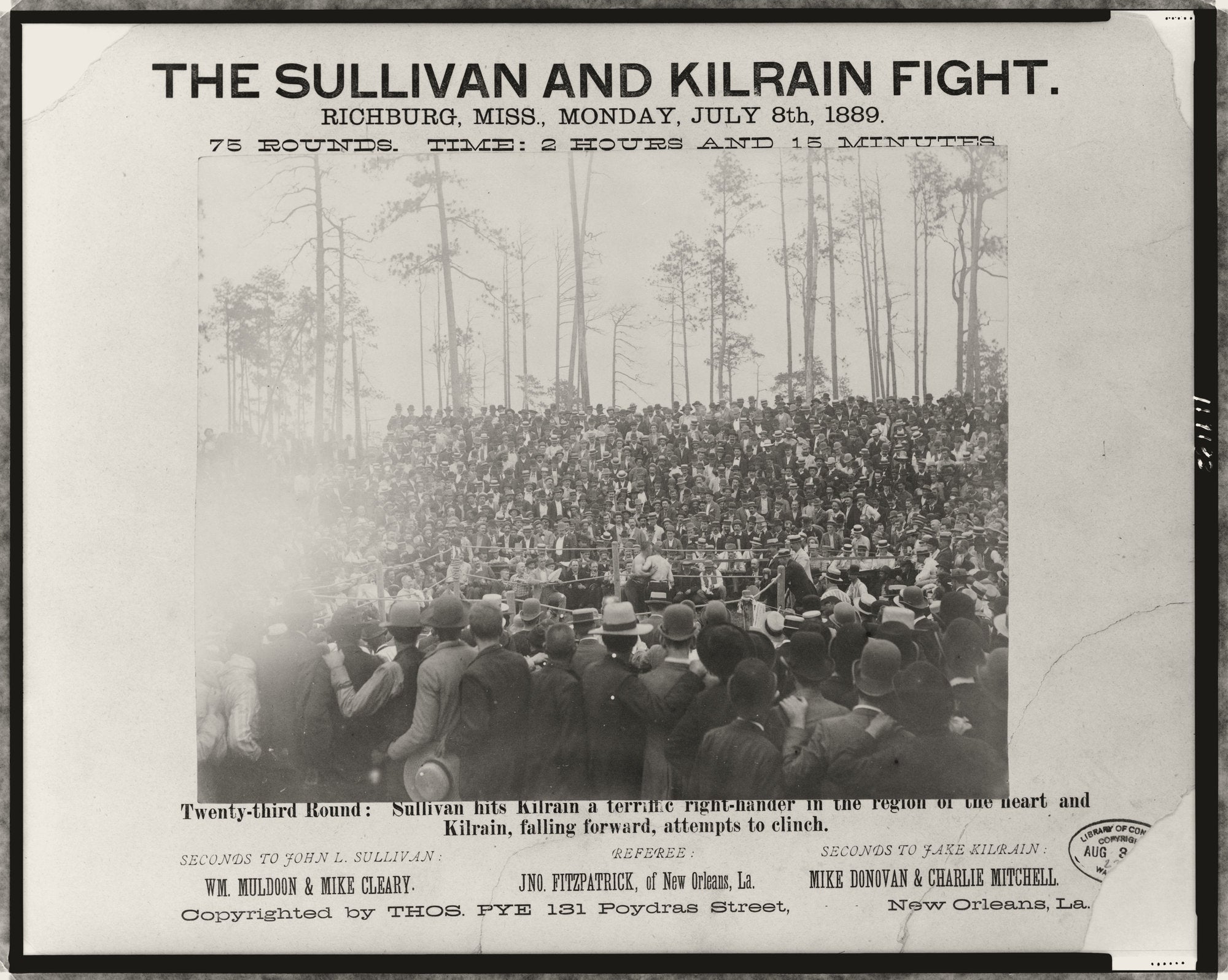
Sullivan fought Jake Kilrain in Mississippi on 8 July 1889. The bout lasted seventy-five rounds in extreme heat and remains the last bare-knuckle heavyweight title fight.
Both men faced legal consequences afterwards.
New Orleans, 1892
On 7 September 1892 Sullivan defended the title with gloves under Marquess of Queensberry rules against James J. Corbett.
Corbett, faster and technically far more sophisticated, avoided him for twenty rounds and stopped him in the twenty-first.
Sullivan addressed the crowd afterwards and said he was pleased the championship remained in the United States.
After
He lost most of his money. In 1905 he stopped drinking and became a temperance lecturer, which he remained for the rest of his life.
He died in 1918.
The colour line
Sullivan refused to fight Black challengers, most notably Peter Jackson. That refusal set a precedent that shaped the heavyweight division for decades and is inseparable from his record.
Why it goes on a wall
Because he is the hinge. He made the sport popular enough to be legalised, and legalisation produced the rules that beat him.
John L. Sullivan.