
That is the score, and it is the part of this story that nobody disputes.
The bakery
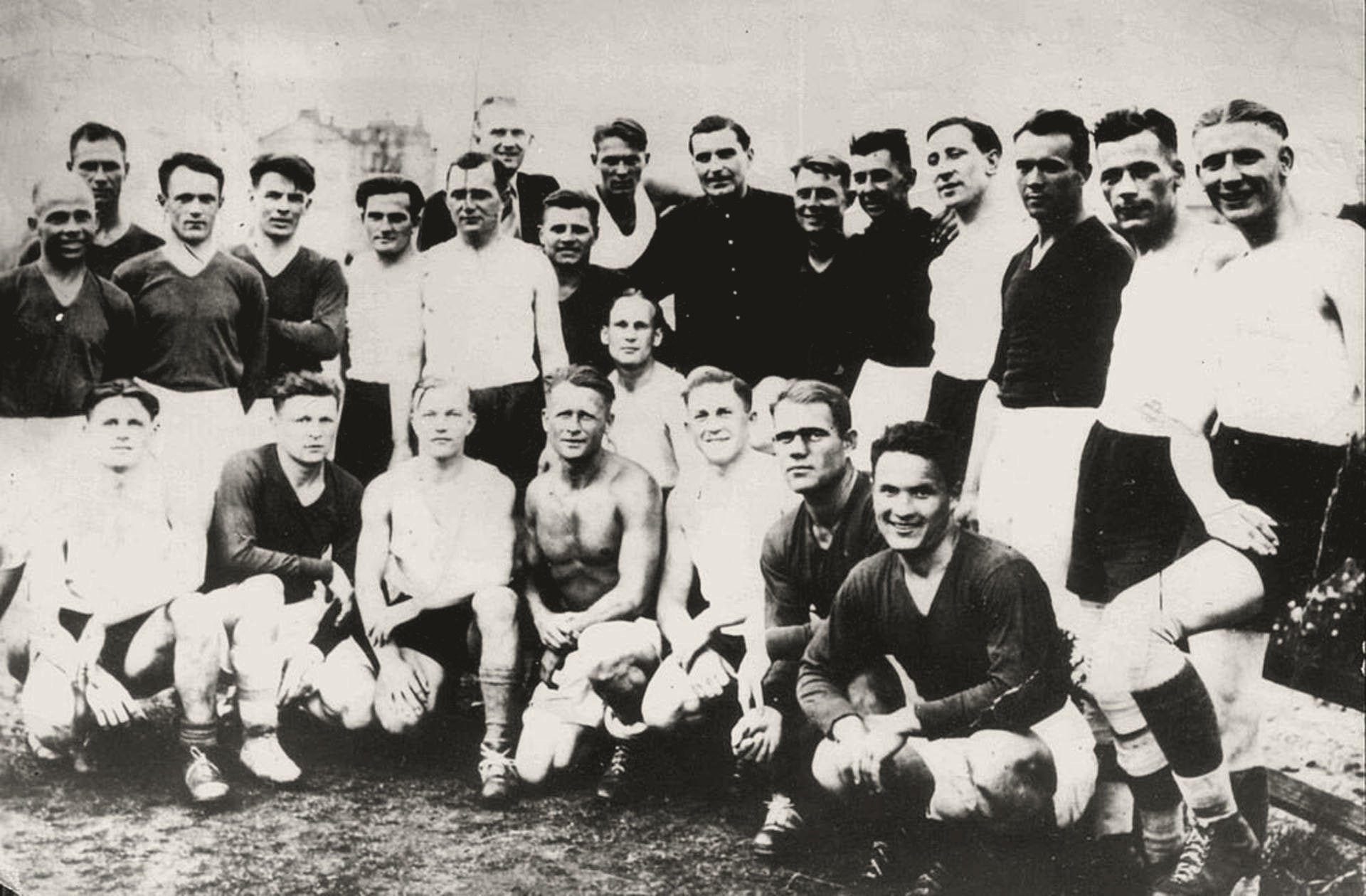
Kyiv was occupied in September 1941. By the summer of 1942 a group of former Dynamo Kyiv and Lokomotyv Kyiv players had found work at Bakery Number 3, which meant food, which in occupied Kyiv meant survival.
The bakery's director permitted them to form a team. It was called FC Start. They had no proper kit and played in what could be assembled.
The matches
Between June and August 1942 Start played roughly eight matches against Hungarian, Romanian and German garrison and railway teams. They won all of them, several by large margins. This was not a secret. It was played in public, in front of crowds, in a city under occupation.
9 August 1942
The opponent was Flakelf, a side drawn from Luftwaffe anti-aircraft personnel. Start had already beaten them 5 to 1 three days earlier, and this was a rematch with a strengthened team.
Start won 5 to 3.
What the story became
After the war this match was turned into a set piece of Soviet propaganda, and later into films. In the popular version an officer enters the changing room at half time and states plainly what will happen if they win, the referee is in uniform, and the entire team is executed at the side of the pitch immediately afterwards.
Subsequent research by Ukrainian and German historians has dismantled much of that. There is no reliable evidence of a half time ultimatum. The players were not shot after the match. Start played again, and won, a week later.
We are not interested in repeating a story that has been shown to be embellished. The real one is enough.
What happened to them
In late August 1942 several Start players were arrested. Mykola Korotkykh, who had a background that made him a particular target, died under interrogation. Others were sent to the Syrets concentration camp.
In February 1943, following an act of sabotage elsewhere and the reprisals that followed, Mykola Trusevych, Ivan Kuzmenko and Oleksiy Klymenko were shot at Syrets.
Whether the football was the cause, a contributing factor, or coincidental to the camp's ordinary brutality is genuinely contested. What is certain is that men who had beaten the occupiers in public that summer were dead within six months.
Why it goes on a wall
Because a group of underfed bakery workers were given every reason to lose and did not, repeatedly, in front of the people who had those reasons.
Five three, and the arrests came later.