
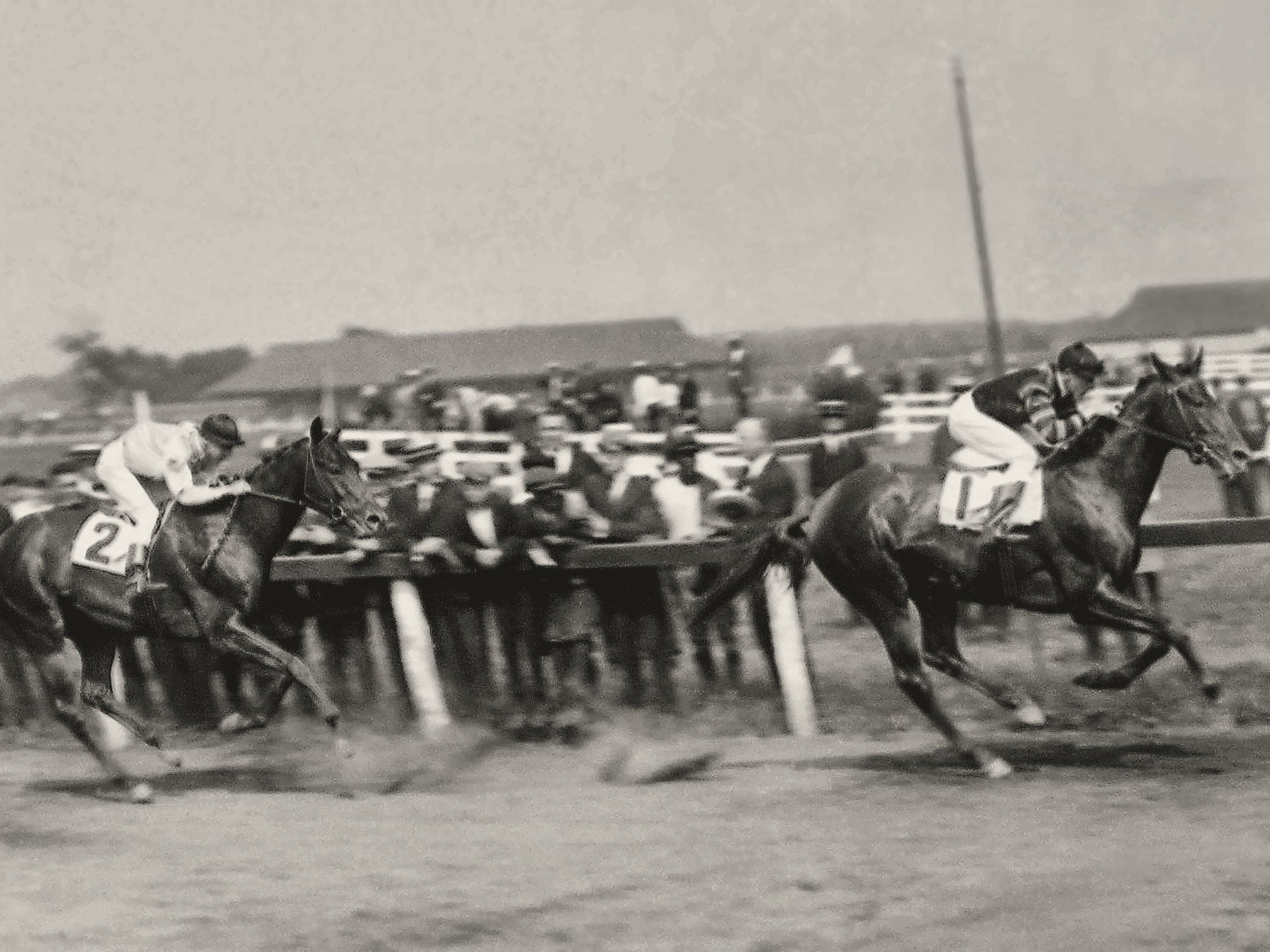
Races run by Man o' War in 1919 and 1920, of which he won twenty and lost one.
Big Red
He was foaled on 29 March 1917 at Nursery Stud, near Lexington, Kentucky, a chestnut bred by August Belmont Jr. Not long afterwards Belmont, at sixty-five, joined the United States Army to serve in France. While he was away, his wife named the colt Man o' War in his honour.
In the summer of 1918, because of the war effort, the Belmonts sold their racing stable. At the Saratoga yearling sale the colt went for five thousand dollars to Samuel D. Riddle, who ran a woollen mill in Pennsylvania. Two years later Riddle turned down four hundred thousand.
He was trained by Louis Feustel and called Big Red.
Saratoga
He won his first six races, beginning at Belmont Park on 6 June 1919. The seventh was the Sanford Memorial Stakes at Saratoga, on 13 August.
There were no starting gates. The horses lined up behind a strip of webbing, the barrier, and were sent away when it went up. That day the regular starter was absent. The start was held up for several minutes while other colts broke through the barrier, and when the field was released only the horses near the rail were ready. Man o' War was far behind. His jockey, Johnny Loftus, got him boxed in, and he was checked by tiring horses. He was conceding fifteen pounds to the winner, Upset, a colt owned by Harry Payne Whitney, and he finished close behind him.
They met five times. Man o' War won the other four.
It is often written that the word upset, for a favourite beaten by an outsider, comes from this race. It does not. It had been used that way in racing since at least 1877.
One rival
Riddle did not enter him for the 1920 Kentucky Derby. He thought it too early in the year for a young horse to go a mile and a quarter. Man o' War began his three-year-old season in the Preakness instead and beat Upset by a length and a half.
After that the fields shrank. In the Withers Stakes he had two opponents. In the Belmont Stakes he had one, Donnaconna, and won by twenty lengths in a world record time for a mile and three-eighths.
The Dwyer
The Dwyer Stakes at Aqueduct, on 10 July 1920, is the race in this photograph. The owner of John P. Grier was the only one willing to take Man o' War on. John P. Grier had challenged him in the Futurity the year before and was now the second-best three-year-old in the country. Man o' War carried a hundred and twenty-six pounds and John P. Grier a hundred and eight.
They went side by side down the backstretch, Man o' War on the rail. Into the turn Man o' War edged ahead. John P. Grier came back level, and they passed the mile together, inside the American record Man o' War had set in the Withers six weeks earlier.
At the eighth pole John P. Grier put his nose in front. Clarence Kummer hit Man o' War with the whip, and he drew clear in the final fifty yards to win by a length and a half. The time for the mile and an eighth was a world record.
A hundred lengths
On 4 September, in the Lawrence Realization at Belmont Park, his only rival was scratched. To keep the race from becoming a walkover, Sarah Jeffords, the niece of Riddle's wife, entered a horse called Hoodwink. Kummer neither held Man o' War nor pushed him. He won by slightly more than a quarter of a mile. The official margin was a hundred lengths. His time for a mile and five-eighths was a world record, and it stood until 1956.
His last start was the Kenilworth Park Gold Cup at Windsor, Ontario, on 12 October 1920, against Sir Barton. He won by seven lengths, in the first horse race to be filmed in its entirety.
A hundred and forty pounds
Most American races for older horses were handicaps, in which the best horse carries the most weight. Had he raced at four, the handicappers would have started him at a hundred and forty pounds and added more each time he won. Riddle retired him with twenty wins from twenty-one starts and almost a quarter of a million dollars in prize money, more than any horse in American racing had earned.
Faraway Farm
From 1922 he stood at Faraway Farm, near Lexington. He was the leading sire in North America in 1926. One of his sons was War Admiral, foaled at Faraway in 1934 to a mare, Brushup, who never won a race. War Admiral won the Triple Crown in 1937. Another son, Hard Tack, sired Seabiscuit, who beat War Admiral by four lengths in a match race at Pimlico in November 1938.
His groom, Will Harbut, led him out for visitors, and more than half a million people signed the guest book at the farm. He died on 1 November 1947, aged thirty, a short time after Harbut. He was buried in a casket lined with Riddle's racing silks and in the early 1970s was moved to the Kentucky Horse Park, where a statue by Herbert Haseltine marks the grave.