
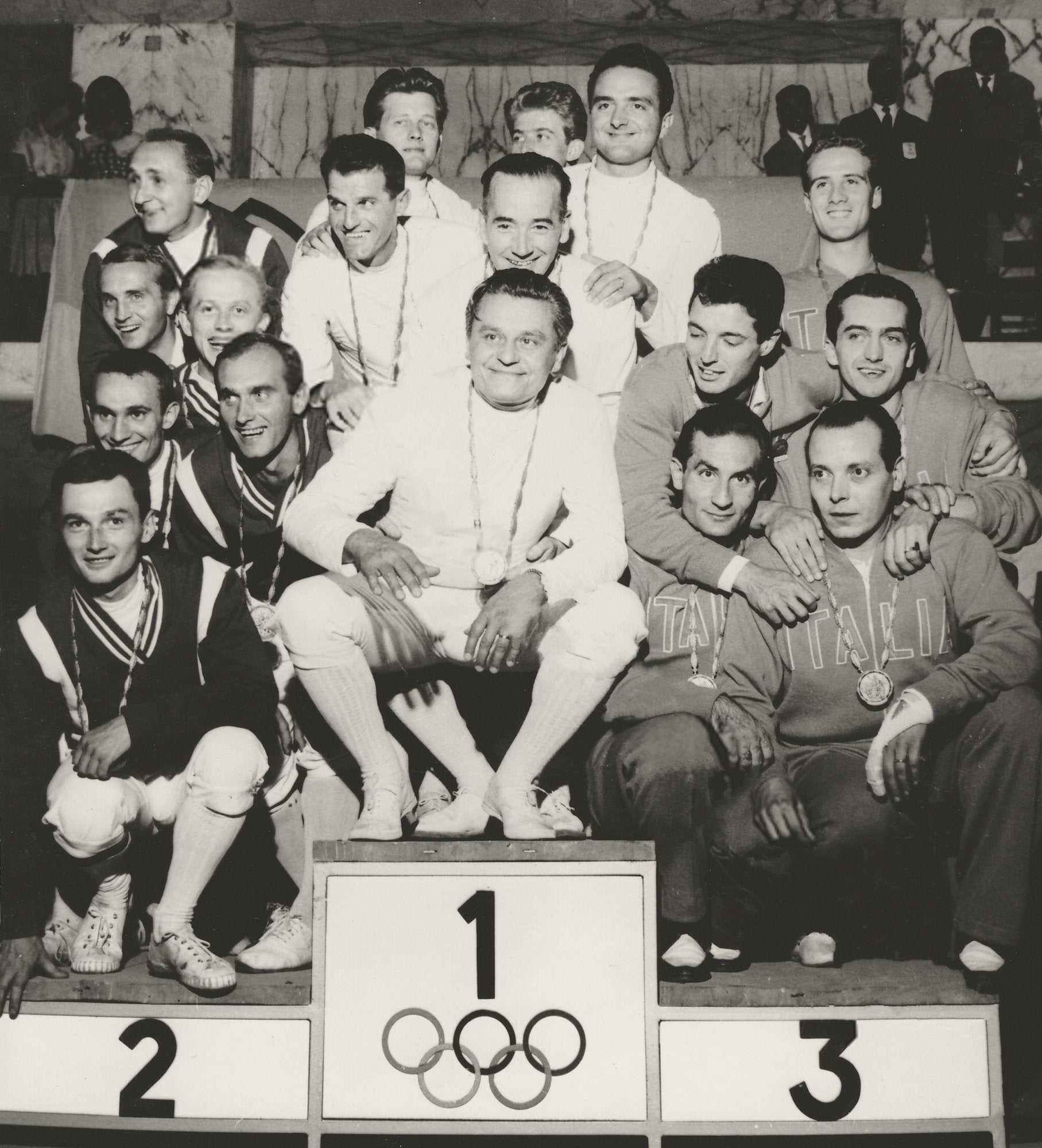
Aladár Gerevich won an Olympic gold medal at six consecutive Games: 1932, 1936, 1948, 1952, 1956 and 1960.
Twenty-eight years separate the first from the last, and the gap is longer than the numbers suggest, because the 1940 and 1944 Olympics did not take place. He was twenty-two at his first and fifty at his last.
Nobody in any sport has matched it. A handful of people have won medals across six Games. Winning gold at all six, in a combat discipline decided by reaction speed, is a different proposition.
An Italian in Budapest
The Hungarian sabre school was founded by a man from Livorno.
Italo Santelli went to Budapest around the end of the nineteenth century and stayed. What he taught was a departure from the prevailing method. Sabre had grown out of cavalry practice and was fenced heavily, from the shoulder, with a weapon and a technique that assumed you were on a horse hitting somebody who was also on a horse. Santelli taught a lighter blade handled from the wrist and fingers, with the emphasis on speed of the point and the timing of the attack rather than on force.
The Hungarians took to it completely, and within twenty years they were unbeatable. Santelli's pupils and their pupils held the discipline for half a century. The Italian federation, which had let him go, spent decades losing to what he had built.
There is a well-known episode from the 1924 Olympics in which a dispute over Santelli's honour led to an actual duel with sabres between his son Giorgio and an Italian journalist. Giorgio won, with a cut to the head. The story is repeated so often that it has acquired several incompatible versions, and the safest thing to say is that a duel took place and that the Hungarian side of the argument prevailed.
What sabre actually is
The three fencing weapons are not variations on a theme, and the differences matter for why one small country could own one of them for half a century.
Foil and épée are thrusting weapons: you score with the point. Sabre is a cutting weapon, descended from the cavalry sword, and you score with the edge as well as the point, anywhere above the waist. That makes it faster and less precise, because a cut is a larger and quicker action than a thrust, and it makes the target enormous.
Sabre also uses right of way, a convention which says that when both fencers hit at the same time, the one who initiated the attack correctly gets the point. This turns the bout into an argument about who started what, adjudicated at speeds where the human eye is guessing. Fencers do not merely have to hit. They have to hit in a way that will be read, by a referee, as having been the attack.
That is the discipline the Hungarians took over. The Santelli method suited it exactly: a light blade, moved from the wrist and fingers rather than the shoulder, generating speed and a clean beginning to the action. Against opponents still fencing with heavy shoulder-driven cuts, a Hungarian was both faster and clearer, which meant he won the exchange and won the argument about the exchange.
The run
Between 1908 and 1964 the individual Olympic sabre championship was won by a Hungarian at every Games with one exception, and the exception is 1920, when Hungary was excluded from the Antwerp Olympics as a defeated power from the First World War.
The team event ran similarly. Hungary won it in 1928, 1932, 1936, 1948, 1952, 1956 and 1960: seven consecutive titles, across a period in which the country changed political system three times.
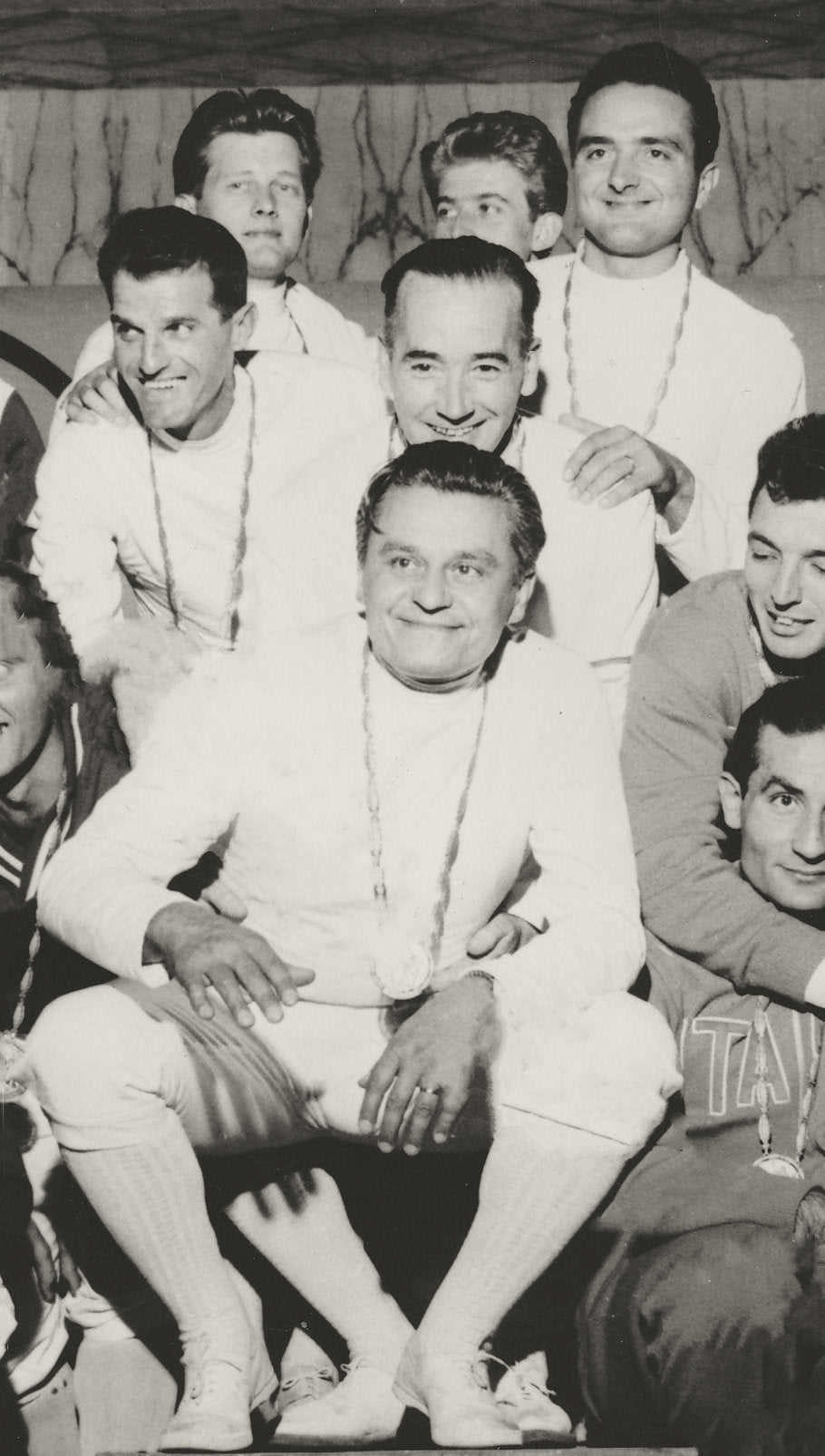
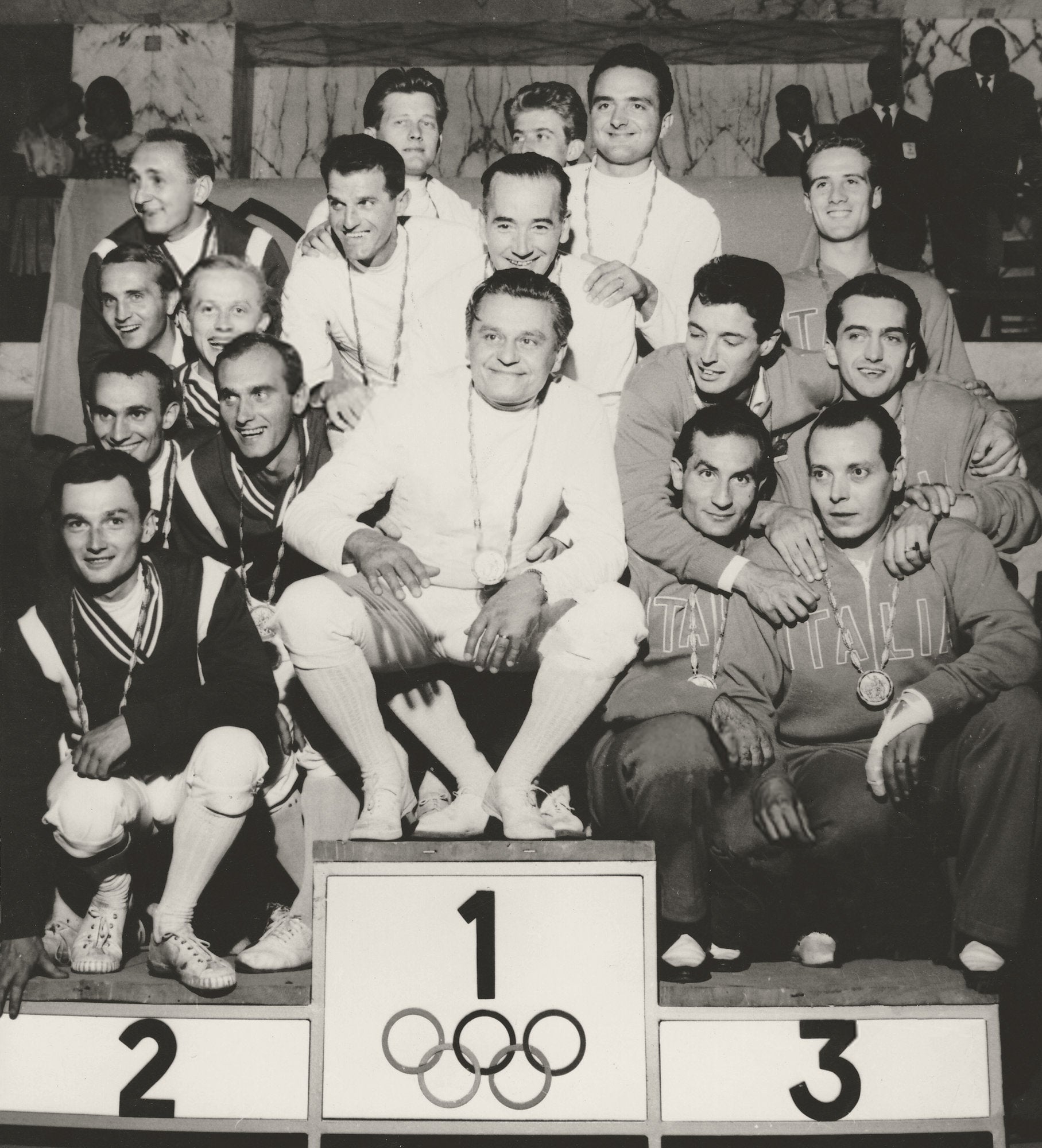
Two of the photographs here are from Rome in 1960: the Hungarian team, and the team podium. That was the last of the seven. In 1964, in Tokyo, the Soviet Union won it, and the run was over.
Gerevich
He was born in 1910, in Jászberény. He took up fencing seriously in his teens and came into a squad that was already the best in the world, which meant that being selected was harder than winning.
His first gold was in the team event at Los Angeles in 1932, at twenty-two. He won the team title again in Berlin in 1936. Then the Olympics stopped for twelve years.
What happened in Hungary in the intervening period was catastrophic and it is relevant. The country allied with Germany, was occupied by Germany in 1944, and had its Jewish population deported and murdered in a matter of months. Several of Hungary's greatest fencers were Jewish. Attila Petschauer, who had won team sabre gold alongside Gerevich in 1928 and 1932, was sent to a forced labour battalion on the eastern front and died there in 1943 after being tortured by Hungarian officers, at least one of whom is said to have recognised him.
Gerevich survived the war. He was not Jewish. He came back at Wembley in 1948, at thirty-eight, and won both the individual and the team title.
Fencing for whoever was in charge
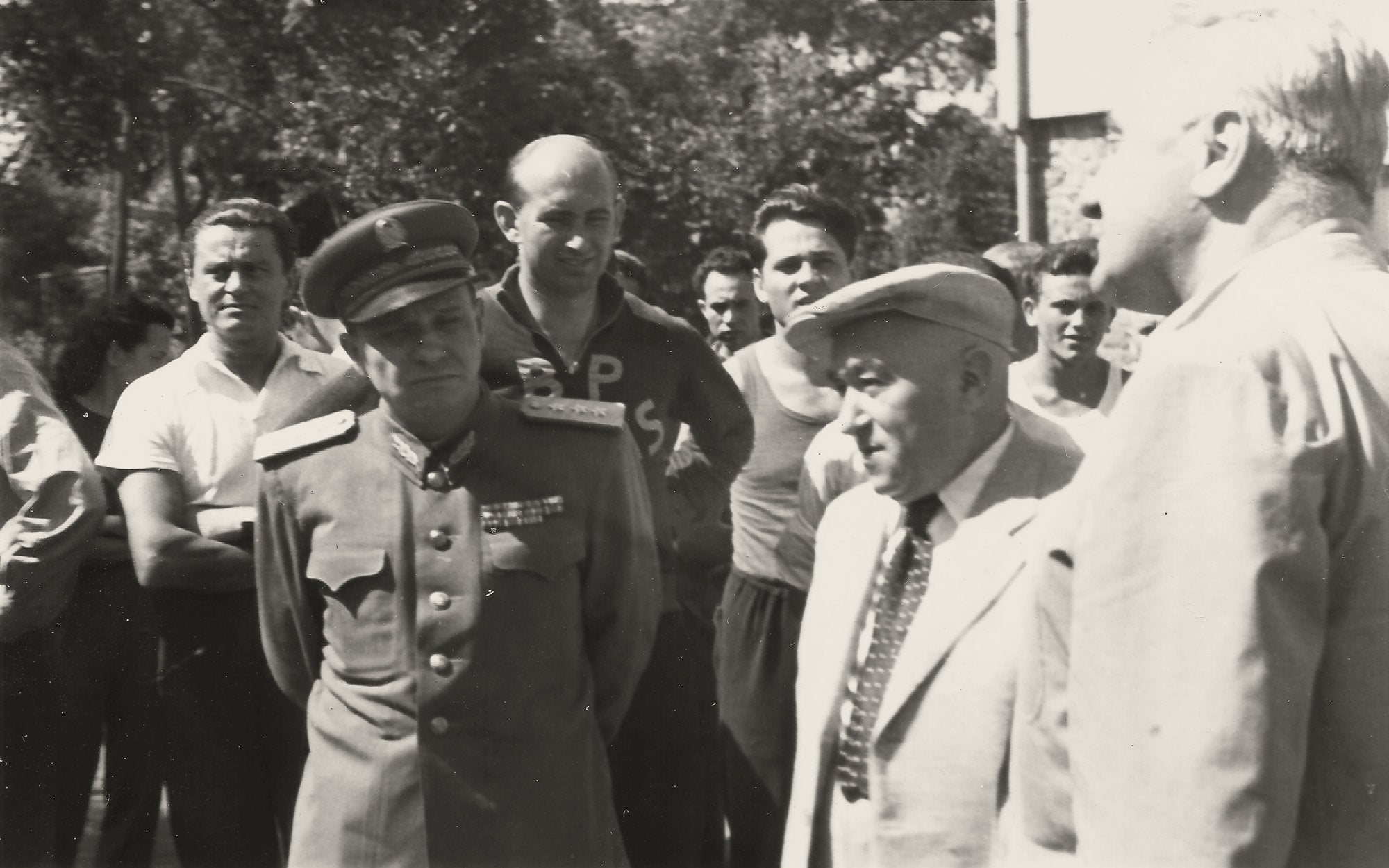
Then came the communist period, and this is the part the photograph in this piece is about.
The image is from 1952. Mátyás Rákosi, the Hungarian Stalinist leader, is at the centre with the defence minister Mihály Farkas and the sports administrator Gyula Hegyi. Behind Farkas stand two Olympic champions, one of whom is Gerevich.
Rákosi's Hungary was among the harshest regimes in the bloc, with a secret police apparatus, show trials, internments and a personality cult. It also invested heavily in sport, because Olympic medals were cheap international prestige and because a population with something to cheer is easier to govern. Athletes were displayed. Standing in that photograph was not optional.
Gerevich won the team title in Helsinki that summer, and again in Melbourne in 1956, which came weeks after Soviet tanks had put down the Hungarian revolution. A significant number of Hungarian athletes did not go home from those Games. Gerevich did.
He fenced for the Kingdom of Hungary, for the wartime government, for the Rákosi regime and for what came after it. He was very good at one thing and the state of the day always wanted it.
Rome, at fifty
By 1960 he was fifty and the federation wanted to leave him out.
The story, which he told and which his teammates confirmed, is that he asked to fence the entire selected squad, individually, and beat every one of them. He went to Rome and won a sixth gold.
It is a good story partly because it is funny and partly because of what it says about the standard of the squad he beat. These were not passengers. Hungary won the team event in Rome. He was the oldest man in it by roughly twenty years.
A family, and a plaque
He married Erna Bogen, who had won an Olympic bronze in foil in 1932. Her father, Albert Bogen, had won an Olympic silver for Austria in 1912. Their son Pál Gerevich won two Olympic bronzes in sabre in the 1970s.
Four generations of one family with Olympic fencing medals. That is not a coaching system, it is a household.
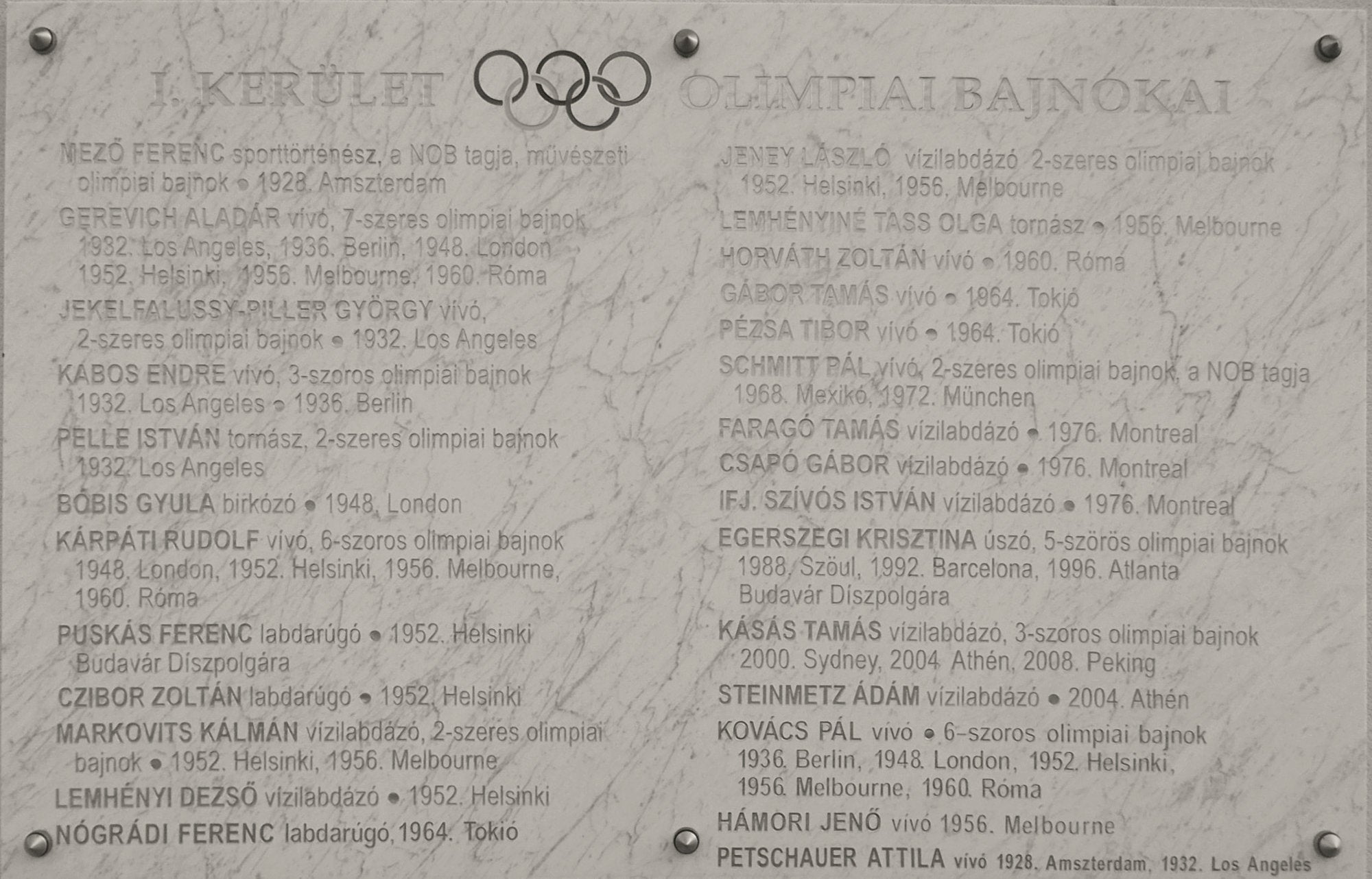
The last photograph here is a plaque on a wall in Budapest listing Olympic champions from the district. Gerevich died in 1991, at eighty-one, having lived just long enough to see the political system he had spent forty years being photographed in front of come to an end.
What ended
Hungary is still a serious fencing country and still wins sabre medals. What it does not have is the position it held for fifty-six years, when the question at each Olympics was which Hungarian would win rather than whether one would.
The reasons the run stopped are ordinary. The Soviet Union built a fencing programme. Then everybody else did. The technical advantage that Santelli had brought to Budapest in about 1900 became common property, as technical advantages do, and once everyone fenced that way the only thing left was the ordinary distribution of talent.
Fifty-six years is a long time to be first at anything. The men who did it are now names on a plaque on a wall in the first district, in a language almost nobody outside the country reads.