
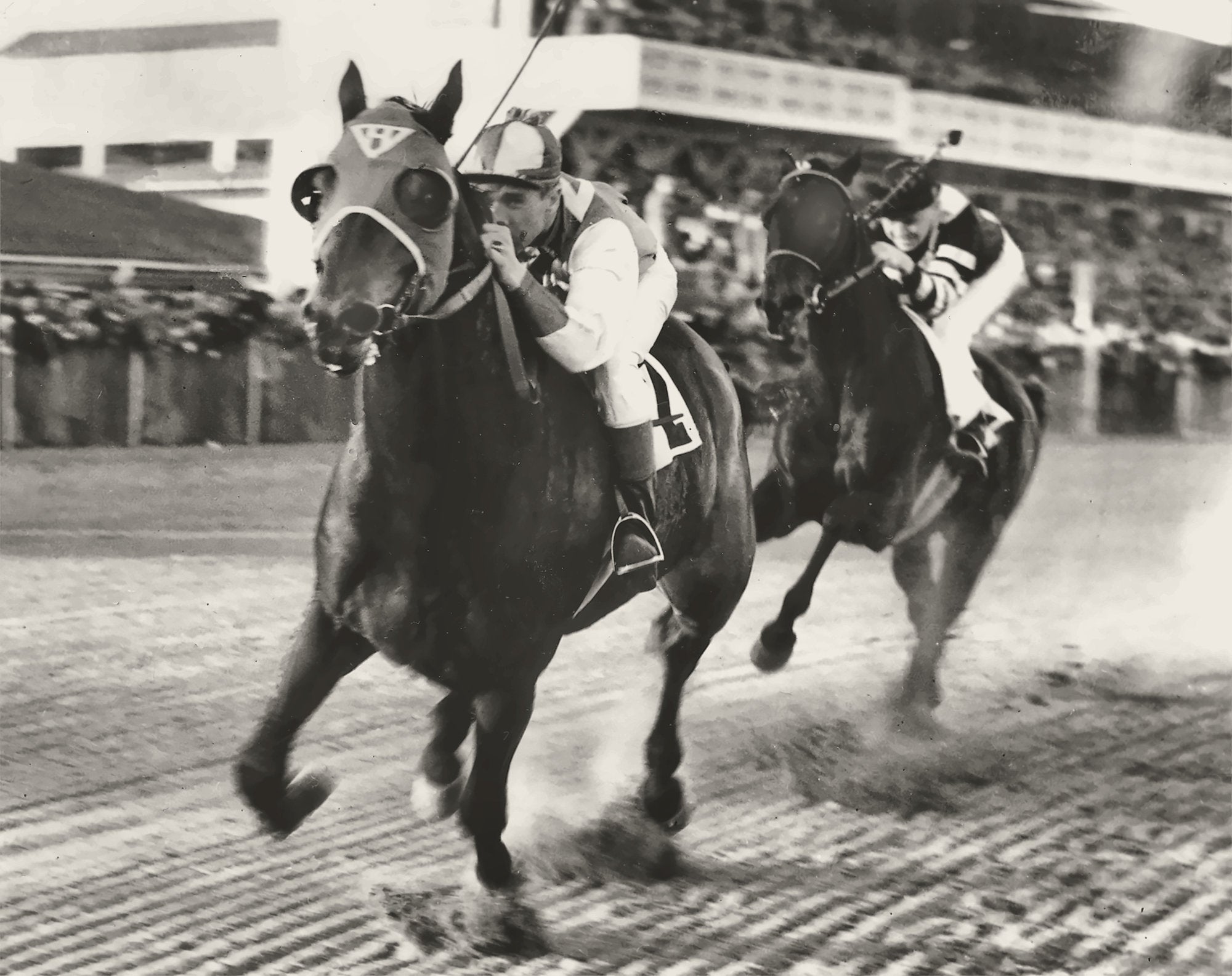
Races Seabiscuit ran and lost before his first win, usually finishing back in the field.
The stable joke
He was foaled on 23 May 1933 at Claiborne Farm in Kentucky, bred by Gladys Phipps. His sire, Hard Tack, was a son of Man o' War.
He was undersized and knobbly-kneed, and given to long spells of sleeping and eating. He raced for the Wheatley Stable, where he was sometimes the butt of the jokes, and his trainer, Sunny Jim Fitzsimmons, thought he was too lazy. Fitzsimmons also had Omaha, who won the Triple Crown in 1935, and that was where his attention went.
As a two year old Seabiscuit ran thirty five times and won five. Three of those races were claiming races, in which he could have been bought for two thousand five hundred dollars. There were no takers.
Eight thousand dollars
Tom Smith first saw him on 29 June 1936, at Suffolk Downs. Smith had been born in a log cabin in Georgia, had trained horses for the United States Cavalry and had worked on a cattle ranch. He was known as Silent Tom. Since 1934 he had trained for Charles Howard, who had made his money selling Buicks in San Francisco.
In August 1936, at Saratoga, Howard bought Seabiscuit for eight thousand dollars and put him in Smith's barn.
The jockey Smith chose was Red Pollard, born in Edmonton, Alberta, and down and out in Detroit when Smith took him on that year. Pollard had lost the sight of his right eye when a stone thrown up by another horse hit him during a training ride. He kept it hidden, because he would not have been allowed to ride.
East and West
In 1937 Seabiscuit won eleven of his fifteen races and was the leading money winner in the United States. He lost the Santa Anita Handicap by a nose, to Rosemont.
That year War Admiral won all eight of his races, the Triple Crown among them, and was Horse of the Year. He was a son of Man o' War and raced for Samuel Riddle, who had owned his father. He was not a big horse either. He stood about fifteen hands and two inches, much the same as Seabiscuit, and one of his nicknames was the Mighty Atom.
Seabiscuit was the leading horse in the West, War Admiral the champion of the East. Races were planned that would bring them together, and each time one of them was scratched. In May 1938 the owners agreed a match at Belmont Park. Seabiscuit was scratched.
Two falls
Pollard did not ride at Pimlico. On 19 February 1938 a horse called Fair Knightess fell on him and crushed his chest. On 23 June, working a young colt called Modern Youth, he was thrown when the horse bolted, and his leg was shattered.
Howard gave the ride to George Woolf, an old friend of Pollard's, born on a ranch at Cardston, also in Alberta. Woolf had diabetes and rode far fewer races in a year than most jockeys. He was called the Iceman, for the way he waited before he moved.
The bell
The match was set for the Pimlico Special, in Baltimore, on 1 November 1938, over a mile and three sixteenths. Riddle asked for it to be run without a starting gate, because War Admiral had a history of trouble at the gate. That meant a walk-up start, which was expected to suit War Admiral, the faster horse away. Smith secretly trained Seabiscuit to break at the sound of a bell.
About forty thousand people came to the track, and trains were run from all over the country to bring them. Tens of millions more followed on the radio, by the usual estimates. War Admiral was favourite, at one to four with most bookmakers.
When the bell rang Seabiscuit broke in front. After twenty seconds he led by more than a length, and he crossed over to the rail. Halfway down the backstretch War Admiral began to close, came level, and then went slightly ahead. Woolf, as Pollard had advised him, had eased Seabiscuit so that he could see the other horse. Then he asked him for more.
Two hundred yards from the wire Seabiscuit pulled away again. He won by four lengths and broke the track record. War Admiral had run his best time for the distance.
Seabiscuit was voted Horse of the Year for 1938.
After
He was injured in a race some months later, with Woolf riding: a ruptured suspensory ligament in his front left leg. He and Pollard, who was still convalescing, recovered together at Howard's ranch.
In 1940, at seven, with Pollard riding, he won the Santa Anita Handicap, the race he had lost twice, by a length and a half from Kayak II, another of Howard's horses and his training partner. There were seventy eight thousand paying spectators. It was his last race. He retired as the leading money winner in the history of the sport, with thirty three wins from eighty nine starts.
Woolf died in January 1946, the day after a fall at Santa Anita. Seabiscuit died on 17 May 1947 and is buried at Ridgewood Ranch, Howard's property in Mendocino County. Pollard rode into the 1950s and died in 1981.