
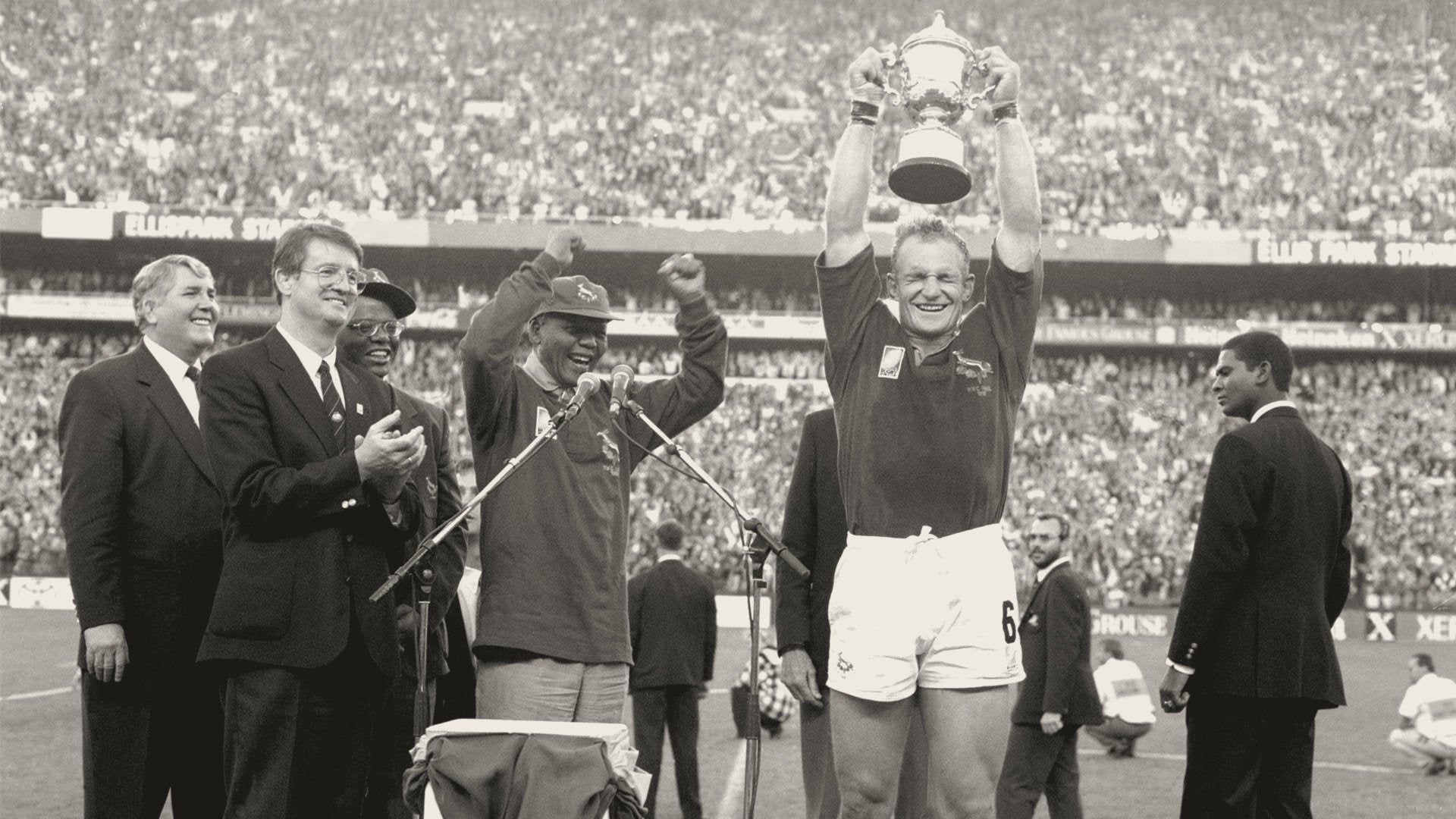
The number on the jersey Mandela wore. It was Francois Pienaar's, the captain's, and that detail is the whole gesture: he did not wear a neutral shirt, he wore the captain's.
What the emblem meant
The Springbok had been the badge of South African rugby since 1906 and, through the apartheid decades, the most visible sporting symbol of the regime. International boycotts targeted it specifically.
Black South Africans overwhelmingly supported opposing teams. This was not subtle and nobody pretended otherwise.
The argument to keep it
After 1994 the National Sports Council moved to scrap the emblem. Much of the ANC agreed.
Mandela argued against his own side. His reasoning, as he set it out at the time, was that removing the symbol would confirm to Afrikaners that the new South Africa had no room for them, and that reconciliation required giving something rather than taking it.
He won the argument, narrowly, and at cost.
24 June 1995
South Africa against New Zealand in the World Cup final at Ellis Park, Johannesburg. The All Blacks were heavy favourites with Jonah Lomu, who had scored four tries in the semi final against England.
Before kick-off Mandela walked out in the green Springbok jersey and cap, with number six on the back.
The crowd, around sixty-two thousand and overwhelmingly white, chanted his name.
The match
New Zealand were held. The score was 9-9 at full time. In extra time Joel Stransky dropped a goal to make it 15-12.
Mandela presented the trophy to Pienaar and thanked him for what he had done for the country. Pienaar's reply, that South Africa thanked Mandela for what he had done, has been quoted ever since.
Asked afterwards about the support of sixty-two thousand fans, Pienaar said they had the support of forty-three million South Africans.
What it did not do
South African rugby remained overwhelmingly white for years. Quota debates ran for decades. Economic inequality was untouched.
Pienaar has consistently declined to claim the match healed the country.
Why it goes on a wall
Because it is a precise, deliberate act rather than a sentiment. A man who had lost twenty-seven years to a system put on that system's shirt, in front of the people who had run it, and asked them to belong to something else.
He wore their jersey.