
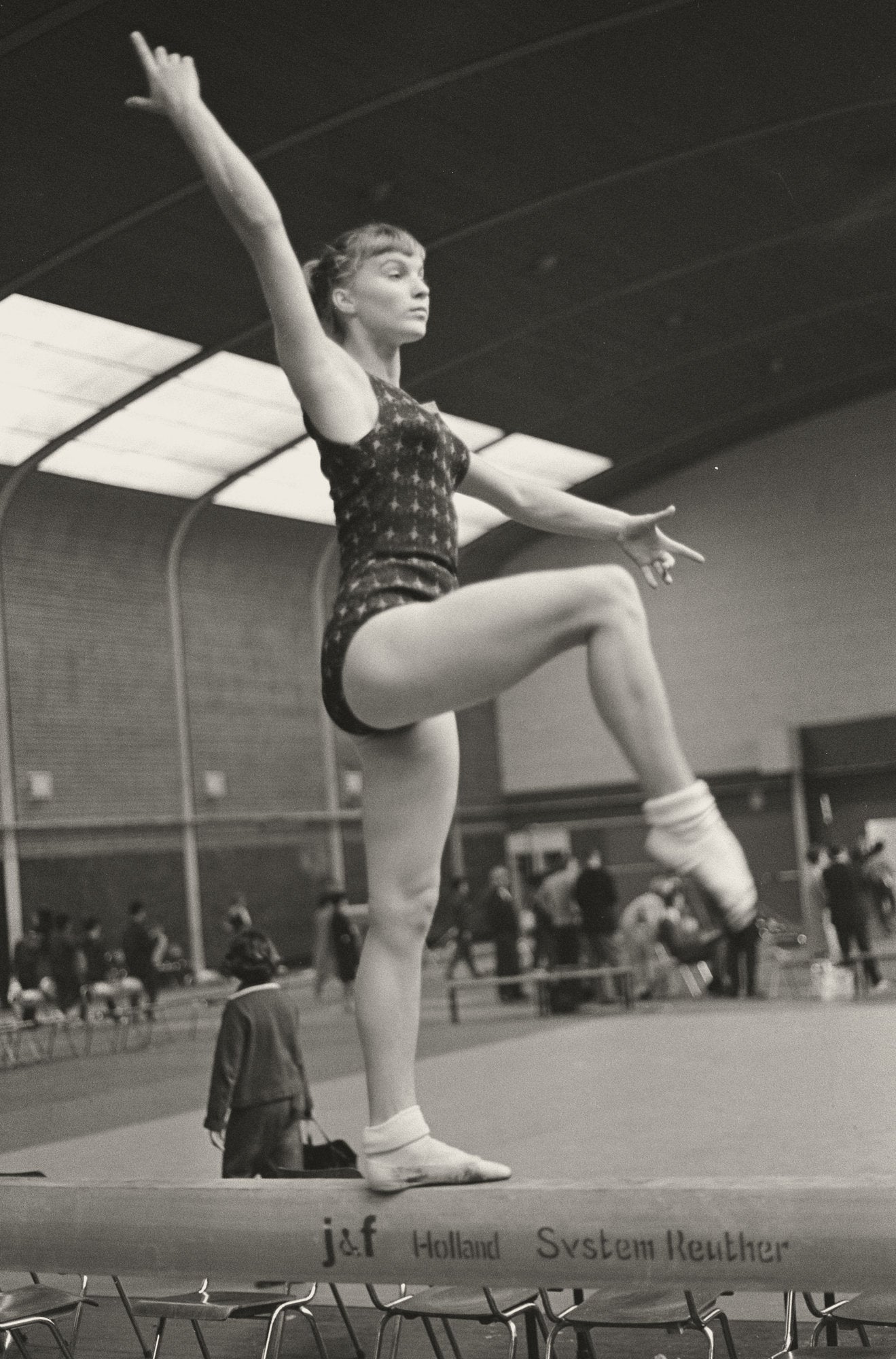
Between the Helsinki Olympics of 1952 and the Barcelona Olympics of 1992, the Soviet women's gymnastics team competed at ten Games and won the team title at all ten.
The run is 1952, 1956, 1960, 1964, 1968, 1972, 1976, 1980, then 1988, then 1992 under the flag of the Unified Team after the country had dissolved. The gap is 1984, when the Soviet bloc boycotted Los Angeles in response to the American boycott of Moscow four years earlier. Romania won it in their absence.
There is no comparable sequence anywhere in Olympic sport. Forty years of a single national team not being beaten at a discipline contested by everybody.

How it was done
The apparatus was built into the state and it started early.
Children were screened at physical education classes and at specialist assessments from around the age of six. Those who were selected went into a system of sports schools, and the most promising into boarding institutions where training occupied most of the day and ordinary schooling fitted around it. There was no fee. There was also no exit that did not involve being told you were finished.
By the standards of the western sporting world at the time this was extraordinary. Elsewhere gymnastics was a club activity funded by parents. In the Soviet Union it was a career path administered by the state, with coaches trained in a formal methodology, medical supervision, and a clear route from a gymnasium in a provincial town to an Olympic team.
It should be said plainly that the system was hard on children, that injuries were routinely trained through, and that a great deal of what happened inside it would now be classed as abuse. The results were also not in doubt. Both of those are true and the second does not excuse the first.
Latynina
Larisa Latynina competed at three Olympics, in 1956, 1960 and 1964, and came away with eighteen medals: nine gold, five silver, four bronze.
That was the all-time Olympic record, across all sports and both sexes, and it stayed the record for forty-eight years. It was finally passed by Michael Phelps at London in 2012, by which point Latynina was in her late seventies and had spent decades being a footnote in other people's record attempts.
She competed while pregnant at one point, coached the national team for years afterwards, and is the reason the programme had a methodology rather than a collection of talented individuals.
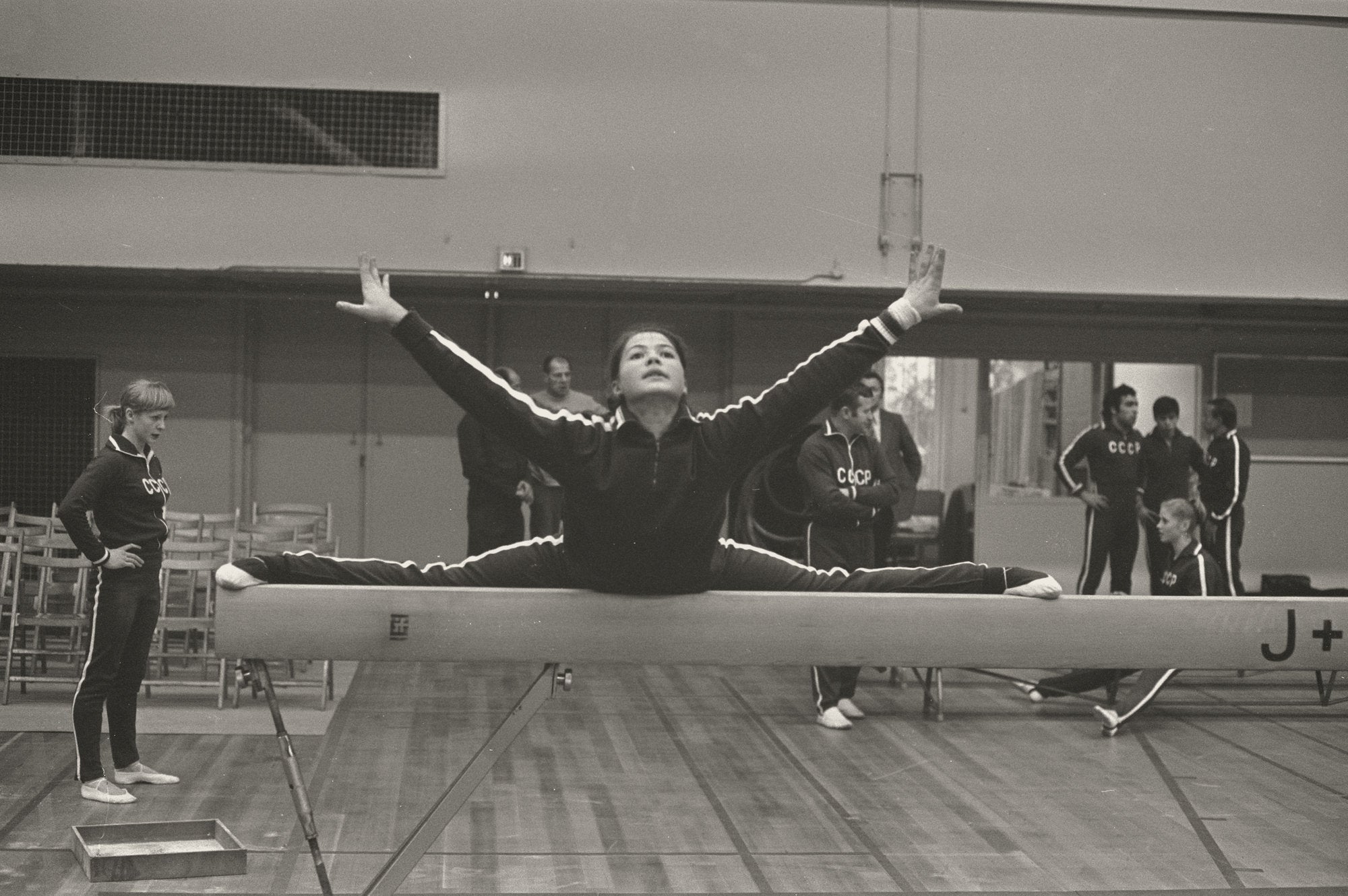
The ones who did not make it
Every account of this programme is written from the top of it, which distorts the shape of the thing.
For each girl who reached an Olympic team there were several thousand who entered the system at six or seven, trained for years, and were told at twelve or fourteen that they had grown too tall, or developed too early, or were not going to be good enough. They then returned to ordinary schooling several years behind their contemporaries, with a body that had been worked hard through the years in which bodies are being built.
There was no compensation for this and no particular acknowledgement that it was a cost. The programme was assessed on Olympic results and it produced them, and the attrition was a feature of the design rather than a failure of it.
The same is true of what happened to the ones who did succeed. Training through injury was routine. Weight was controlled by methods that would now be described in clinical terms. Girls in their early teens lived away from their families for most of the year. When former Soviet gymnasts have spoken about this in later decades, the tone is generally matter-of-fact rather than aggrieved, which is not the same as saying it was fine.
None of this is an argument that the gymnastics was not extraordinary. It is an argument that a record of ten Olympic titles is not, on its own, a description of what happened.
Munich, and the somersault
Everything changed in 1972, and it changed because of television.
Olga Korbut was seventeen, from Grodno in what is now Belarus, and had not been the first choice for the team. In the team competition in Munich she performed a backward somersault on the balance beam, which nobody had done in competition, and a release move on the uneven bars that involved standing on the high bar and throwing herself backwards.
The Munich Games were the most widely televised to that point. Several hundred million people watched a small girl do something that appeared to be physically impossible, then fall apart the following day on the bars, cry on camera, and come back to win two individual golds. The combination of the audacity and the visible distress made her the most famous athlete of the Games.
The consequences for the sport were enormous and are still argued over. Before Munich, elite gymnasts were young women in their late teens and twenties. Afterwards the advantage moved decisively to smaller, lighter, younger bodies capable of rotating faster, and federations everywhere restructured their programmes to find girls at nine rather than fifteen. The minimum competition age has since been raised twice, to fifteen, precisely to undo what 1972 started.
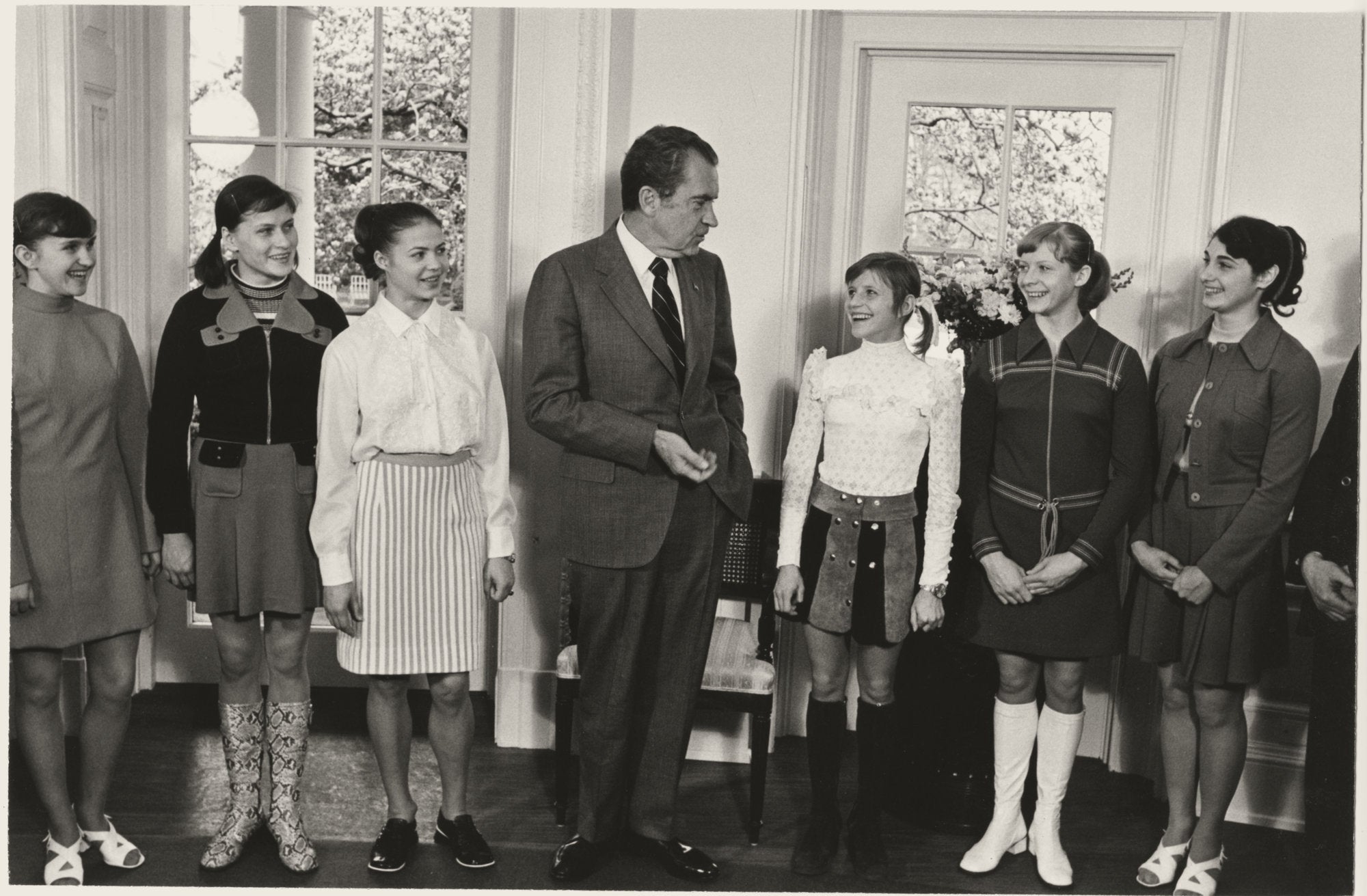
Korbut toured the United States in 1973 and was received at the White House. One of the photographs here is from that visit: the Soviet team standing in the Oval Office in the middle of the Cold War, because a teenager on a beam had made the arrangement politically useful to both sides.
Tourischeva
The best gymnast on that team was not Korbut.
Ludmilla Tourischeva won the all-around title in Munich, which is the title that matters, and won it while Korbut was collecting the attention. She was a classicist: full-length lines, controlled landings, an adult presence on the floor. Two of the photographs here are of her, in the Netherlands in October 1972, weeks after Munich, arriving at Schiphol and training in a hall in Amsterdam.
She continued to the 1976 Games and won more medals there. Her routine at the 1975 World Cup, completed after the uneven bars collapsed behind her without her breaking stride, is the single most watched clip of her career and it is watched because of the equipment failure.
There is a familiar pattern here and it is worth naming. The gymnast who was rewarded was the one who produced a televisual moment. The one who was better was overtaken by her. Tourischeva married the sprinter Valeri Borzov and went into coaching and administration in Ukraine, where she still is.
Nellie Kim, and the arrival of Romania
At Montreal in 1976 the Soviet team won again, but the story of the Games was Nadia Comăneci of Romania and the first perfect ten.
What is less often recalled is that Nellie Kim, of the Soviet team, also scored perfect tens at those Games, on vault and on floor. She won three golds in Montreal. She is a footnote in an account that is otherwise entirely about the fourteen-year-old from Oneşti.
Romania's rise, built on a version of the same state system with a different coaching philosophy, was the first serious challenge the Soviets had faced. It did not dislodge them from the team title. It did end the assumption that the individual honours were theirs by right.

The end of it
The country dissolved at the end of 1991. The team that competed in Barcelona in 1992 did so as the Unified Team, under the Olympic flag, and won the team title one last time.
After that the programme fragmented. Russia, Ukraine and Belarus each inherited a portion of the coaching structure, the facilities and the athletes. Russia has remained a strong gymnastics nation and has not been the dominant one. The Soviet apparatus, which was pooling the talent of fifteen republics into one selection, is not reproducible by any of the successor states individually.
Many of the coaches left. A significant number went to the United States, which is one of the reasons American gymnastics improved so sharply in the following two decades, and also one of the reasons some of the coaching culture that came with them ended up under investigation there.
Afterwards
Latynina lived into her nineties and saw her record broken.
Tourischeva went into administration.
Korbut's later life was difficult in ways that are widely documented and do not need itemising here. She moved to the United States, had money problems, and in 2017 sold her Olympic medals and other memorabilia at auction. They went for a few hundred thousand dollars. She said at the time that she wanted the items to be somewhere they would be looked after.
The last photograph here is a Soviet postal envelope from 1980, printed for the Moscow Games, with a gymnast on it. It was cancelled in July of that year, during the boycotted Olympics, in a country that had eleven years left, by a postal service that no longer exists, for a team that won again.