
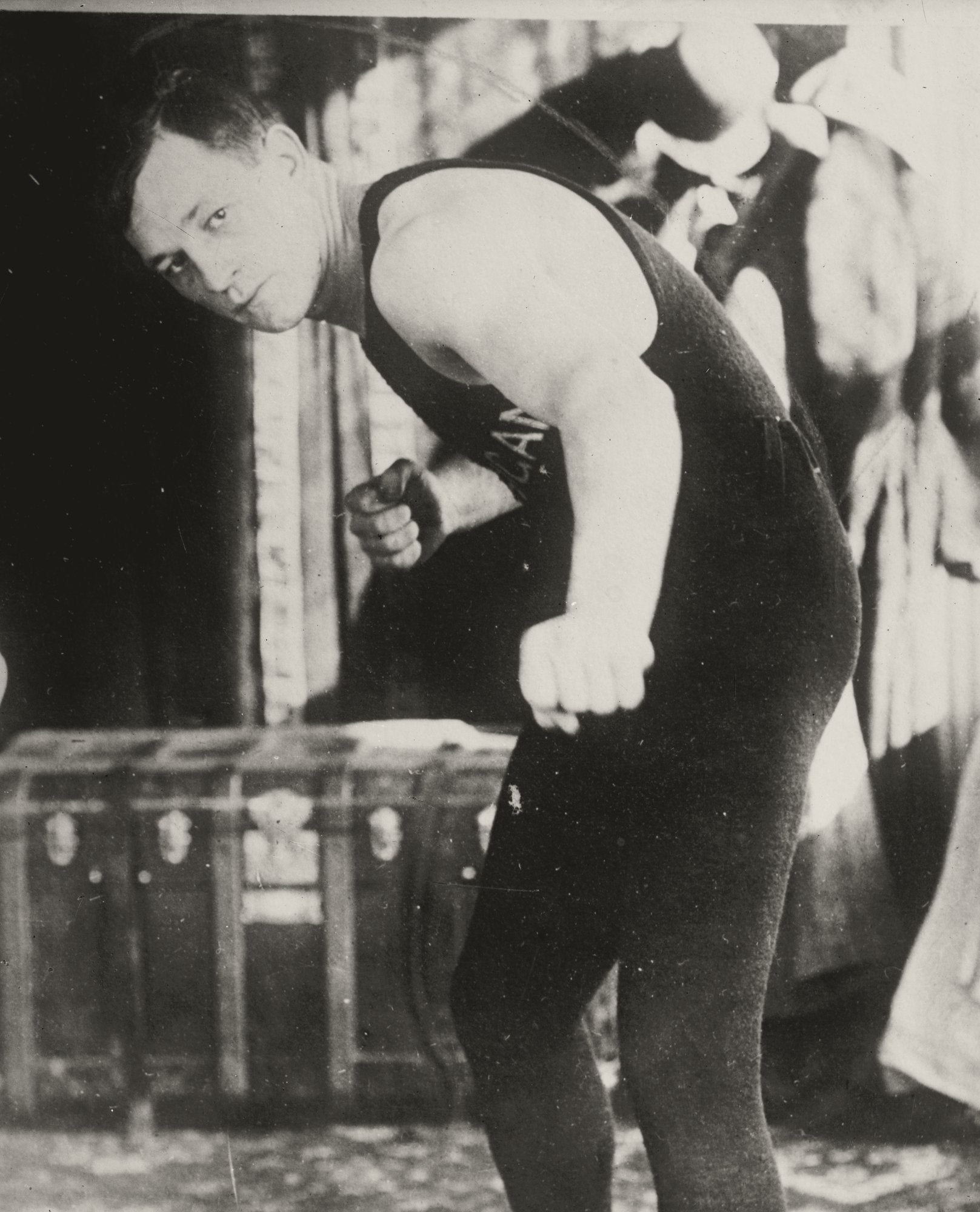
That is the age Stanley Ketchel reached and did not pass. A rifle saw to it, on a farm in Missouri, in the autumn of 1910. By then he had been the middleweight champion of the world. He had, the year before, put the largest and most feared man in the sport onto the floor. And he was gone at an age when most fighters are only beginning to understand the trade.
The number sits oddly against the life. Twenty-four is young for a career. It is younger still for the end of one.
A boy off the trains
He came from Michigan, the son of Polish immigrants who had crossed an ocean toward the promise of work and found the hard kind of it. The name that later followed him, the Michigan Assassin, at least kept the state in it. That is close to the only gentle thing the name did.
The family name was Polish, and the ring smoothed it into something a crowd could shout without stumbling. He was not the only fighter of the age to arrive under a name half-translated. The boxing halls of that America were full of the sons of immigrants, hitting for a purse because the other doors stood narrower. What set Ketchel apart came later, once the bell went.
He did not stay put. As a boy he went west the way poor boys went then, on freight trains, riding in the cars and under them, sleeping wherever a rail yard or a mission hall allowed. He took whatever work a town would hand a stranger who could use his hands. This was the America of the drifting young man, before the automobile, when a boy with nothing could cover a thousand miles by climbing into a boxcar and could vanish just as easily. Thousands lived that way and left no record at all.
Some of Ketchel's version has surely been buffed in the retelling. Drifters make good copy, and once a man is famous his childhood is rewritten to fit the fame. What holds steady across the accounts is plain enough. He was on his own early. He went hungry often. Somewhere in that rough passage he found the one thing he could do better than the men around him. He could hit. Not with any neatness. He hit as though ending the matter were the whole of the idea.
The fighter he became
Boxing then was a coarser business than the one that survives in scratched film and careful record books. In much of the country it lived at the edge of the law, tolerated in some places and driven underground in others, staged in mining towns and the back rooms of athletic clubs. Contests could run for many rounds under small gloves, closer to a test of endurance than the sharp modern bout. A young man who could take punishment and hand back more of it could make a living, and a name, moving from town to town and taking on whoever the local promoter put up.
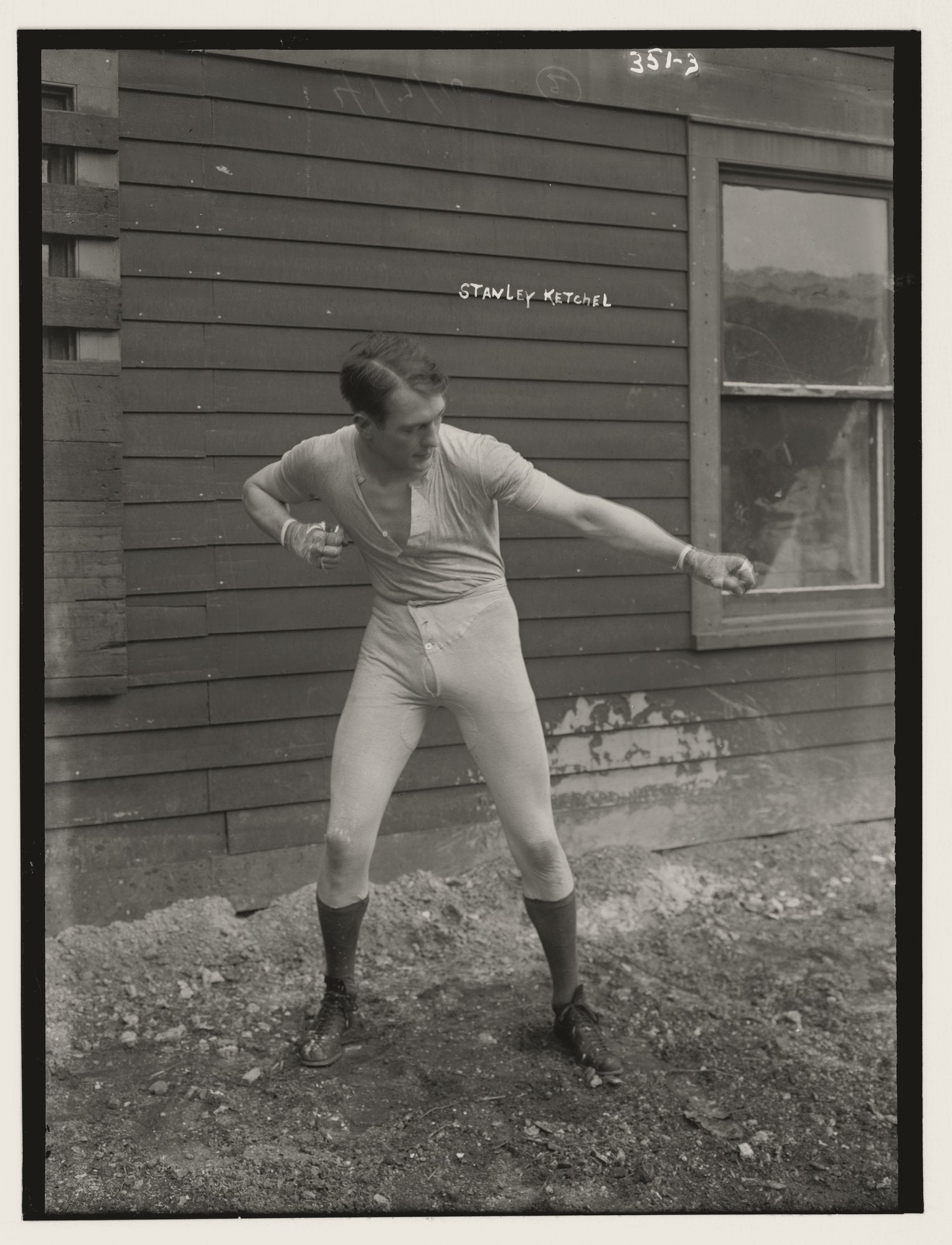
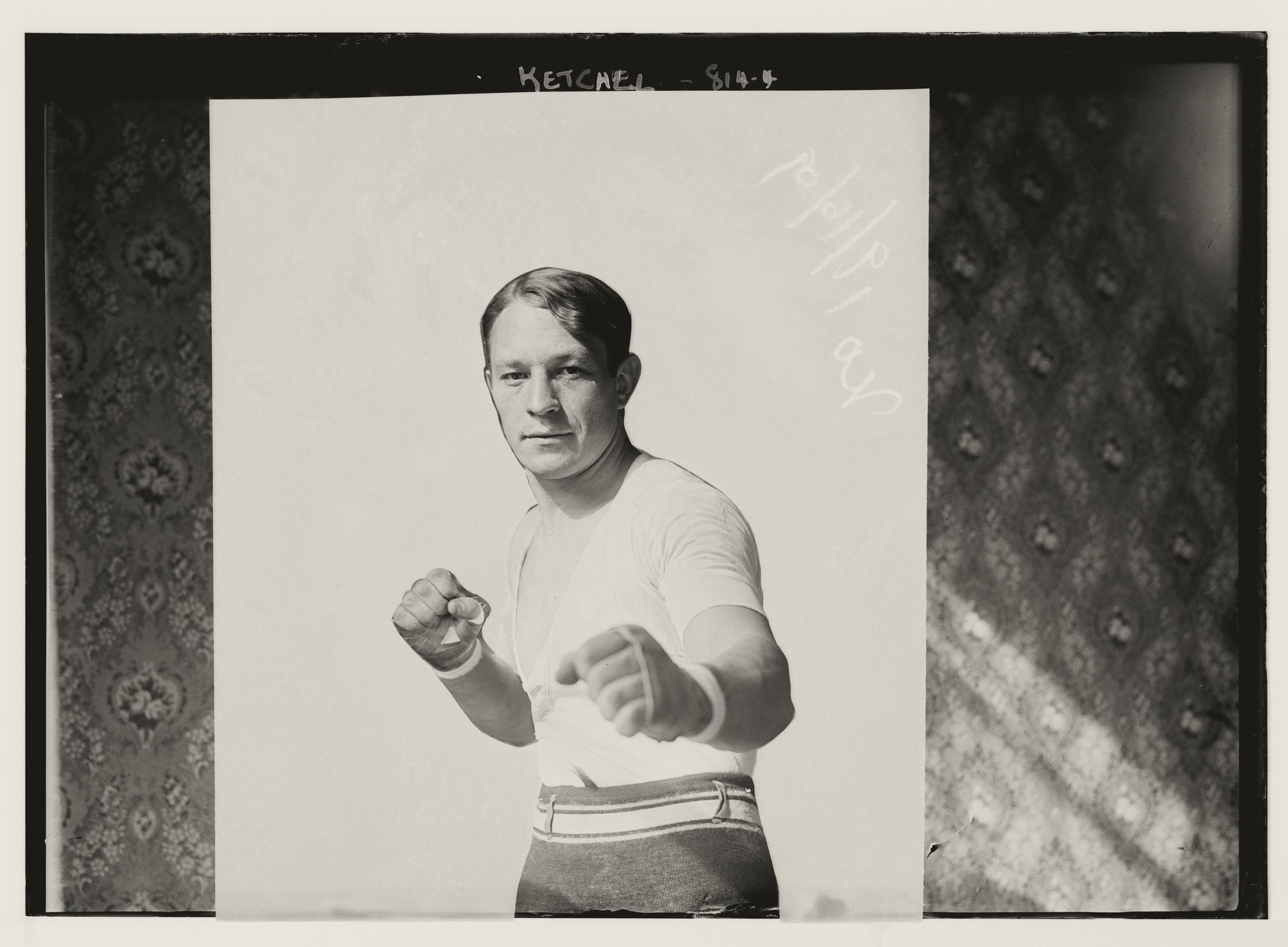
Ketchel came up through that world quickly. Before he was much past twenty he held the middleweight championship, and he held it in a manner that left little doubt about the method. He walked forward. He kept walking forward. Cleverer men, and there were plenty of them, discovered that cleverness has a short life against someone who refuses to stop coming at you. He fought as if a decision on points were a kind of defeat, an admission that the other man had been allowed to survive.
He was not a large man, even by the measure of his own division. The power did not come from size. It came from somewhere in the timing and the will, and from a readiness to be hit in order to land, which is a young man's bargain and not one that lasts.
There is a temptation to call him a brute and let the single word do all the work. The word flattens him. Men who watched him closely spoke of timing underneath the fury, of a fighter who knew exactly what he was about even while he seemed to be doing one blunt thing over and over. The fury was real all the same. It was the first thing anyone saw, and it is the thing that carried his name past the end of his life.
The night he reached above his weight
In 1909, in California, he did the thing that lodged him in the memory of people who never once watched a middleweight fight. He climbed into the ring with Jack Johnson.
The man across from him held the heavyweight title. He was the first Black fighter to hold it, and he held it against a country that largely wished he would not, in years when that fact alone could fill a stadium with people hoping to see him beaten. He was bigger than Ketchel by a broad margin, heavier and longer in the reach, and by common reckoning the more artful defensive boxer of the age. A middleweight had no business being in there with him. Ketchel went in regardless, giving away size to the best big man alive.
For most of the fight the difference told, the way it nearly always does. The bigger man controlled the range and the pace and seemed in no great hurry. Then, late on, Ketchel found something. He put the larger man down onto the boards. For a handful of seconds the impossible sat there in open view, the heavyweight champion on the floor and a middleweight standing over him, and every person in the place understood they were seeing something that was not supposed to happen.
It did not hold. The champion got back up, and the reply he gave closed the argument at once. A single blow, from a far stronger man who had just been handed a reason to use his strength, and Ketchel was counted out on the canvas. The retellings of that punch have thickened with detail over the decades, and some of the detail is plainly invented; the story has been improved by many hands. Take the improvements away and the shape of it survives. A small man knocked down a giant, and the giant rose and reminded him why the weights are kept apart in the first place.
There has long been talk that the two men had an understanding about how the night was to go, and that Ketchel broke it the moment he saw his opening. The talk has never been proved, and both men are long past settling it. What is certain is that a middleweight put a heavyweight champion on the floor, and paid for it at once.
The quarrel that ended it
He had little time left after that. Something over a year on from the fight on the coast, Stanley Ketchel was staying on a farm in Missouri when a man shot him with a rifle. He was twenty-four years old.
Why it happened is where the story divides and stays divided. There was a woman on the place, and a dispute over money, and a sense of grievance that seems to have run in more than one direction. The versions handed down cannot agree on which of these struck the spark. One account leans toward robbery, another toward jealousy over the woman, and others describe a hired man who felt cheated of his wages and took up a rifle over a matter that, in a calmer week, would have cost nobody his life. The one person who could have told it straight was lying on the floor of the ranch house. The stories that rushed in to fill the silence have never quite settled with one another, and at this distance they never will.
What no account disputes is how ordinary the cause was, whatever its precise shape. The cause was small. A quarrel of the common kind, the sort that flares in kitchens and farmyards and is usually spent by morning. This one was not spent. He was the middleweight champion of the world, and he was killed over it.
The sport could not believe it
News of the killing travelled fast and landed hard. The most feared fighter in the country, a man who had spent his short career dealing out violence for money, had been shot on a quiet farm by someone whose name almost no one knew. It did not fit. Those who had been near him said, in the days after, that he had seemed too full of life to be stopped by anything, least of all a single shot in a ranch-house kitchen. One remark, passed down ever since and probably improved along the way, had it that the man could not really be dead, that somebody should start the count and watch him climb to his feet. It is the sort of thing said about the young when the young are not meant to die. He did not climb to his feet. The count, this time, was not one a fighter beats.
The records that will not settle
He had lost the middleweight title along the way and won it back, in the manner of a time when belts moved with the gate money and the mood of the promoters as much as with the results. The list of his fights runs long for so brief a life. Parts of it are argued over to this day, because the record-keeping of the era was loose, newspapers disagreed with one another, and the men who kept the books often had reasons of their own to shade a number one way or the other. Fixing an exact figure to his wins is a task for the credulous. The honest answer is many, and hard-won, and not worth pretending to count to the last.
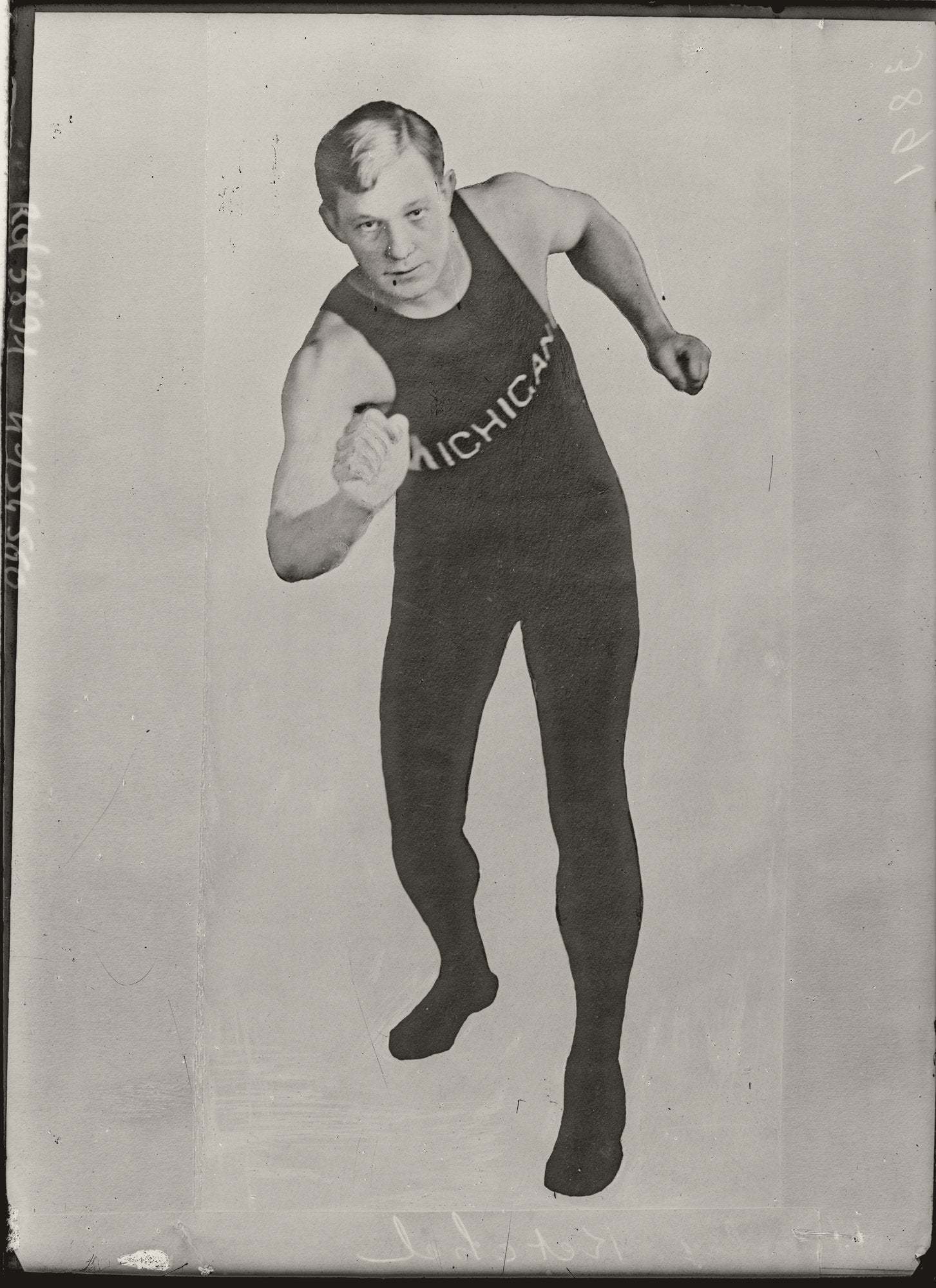
This is the ordinary condition of the fighters of that generation. They survive in fragments, through a handful of photographs and a stack of contradictory newspaper columns, their real records blurred by distance and by the loose habits of the people who wrote them down. Ketchel is better remembered than most of his contemporaries, and even his story arrives full of holes.
What a short flame leaves
What stays is not the tally. It is the shape of the thing. A boy off the freight trains who was champion before he was old enough to vote. A middleweight who knocked down a man he had no business troubling. Then a farmhouse in Missouri, a rifle, and an ending before his twenty-fifth birthday. Lives cut like that do not round themselves off into a lesson. They simply stop, mid-sentence, and leave the reader to guess at the rest.
His body went home by train, back across the country he had crossed as a penniless boy, this time in a coffin and with his name in every sporting paper of the day. In the years since, when people who know the sport reach for the hardest punchers the middleweight ranks have produced, his name still surfaces near the top, carried less by the record, which is patchy, than by the manner of the man. The fury outlived the facts.
There is a print of him, somewhere on a wall, with that number set on it where a person would expect to find a count of titles. Twenty-four. Most who pass it will take it for a misprint, or a birthday, and walk on. A few will stop and ask what it means. That question is the whole reason the number is there.
He lies now in Michigan, in the ground he started from, a long way from the California ropes and from the farmhouse in Missouri where it ended. What the quarrel on that farm was truly about, no two accounts have ever agreed.