
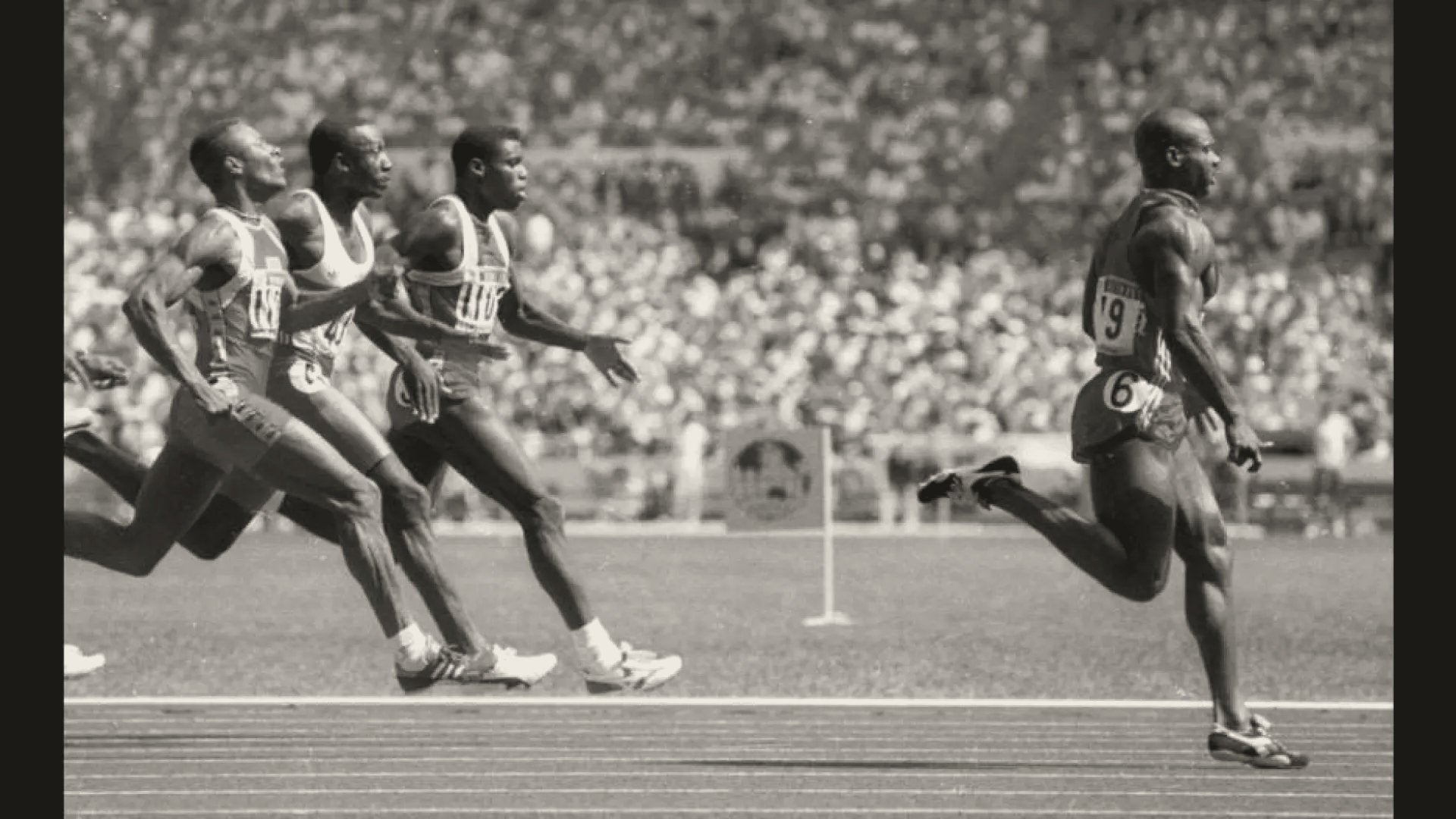
The time on the clock, 24 September 1988. It was a world record and it stood for less than seventy-two hours before being annulled.
The race
Ben Johnson led from the start and raised his right arm before the line while looking towards Carl Lewis in the next lane.
Official times: Johnson 9.79, Lewis 9.92, Linford Christie 9.97, Calvin Smith 9.99.
The test
Johnson's sample contained stanozolol. He was disqualified on 27 September, stripped of the medal and the record, and returned to Canada.
He received a two year ban, returned in 1991, and was banned for life in 1993 after a further positive test.
The others
Over the following two decades, information emerged about most of the field.
Carl Lewis tested positive for pseudoephedrine, ephedrine and phenylpropanolamine at the 1988 US Olympic trials. The United States Olympic Committee accepted inadvertent use and did not sanction him. The documents became public in 2003.
Linford Christie tested positive for pseudoephedrine in Seoul and was cleared by the IOC medical commission by a narrow margin. He tested positive for nandrolone in 1999 and was banned.
Dennis Mitchell was banned in 1998 after a testosterone positive and later admitted receiving performance enhancing drugs in the BALCO investigation.
Desai Williams was named in the Dubin Inquiry as a steroid user.
Raymond Stewart was banned for life in 2010 for trafficking and administering banned substances.
Calvin Smith and Robson da Silva have never been linked to doping.
That is six of eight.
Calvin Smith
Smith finished fourth and was eventually elevated to bronze. He has repeatedly pointed out that he ran clean and received no medal ceremony, and that the athletes who benefited from the system were not all caught.
The Dubin Inquiry
The Canadian government appointed Charles Dubin to lead a commission of inquiry. It sat for ninety-one days, heard a hundred and nineteen witnesses, and documented systematic doping in Canadian athletics.
Its recommendations shaped the anti-doping framework that led eventually to the World Anti-Doping Agency in 1999.
What Johnson says
He has never denied using anabolic steroids. His consistent position is that the practice was widespread and that he was made an example of.
The record of the other seven lanes does not contradict him. It also does not excuse him.
Why it goes on a wall
Because the honest version is not a morality tale with one villain. It is a race where nearly everyone was compromised, one man was caught, and the sport built its entire modern integrity apparatus on that accident.
Six of the eight finalists.