
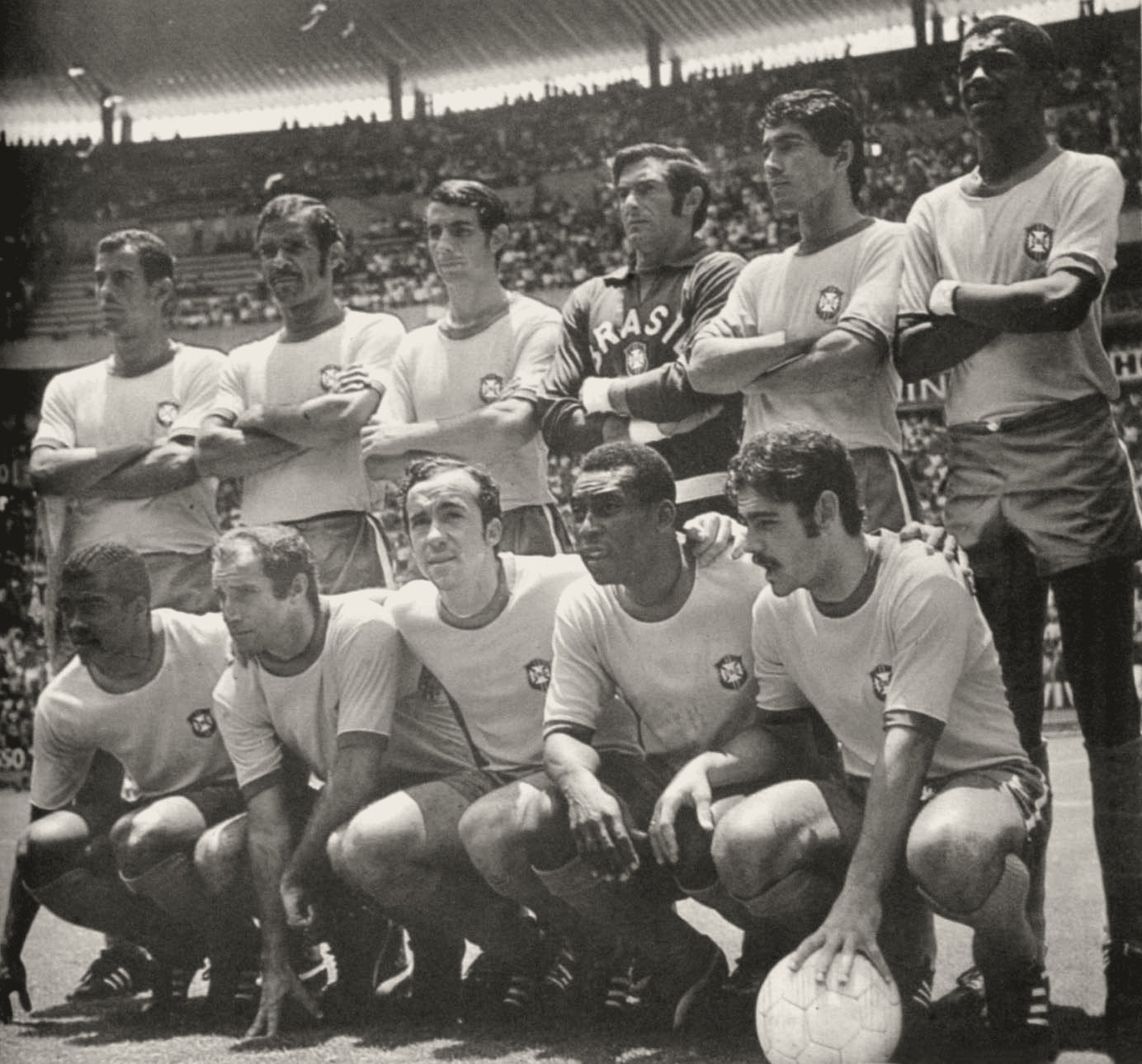
The third World Cup, which under the rules of the era meant the Jules Rimet trophy became Brazil's property permanently.
The record
Six matches played, six won. Nineteen goals scored. No other World Cup winner has a hundred per cent record with that margin of performance.
Jairzinho scored in every one of the six matches, a feat nobody has repeated.
The conditions
Mexico 1970 was played at altitude and, in several cases, at noon, to suit European broadcasters. Contemporary accounts describe players walking through the closing stages.
Brazil's fitness preparation, run by Claudio Coutinho, was unusually scientific for the period and is generally credited with part of the difference.
The selection nobody believed in
The attacking core was Pele, Gerson, Rivelino, Tostao and Jairzinho: five players who wore number ten for their club sides. In an era dominated by defensive organisation, this was widely described in Europe as naive.
Mario Zagallo, who had replaced Joao Saldanha shortly before the tournament, made it work by giving them distinct zones rather than distinct roles.
The fourth goal
In the final against Italy, with the score at 3-1, Brazil scored a goal that involved nine outfield players. Clodoaldo beat four Italians inside his own half. The ball went wide to Rivelino, forward to Jairzinho, inside to Pele, and Pele rolled it laterally into the run of Carlos Alberto, the right back, arriving at speed. He struck it first time.
It is routinely named the greatest team goal ever scored.
The uncomfortable part
Brazil was governed by a military dictatorship. The regime made extensive propaganda use of the team, and the players were aware of it. Some, including Tostao, have spoken about the position it put them in.
A sporting achievement and its political use are separate things, and this print does not pretend otherwise.
The trophy
Brazil took permanent possession of the Jules Rimet trophy and displayed it at the CBF headquarters in Rio de Janeiro.
In December 1983 it was stolen. Several men were convicted. The trophy was never recovered and the accepted conclusion is that it was melted down almost immediately. What is displayed today is a replica.
Why it goes on a wall
Because the team that won football's highest honour outright, and was given the actual object to keep forever, then lost the object entirely.
They kept the trophy.