
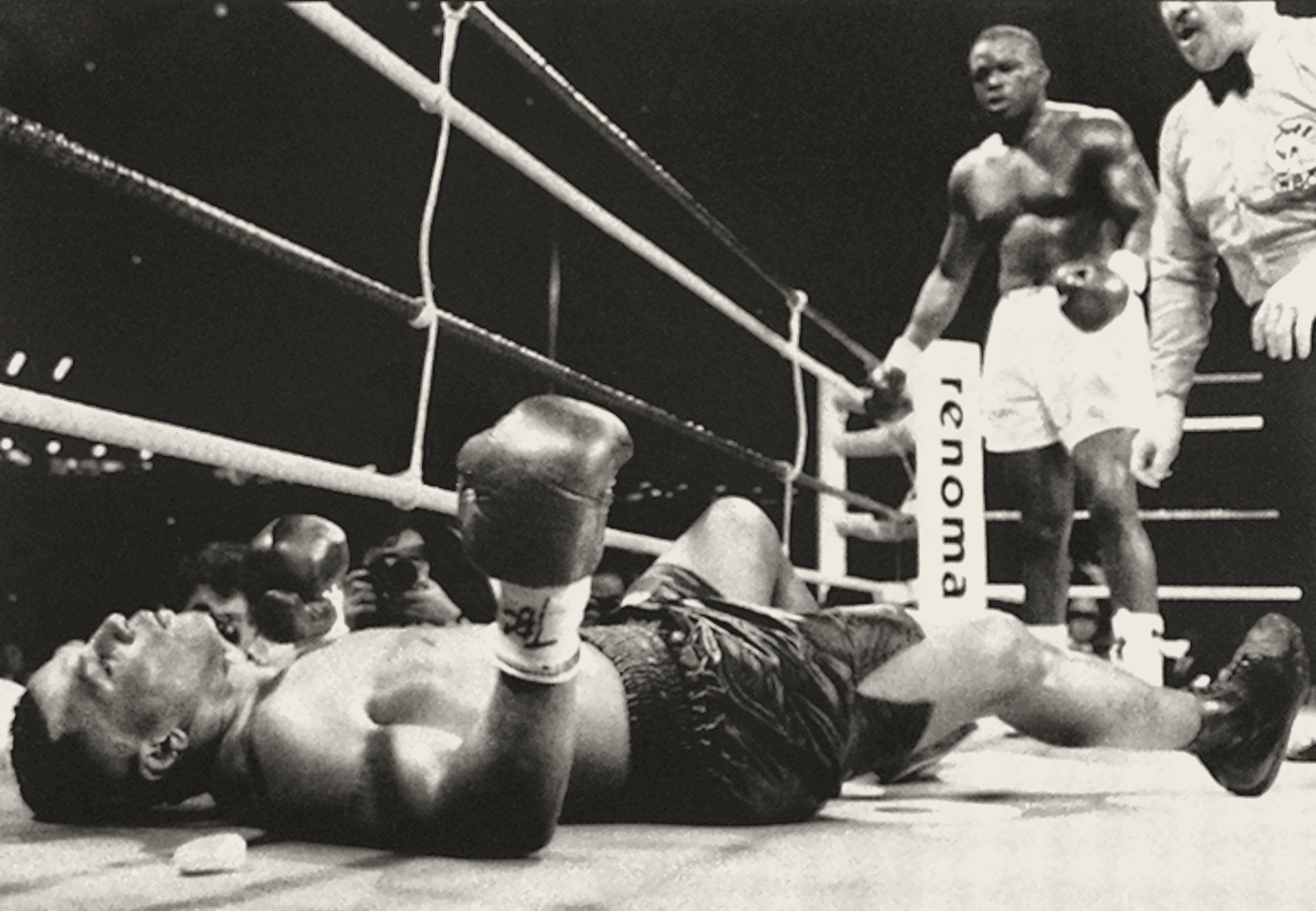
The price on James Buster Douglas at the Mirage, the only casino in Las Vegas that would take bets on the fight. The others did not consider it a contest.
Tyson
Tyson was thirty seven and zero with thirty three knockouts. He had won his first world title at twenty, unified them at twenty one, and knocked out Michael Spinks in ninety one seconds twenty months earlier. The fight in Tokyo was regarded as an exhibition on the way to a meeting with Evander Holyfield, which was already being negotiated.
Douglas
Douglas was twenty nine, with four defeats on his record and a reputation for stopping when a fight got difficult. His mother, Lula Pearl, had died of a stroke twenty three days before the fight, at forty six. He fought anyway.
The fight
He used his reach and his jab and did not let Tyson get inside. For eight rounds he was the better fighter and it was not close.
Late in the eighth Tyson caught him with an uppercut and put him down. Douglas got up at nine. The referee's count had started late, and Don King spent the following days arguing that it had run past ten, which is how the phrase long count attached itself to the fight.
Douglas came out for the ninth and hurt Tyson. In the tenth he landed an uppercut and then four punches in a line, and Tyson went down for the first time in his professional career.
Tyson found his mouthpiece on the canvas and pushed it into his mouth sideways, on his knees, and the count reached ten at one minute twenty three of the round.
After
The result was briefly disputed and then confirmed. Douglas lost the title eight months later to Evander Holyfield, in his first defence, and did not fight again for six years.
Tyson lost to Holyfield twice in the nineties and was never again what he had been in Tokyo.
Why it is the reference point
Boxing has produced bigger names losing and better fights. It has not produced another night where the entire industry declined to price the contest, and the man they would not price won it.