
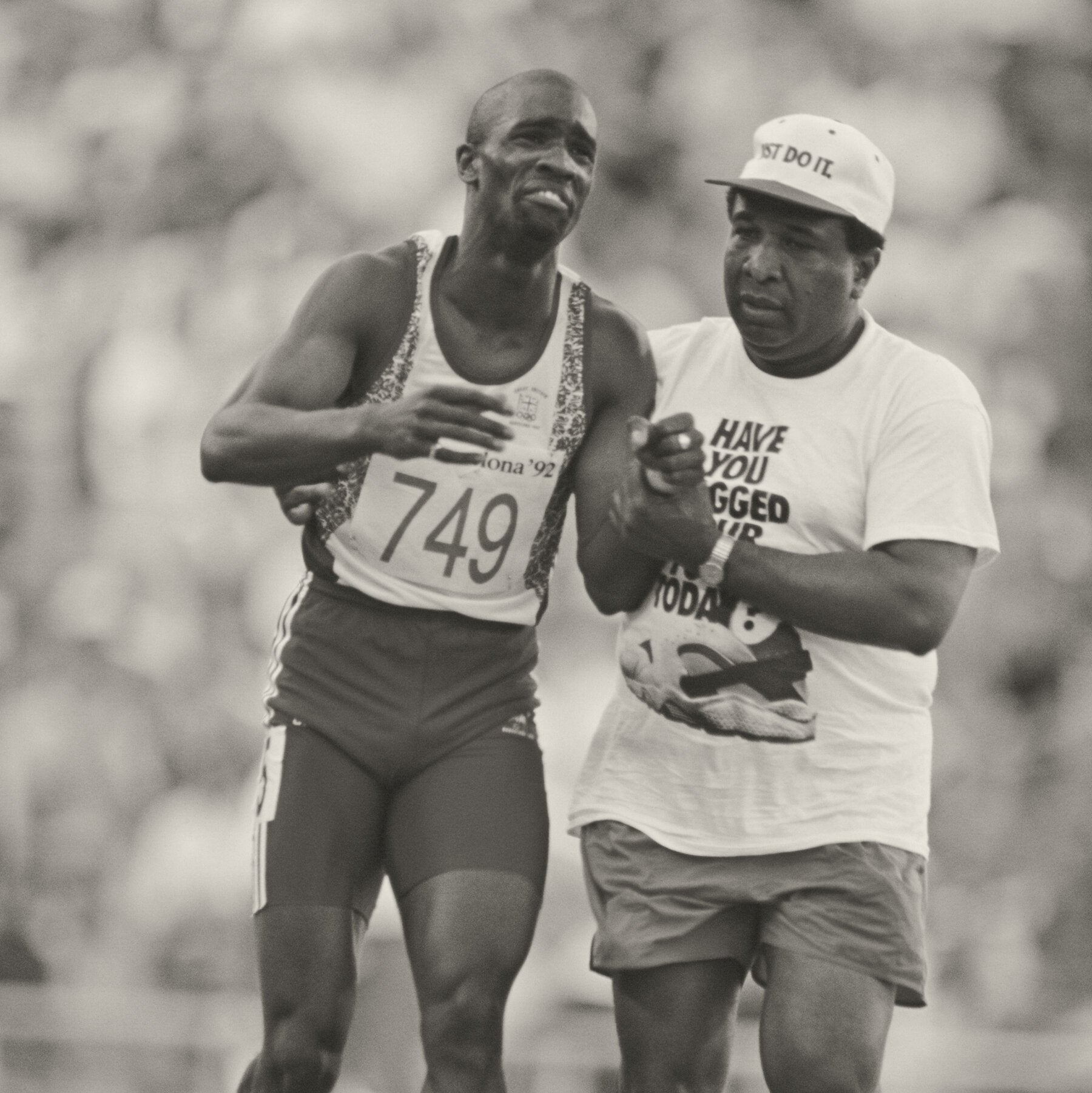
No medal, no time, no placing. The only measurable output of that race was a crowd of about sixty-five thousand people getting to their feet.
Before Barcelona
Redmond was a genuine contender, not a sentimental entry. He held the British 400 metres record and had been part of the team that beat the United States in the 4x400 relay at the 1991 World Championships.
He was also a catalogue of injuries. In Seoul in 1988 he withdrew ninety seconds before his opening heat with an Achilles problem. Between Seoul and Barcelona he had eight operations.
The semi-final
He won his heat and his quarter-final comfortably. In the semi-final, about a hundred and fifty metres in, his right hamstring tore and he fell.
The race continued and finished without him. Medical staff came out with a stretcher, which is the ordinary and sensible end to this story.
He waved them away.
The last two hundred and fifty metres
He got up and began to hop down the track. There was nothing to be gained. The race was over, he could not be placed, and the pain of a torn hamstring bearing weight is not something people volunteer for.
Jim Redmond, his father, was in the stand. He came down, crossed a barrier, got past a security officer who tried to stop him, and reached his son on the final bend.
He put an arm around him and they walked. Officials approached and Jim sent them away. At the finish line he let go so that his son crossed it on his own.
The ruling
Redmond was disqualified. Outside assistance is not permitted, and he had received it in the most visible way possible. The official record shows him as not finishing. His name does not appear in the semi-final results.
This is the correct application of the rule and it makes no difference at all to anyone who saw it.
Afterwards
He never competed in athletics at that level again. He went on to play basketball for England and to race motorcycles.
The footage has been used, repeatedly, in advertising, which is its own small indignity. The moment itself was not staged and had no audience in mind.
Why it goes on a wall
Because almost everything in sport is arranged around results, and this is the clearest example of a stadium collectively deciding that the result was not the point.
No time, no placing, no name in the record, and sixty-five thousand people on their feet.