
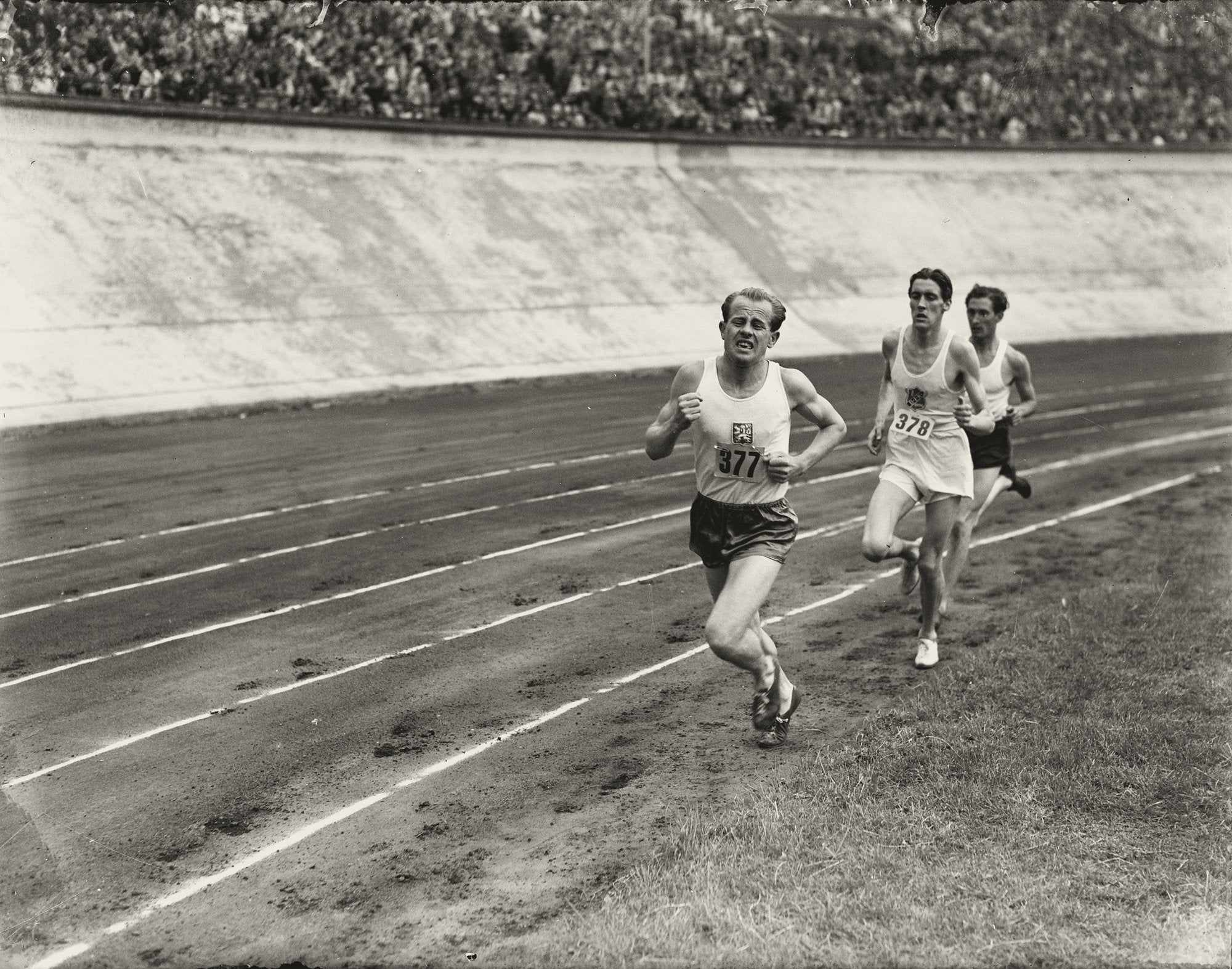
The number is one. One Olympic gold medal, given away by the man who won it to a man who never could.
The runner with no gold
Ron Clarke of Australia set nineteen world records between 1963 and 1970. By any measure of speed he was the finest distance runner on earth for most of a decade.
He never won an Olympic title. He took a bronze in Tokyo in 1964. In Mexico City in 1968 the altitude very nearly ended him: he collapsed at the end of the 10,000 metres and lost consciousness. The Games, the only currency the wider public understands, kept refusing him.
The runner with too many
Emil Zatopek won the 5,000 metres, the 10,000 metres and the marathon at the 1952 Helsinki Olympics, inside eight days. He had never run a marathon before. He entered it more or less to see what would happen, and won it.
His running style was famously terrible to look at, head rolling, face contorted, and it made no difference at all to the results.
Prague, 1966
Zatopek invited Clarke to Czechoslovakia and spent several days showing him around. At the airport, at the gate, he pushed a small wrapped package into Clarke's bag and told him to open it later.
Clarke opened it in the air. It was the Helsinki 10,000 metres gold.
There is no photograph of this. No press was present. It was done at a departure gate, quietly, by a man handing over the most valuable object he owned.
What it cost him
Zatopek was not a man with a comfortable future to fall back on. Two years later he publicly supported the Prague Spring and signed the Two Thousand Words manifesto. When the tanks came, he was expelled from the army and from the party, stripped of his position, and sent to work in a uranium mine and later on a geological drilling team.
The medals were, in the most practical sense, what he had left. He had already given one of them away.
Why it goes on a wall
Because the sport is built on the idea that these objects are the point. Everything is arranged to produce them, and careers are measured by whether you got one.
And then a man who had three decided that the arrangement had made a mistake, and quietly corrected it in an airport, with no witnesses.
One medal, out of a drawer, into someone else's bag.