
The East German women's handball team won the world championship three times: 1971, 1975 and 1978. In the 1978 final they finished ahead of the Soviet Union and Hungary.
They never won an Olympic gold medal. Women's handball entered the Olympic programme at Montreal in 1976, which should have been ideal timing, and East Germany finished second behind the Soviet Union. Four years later, in Moscow, they finished third.
That is an unusual shape for a career. Most great teams have it the other way round: an Olympic title that everybody remembers and a scattering of world championships that only the sport recalls. This one won the specialist competition repeatedly and lost the public one twice.
A country of seventeen million
To understand the team you have to understand what it was for.
The German Democratic Republic had a population of roughly seventeen million and a legitimacy problem. It was the smaller, poorer half of a divided nation, it had built a wall to stop its citizens leaving, and it needed evidence that its system produced something the other side did not.
It chose sport, and it chose it as an instrument of foreign policy rather than as recreation. The state funded a nationwide apparatus: physical screening in schools, specialist sports schools for children identified as promising, a network of sports clubs attached to industries and institutions, full-time coaching, sports medicine, and research institutes working on training methodology. Athletes were employed. They were not amateurs in any sense except the one the International Olympic Committee needed to hear.
The results, judged narrowly, were spectacular. At several Olympics the GDR finished second in the medal table, ahead of every country in western Europe and behind only the Soviet Union, with a population smaller than that of the Netherlands. Per head of population there has never been anything like it.
The part with the files
The other half of the apparatus is not in dispute, because after 1990 the archives were opened.
From 1974 there was a centrally directed doping programme, referred to in the documentation by an administrative designation, run with the knowledge and involvement of the state security ministry. Anabolic steroids, principally an oral compound produced domestically, were administered to athletes across a range of sports. A large number of the recipients were teenagers. Many were told the tablets were vitamins.
The consequences for the people involved have been extensively litigated and extensively reported: liver damage, cardiac problems, infertility, virilisation, cancers, and a long tail of psychological harm. In 2000 the head of the sports federation and the programme's chief physician were convicted in Berlin of complicity in causing bodily harm to minors.
Where handball sits in this is genuinely less clear than where swimming and track and field sit. The programme was concentrated on sports where a marginal physiological gain converts directly into a measurable result, and a team ball game is not the obvious candidate. It was also, on the documentary record, extremely broad. The honest position is that the team came out of a system that was doping its athletes as policy, that specific evidence about this squad is thinner than for others, and that nobody should write a triumphant sentence about East German sport in that decade without saying so.
What they actually played like
Underneath all of that there was a handball team, and it was very good.
East German handball ran on the club structure at Leipzig, Rostock and Berlin, with players concentrated into a small number of sports clubs and effectively training as a national squad year round, in the same way the Soviet hockey team did. The game they played was fast, heavily drilled, and physically imposing, and it arrived at tournaments having rehearsed together for months while opponents assembled a fortnight beforehand.
Between 1971 and 1978 they were the standing measure of the sport. When they lost the two Olympic tournaments it was to a Soviet team built the same way, out of a larger population.
Why handball, and why women
There is a question worth asking that usually is not: why was a small state in central Europe the best in the world at this particular thing.
Part of the answer is that handball is a central European sport with deep roots in Germany, played in schools and factory clubs for decades before the country was divided. The GDR inherited a tradition rather than inventing one.
The larger part of the answer is arithmetic. A state with limited resources cannot be good at everything, so it chooses. The GDR's sports administration made deliberate decisions about where to concentrate, and the criteria were unsentimental: how many medals are available in this discipline, how much does a medal cost to produce, and how contested is the field. Sports with many medal events and shallow international competition were worth funding. Sports the whole world played were not.
Women's events were, in that calculation, extremely good value. Through the 1960s and 1970s most western countries invested a fraction of what they spent on men's sport into women's sport, and in several disciplines the international standard was correspondingly soft. A state that funded women's programmes properly could take a title that a much richer country was not seriously contesting.
That is a cynical reading and it is also, on the documentary record, close to what the planners wrote down. It does not diminish the players. It does explain why a country of seventeen million turns up in the record books of women's handball, women's swimming, women's rowing and women's athletics far more often than in the men's equivalents.
1990
The country was absorbed into the Federal Republic in October 1990. The team was dissolved. Its players became citizens of a state that already had a women's handball team and a federation to run it, and the two structures were merged on the western model.
What that meant in practice was the end of full-time state employment for athletes. The sports schools were closed or converted. The clubs lost their industrial sponsors, because the industries were being wound up. A generation of coaches went into other work, and some went abroad.
Unified Germany's women's handball team has never won a world championship. It has never won an Olympic medal. The three titles in the record book belong to a country that stopped existing, and there is no federation with an interest in commemorating them, because the federation that exists now is the western one and those are not its titles.
The image problem
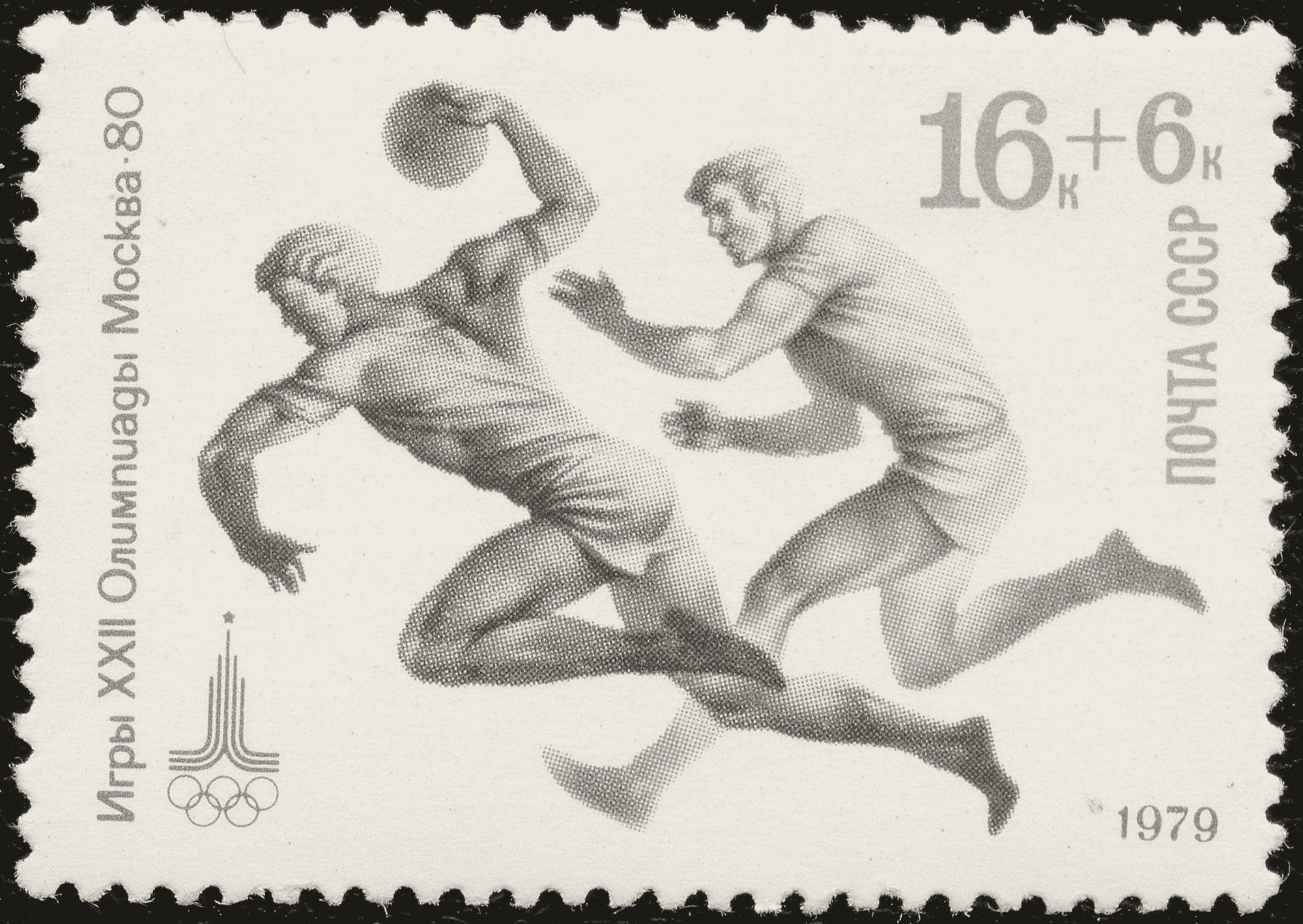
There is one photograph in this piece and it is of a postage stamp.
That is not an editorial choice. There is no freely licensed photograph in existence, as far as can be established, of the East German women's handball team. Not of a match, not of a squad, not of a player. The stamp is Soviet, printed in 1979 for the Moscow Olympics, and shows a generic handball scene.
This is what the erasure of a small state's sporting record looks like in practice. The photographs were taken, by East German agencies, and they are in archives that were absorbed or dispersed, under rights that nobody has cleared, of a team that no successor organisation is promoting. Three world championships and the visual record available to the public is a stamp issued by another country.
That is worth more than the medals, as an illustration of what this whole catalogue is about. A team can win the world three times and leave less trace than a club side from a market town, if the state that owned it goes out of business and takes the filing cabinets with it.