
On the twenty-eighth of May 1983, in qualifying for the Nürburgring 1000 kilometres, Stefan Bellof took a Porsche 956 round the Nordschleife in six minutes and 11.13 seconds.
The Nordschleife is a little over twenty kilometres long and has somewhere around seventy-three corners, depending on who is counting. It runs through forest, over blind crests, across a valley and back. In 1983 it had barriers where it had barriers and trees where it did not.
That lap stood as the outright record for thirty-five years. Formula One cars did not beat it, because Formula One stopped going there in 1976. Nothing else got close. It was finally broken in June 2018 by a Porsche 919 Hybrid Evo, a car released from the regulations that had constrained it, on a closed circuit, with the specific and only objective of taking the record.
Bellof set his on a Saturday, and then raced for a thousand kilometres.
A rule about fuel
Group C was introduced by the sport's governing body for the 1982 season and it was built on one unusual idea.
Almost every set of racing regulations ever written controls the engine. Capacity limits, cylinder counts, turbo boost, rev ceilings. Group C did none of that. The engine was free: any size, any configuration, turbocharged or not.
What was controlled was fuel. The car carried a hundred-litre tank, was allowed a fixed number of refuelling stops, and had a total fuel allocation for the race. Run out and you did not finish.
The effect was to make efficiency the whole discipline. A team could have as much power as it liked, provided it could reach the end on the allowance, which meant engineers spent the decade working on combustion, on aerodynamic drag, and on giving drivers real-time information about consumption. Drivers had to race and manage a budget at the same time, on the same lap, at close to four hundred kilometres an hour.
It is the most interesting rule set anyone has written for motor racing and nobody has gone back to it.
The 956
Porsche built the 956 for the first year of the formula and it is the reason the era is remembered as one-sided.
It was the firm's first monocoque chassis and its first ground-effect car, with the underbody shaped to generate downforce so that less wing was needed and less drag was produced, which mattered enormously under a fuel rule. The engine was a two-and-a-bit-litre flat six with two turbochargers, derived from an existing racing unit, producing something over six hundred horsepower on a diet.
It won Le Mans in 1982, on its first attempt, finishing one two three.
In 1983 it did something more extreme. Porsche 956s, works and customer cars together, took the first eight places in the twenty-four hour race. The category was designed to allow privateer teams to buy a competitive car and Porsche had built exactly that, so the grid filled up with them and the results reflected it.
The 956 became the 962 in 1984, with the pedals moved behind the front axle for safety after concerns about the driver's feet in a frontal impact. Between them they won Le Mans in 1982, 1983, 1984, 1985, 1986 and 1987.
Everybody else
It was not only Porsche, and the second half of the decade is better than the first.
Jaguar came back to sports car racing with the XJR series, run by Tom Walkinshaw, and won Le Mans in 1988, the first British win in the race for years and the first Jaguar win since the 1950s. Mercedes returned, initially behind the Sauber name because the company was still cautious after its history at Le Mans, and won in 1989 with the C9, a silver car that ran the Mulsanne straight at close to four hundred kilometres an hour.
In 1991 the race was won by a Mazda 787B with a four-rotor Wankel engine, the only rotary-engined car ever to win Le Mans and the only Japanese winner for a very long time afterwards. It made a noise that people who were there describe as physically unpleasant and remember with enormous affection.
The Mulsanne straight in this period was six kilometres without a corner. Two chicanes were installed in 1990 because the speeds had reached a point where a tyre failure was not survivable.
Twenty-four hours
It is worth remembering what the drivers were actually being asked to do, because the fuel rule sits on top of an already unreasonable job.
Le Mans runs for a day and a night without stopping. Three drivers share a car, in stints of roughly two hours, sleeping badly in a caravan between them. The circuit is partly permanent track and partly public road, and at night the public road sections have no lighting beyond the cars' own. In the Group C period the closing speed between the fastest prototypes and the slowest production-based cars in the smaller classes was well over a hundred kilometres an hour, in the dark, on a road lined with trees.
To that, add the fuel calculation. A driver in a 956 had a readout telling him how much of his allocation remained against how far he had to go, and he was expected to adjust his driving continuously to stay inside it while racing whoever was next to him. Lift earlier here, short-shift there, take a slower line that costs two tenths and saves half a litre.
There is no other period in motor racing where the mental task and the physical task were both at that level at once. Modern endurance cars do something comparable with energy management, but they do it with software making most of the decisions.
Bellof
Stefan Bellof was German, twenty-five when he set the Nordschleife lap, and by common consent one of the great natural talents of the period. He raced in Formula One at the same time, for Tyrrell, in an uncompetitive car, and did things in it that people still cite.
On the first of September 1985, in the Spa 1000 kilometres, he tried to pass Jacky Ickx's works Porsche 962 at Eau Rouge, which is a corner where there is no room to be alongside anyone. The cars touched and Bellof's went into the barrier almost head on. He was twenty-seven.
Ickx, who was one of the most successful sports car drivers who ever lived and who was not at fault, effectively stopped racing sports cars afterwards.
The end, by regulation
Group C was killed by its own governing body.
For 1991 the rules were changed to require three-and-a-half-litre naturally aspirated engines, the same specification as Formula One. The stated reasoning was that this would attract manufacturers who were already building such engines. The actual effect was that a Group C engine now cost what a Formula One engine cost, which put it out of reach of every privateer team in the category.
The privateers were the grid. Without them there was no grid. Entries collapsed, the championship limped through 1992 and was abandoned. Le Mans carried on with a diminished field and it took most of the decade for top-level sports car racing to recover.
There is a version of this story in which the change was a straightforward mistake and a version in which it was an attempt to protect Formula One's position. The outcome is the same either way. A category that had produced full grids, close racing, and the fastest sports cars ever built was legislated out of existence in about eighteen months.
After
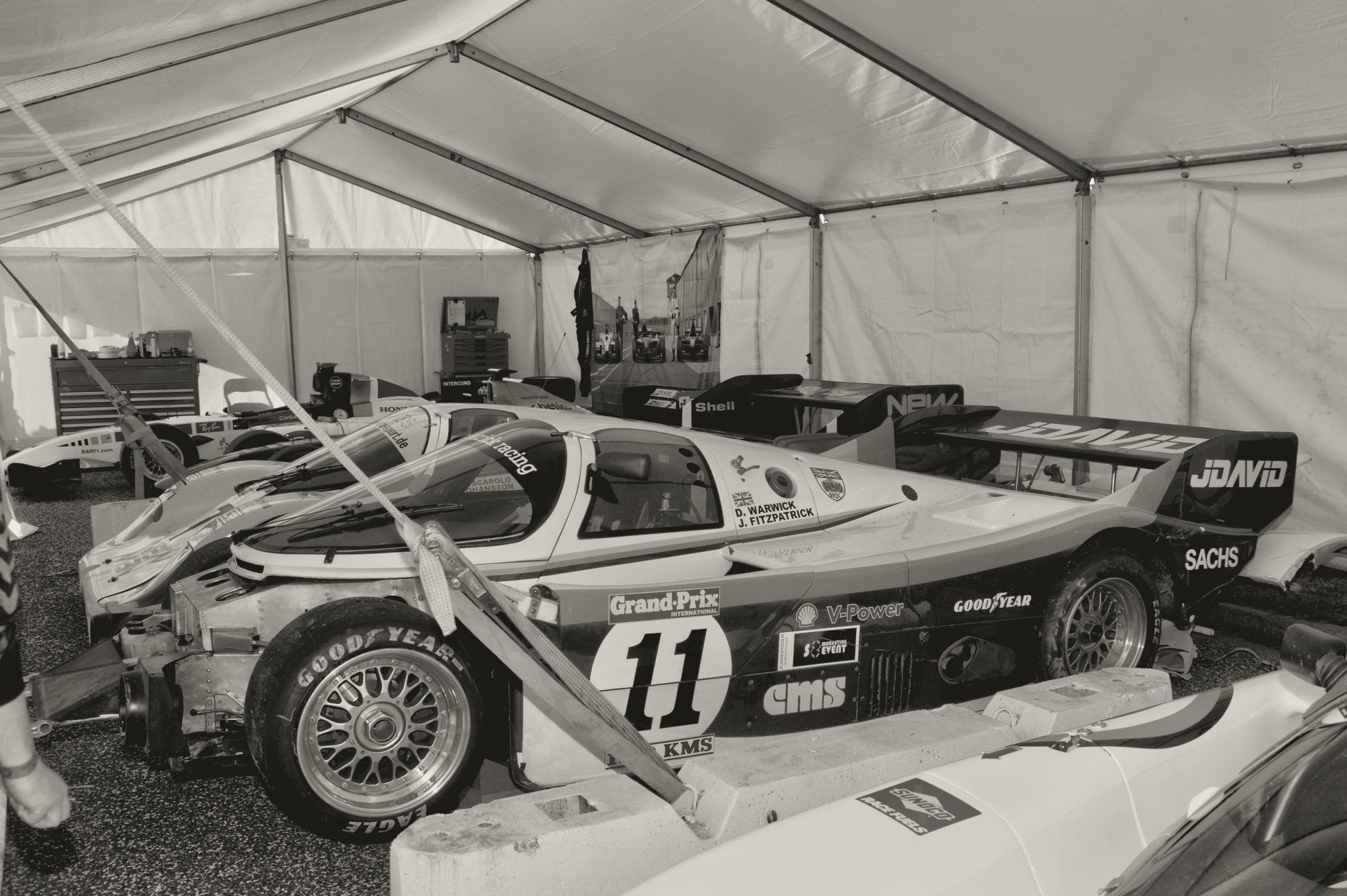
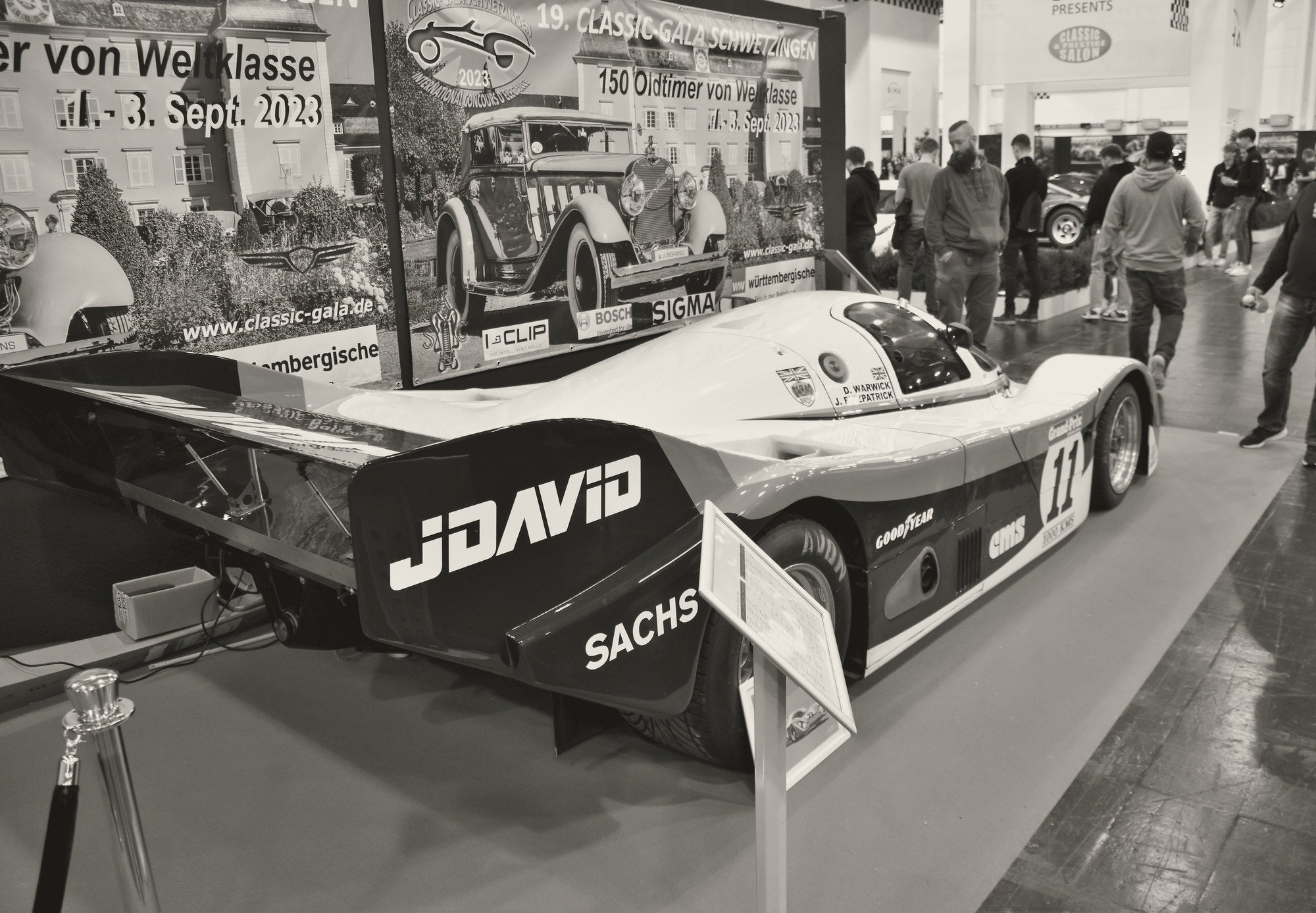
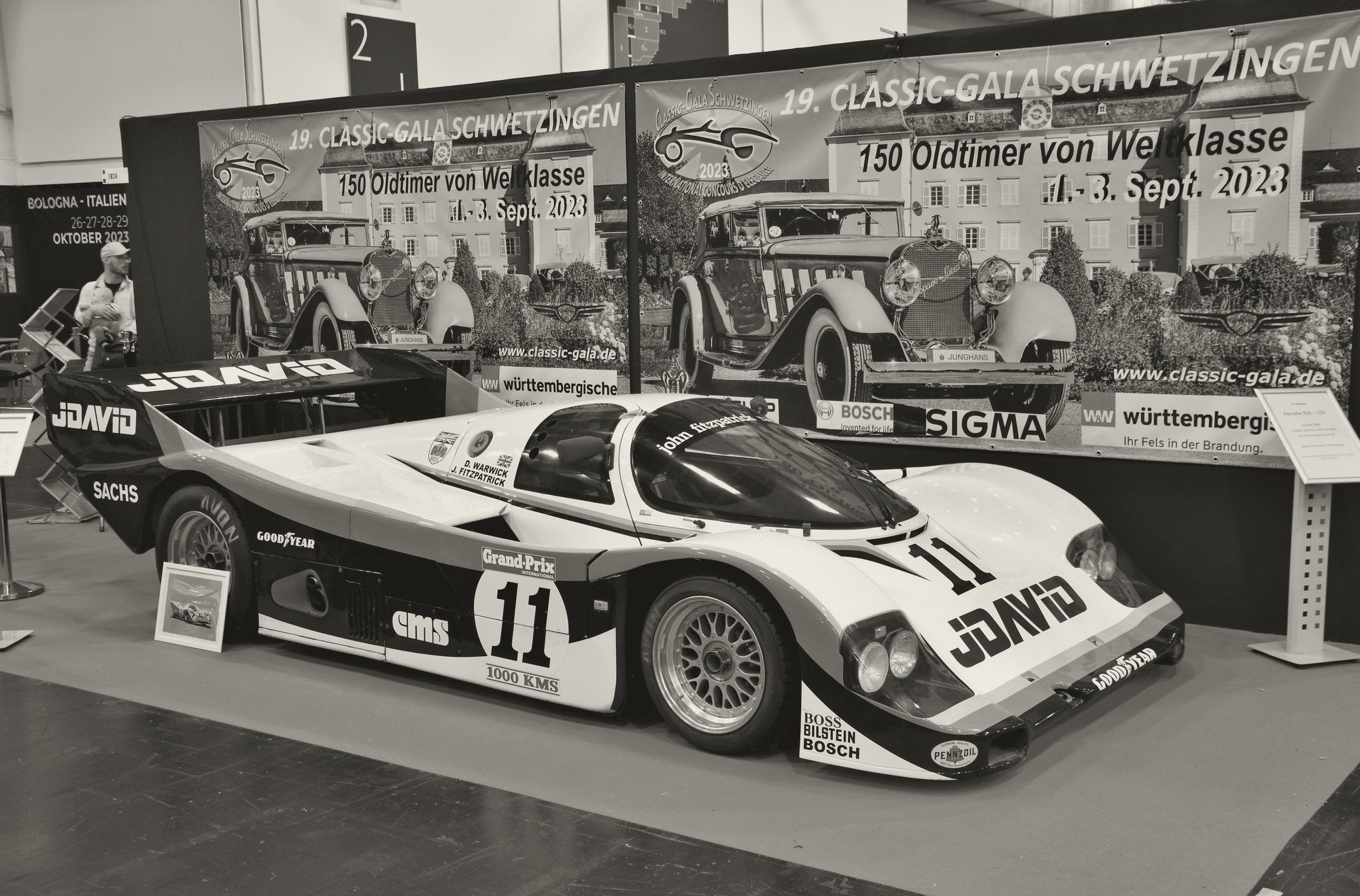
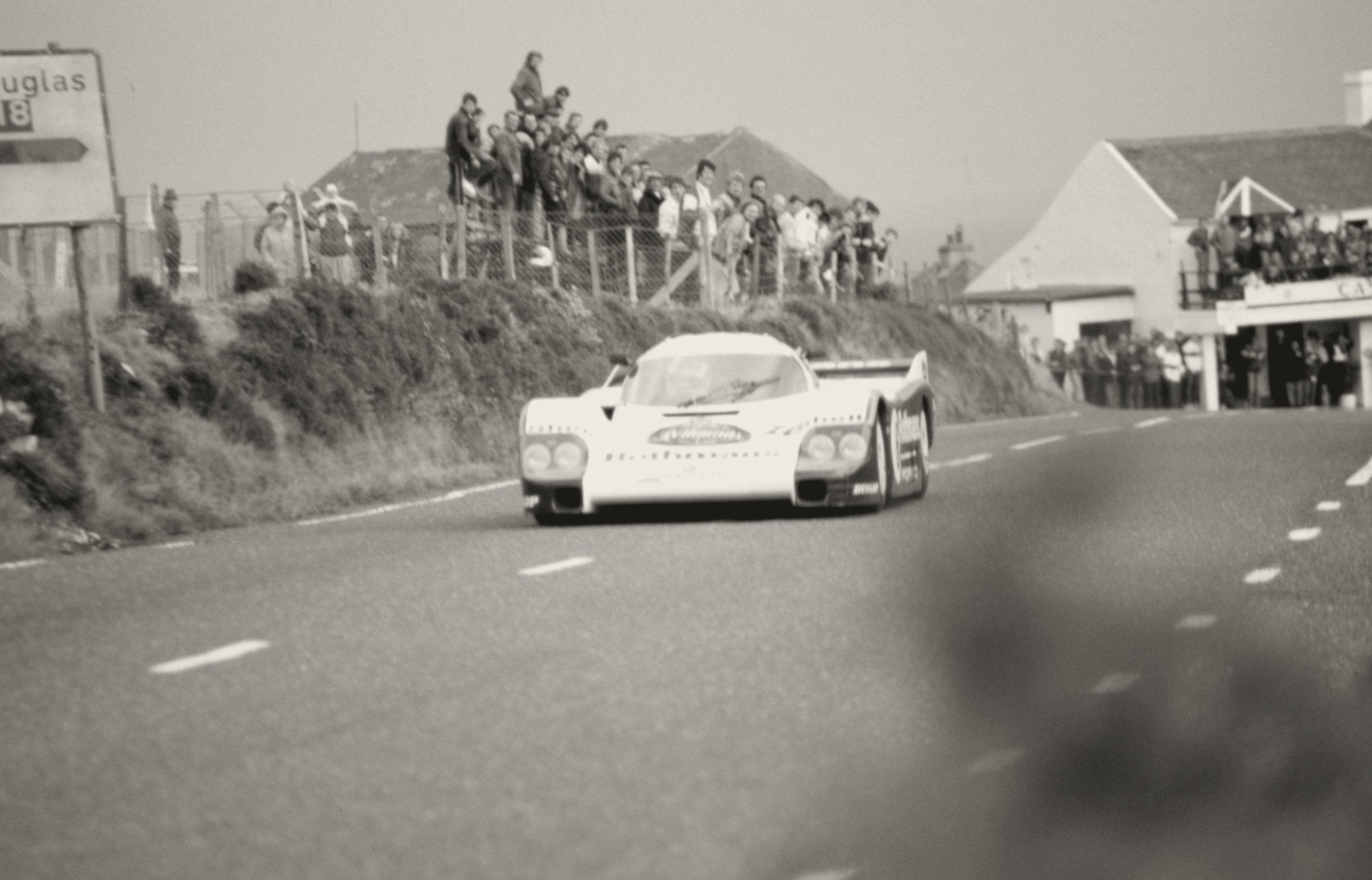
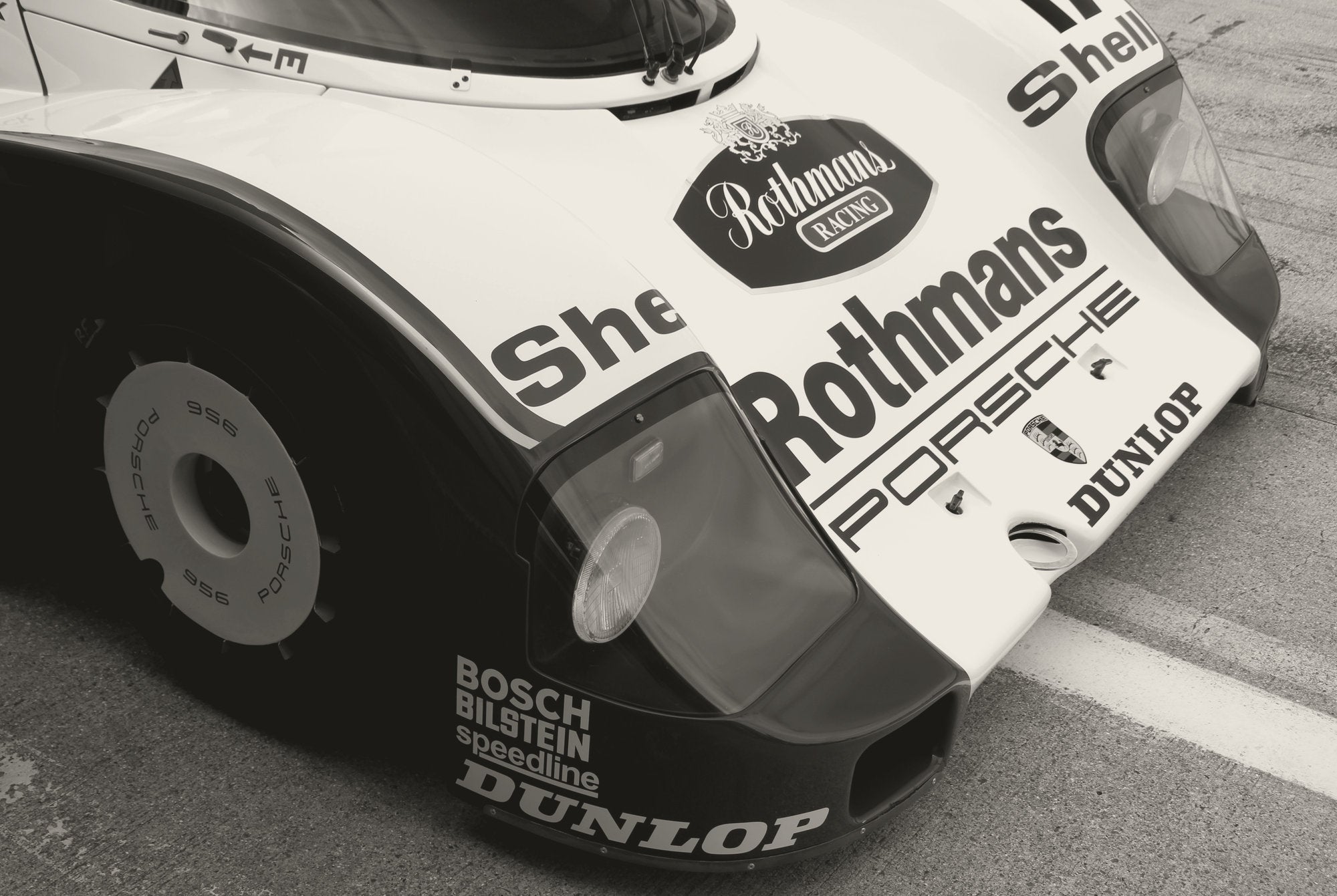
The cars did not go anywhere. Porsche 962s in particular were built in quantity, sold to customers, and have survived, so they turn up at historic meetings and in museums and in private collections. Two of the photographs here are of chassis 102, a 1983 car, photographed recently. One is from the Isle of Man in 1984, when these things were still current. One is a detail of a 962 from 1987.
The Nordschleife record stood until 2018 and the circumstances of its breaking are worth restating: a purpose-built machine, freed from its own category's rules, on a closed road, attempting nothing else. Bellof did it in a car he then took racing for six hours.
The fuel formula has never been used again. Modern endurance racing regulates energy in a related way but under a system of hybrid classes and balance-of-performance adjustments that keeps the field close by intervention rather than by engineering. What Group C did was simpler and more brutal: here is your fuel, here is the finish line, work it out.