
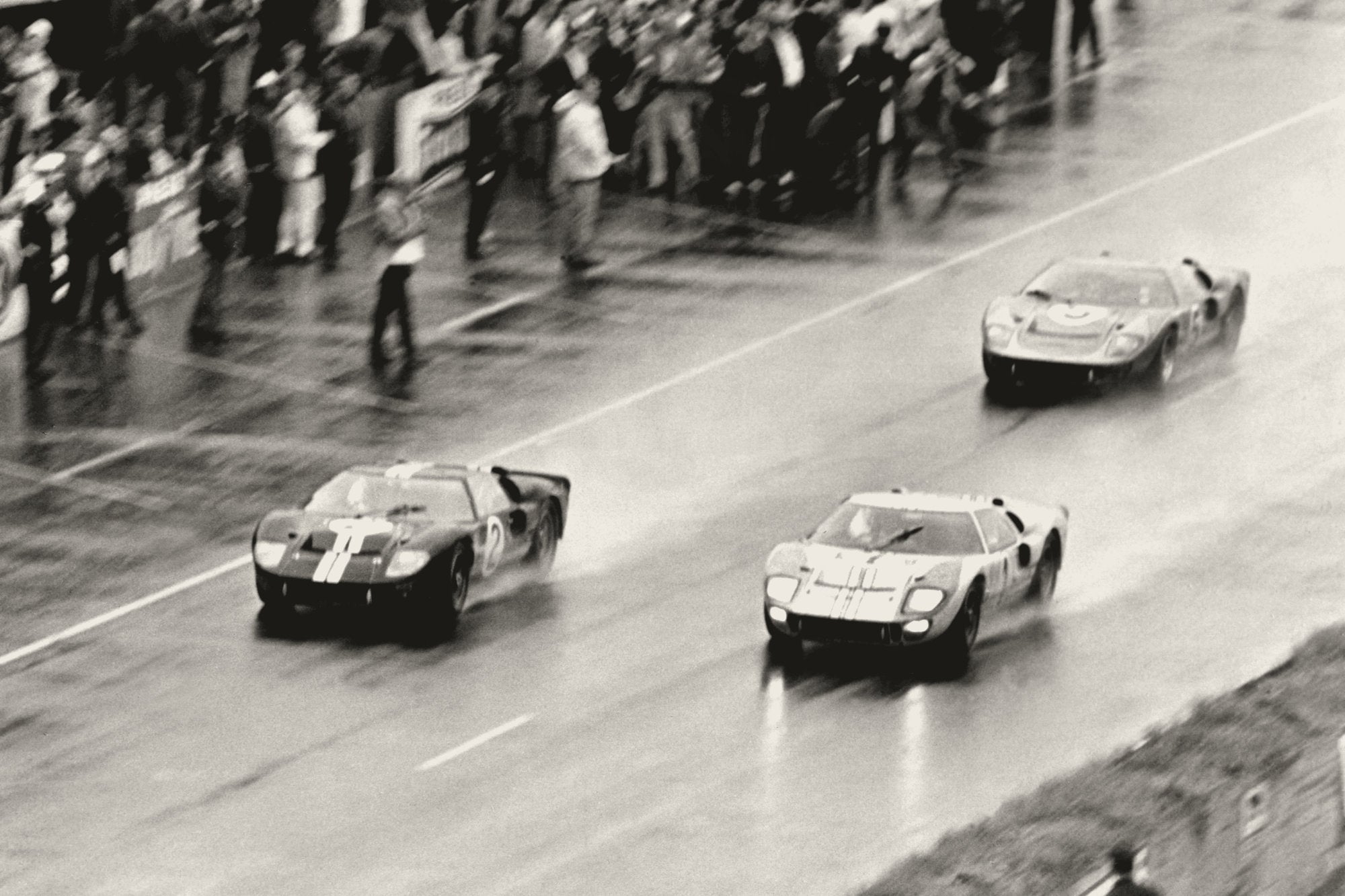
The finishing order Ford wanted on film. It is what the 1966 Le Mans is remembered for, and it is also the reason a man lost a race he had won.
Why Ford was there
In 1963 Ford negotiated to buy Ferrari and Enzo Ferrari ended the talks late in the process. Henry Ford II responded by funding a programme to beat Ferrari at Le Mans, which Ferrari had won six years running.
Ford failed in 1964 and 1965. The GT40 Mk II arrived for 1966.
The race
Held on 18 and 19 June 1966. The Ferrari challenge broke down mechanically during the night.
With an hour remaining Ford held the top three positions with no competitor on the same lap.
The order
Leo Beebe, the Ford executive running the effort, instructed the team to arrange a dead heat so the three cars would cross the line together for the photograph.
Ken Miles and Denny Hulme were leading. Miles had already won the Daytona 24 Hours and the Sebring 12 Hours that season. A Le Mans win would have completed a sweep no driver had achieved.
Miles objected and then complied, slowing to allow Bruce McLaren and Chris Amon to draw level.
The regulation
The Automobile Club de l'Ouest ruled that, because the McLaren and Amon car had started further back on the grid, it had covered a greater distance in the same time and was therefore the winner.
Accounts of the gap vary from around eight to twenty metres. The principle is not disputed.
Miles was classified second.
Afterwards
On 17 August 1966 Ken Miles was killed while testing the Ford J-car at Riverside International Raceway. He was forty-seven.
Ford went on to win Le Mans in 1967, 1968 and 1969.
What is disputed and what is not
Whether anyone at Ford knew the rule in advance is genuinely unclear, and versions differ between participants.
What is not disputed: the leading car was ordered to give up its advantage for promotional reasons, and the driver of that car did not win.
Why it goes on a wall
Because it is the most expensive victory in motorsport history arranged to look good in a photograph, and the photograph worked. Almost everyone remembers the three cars. Almost nobody remembers who was told to slow down.
The finish was staged.