
Consecutive games played, from 1 June 1925 to 30 April 1939. Fourteen seasons. The record stood until Cal Ripken Jr passed it in 1995, fifty-six years later.
What the streak cost
The number alone understates it. Later examination of his hands showed multiple fractures, at least seventeen by most accounts, that had healed without him sitting out.
He was hit in the head by a pitch and knocked unconscious, and played the following day. In 1934, with back spasms so severe he could not stand straight, he was listed at shortstop, batted leadoff, singled, and was immediately replaced by a pinch runner. The appearance counted. The streak held.
1938 and 1939
His 1938 numbers dipped without explanation. By spring training in 1939 the decline was visible to everyone. He struggled with ordinary movements. He fell while dressing. Teammates began congratulating him for routine plays.
On 2 May 1939 in Detroit he asked to be taken out of the lineup, telling manager Joe McCarthy he was hurting the team. He never played another major league game.
The diagnosis
In June he went to the Mayo Clinic. The finding was amyotrophic lateral sclerosis: progressive motor neurone degeneration, no treatment, no recovery. He was told he had roughly two years.
He was thirty-six years old.
4 July 1939
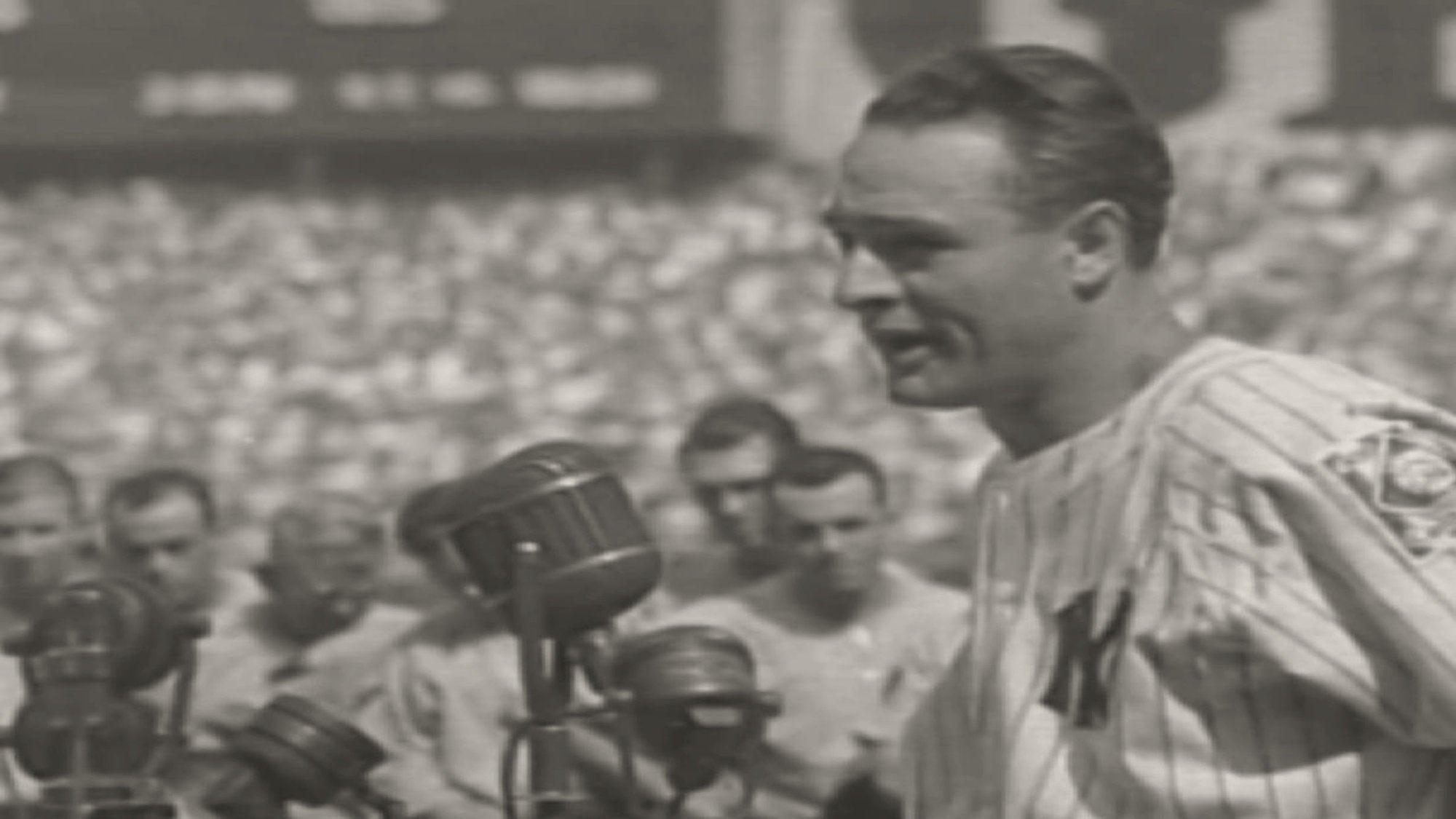
Between games of a doubleheader against Washington, the Yankees held Lou Gehrig Appreciation Day. The attendance was 61,808. Members of the 1927 team returned for it.
He had not planned to speak and had to be persuaded to the microphone. The address that followed lasted under two minutes.
He began by noting he had spent two weeks reading about a bad break, and then said he considered himself the luckiest man on the face of the earth. What followed was a list: the fans, the owners, the ground crew, the opposing teams, his teammates, his mother-in-law, his parents, his wife.
Babe Ruth, estranged from him for years, came over and embraced him in front of the crowd.
Afterwards
The Yankees retired his number 4, the first number retired in major league baseball. The Hall of Fame waived its waiting period and elected him that December.
He died on 2 June 1941, aged thirty-seven. In the United States the disease has been known as Lou Gehrig's disease ever since.
Why it goes on a wall
Because the speech is usually quoted as courage, and it is not quite that. It is an inventory. A man given two years to live stood up and counted what he had, out loud, item by item, in front of sixty thousand people.
The luckiest man on the face of the earth.