
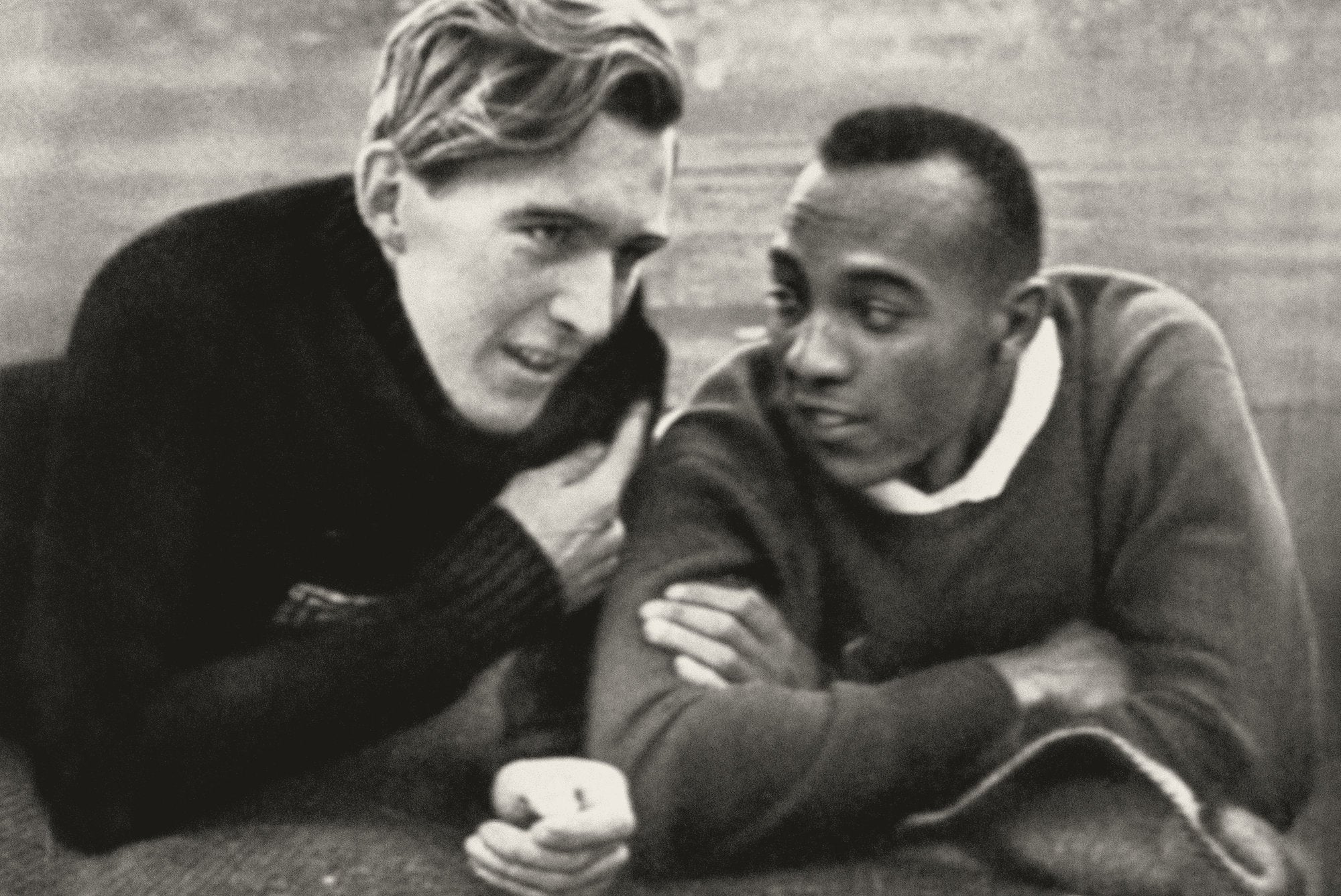
The number that matters here is two. Two fouls in long jump qualifying at the 1936 Olympic Games, which left Jesse Owens with one attempt between himself and elimination.
He was the favourite. He had already won the hundred metres. And he was two bad steps from going out of the competition in the qualifying round.
The stadium
Berlin, August 1936. The Games had been handed to Germany before the regime took power and were then rebuilt into a demonstration. The new Olympic Stadium held a hundred thousand people. The event was designed to be watched and filmed and remembered in a particular way, and the presence of an African American athlete winning repeatedly was not part of the design.
This is the setting. It is why the next part is not a small thing.
The rival
Luz Long held the German record in the long jump. He was tall, blond, and photogenic in exactly the way the propaganda wanted, and he was the home favourite in the event. He was also the athlete with the most to lose if Owens qualified and the most to gain if Owens did not.
He walked over and gave him the fix.
The suggestion was technical and unglamorous. Move the take off back. Jump from behind the board. Do not chase distance in a round that only asks you to reach a qualifying mark. It is the advice a coach gives, offered by the one person in the stadium who had no reason to give it.
What happened next
Owens qualified. In the final he won the gold with 8.06 metres, an Olympic record that would last until 1960. Long finished second.
And then Long reached him first. The two of them walked off the infield together, in front of the officials, in front of the cameras, in front of the crowd. There is no version of that image that serves the regime that built the stadium.
Afterwards
The two men never met again. Long was conscripted, served in the German army, and was killed in Sicily in July 1943 at the age of thirty. Owens kept up a correspondence with Long's family for the rest of his life, and spoke about him for decades.
Owens put it plainly: all the medals and cups he had won, melted down, would not plate the friendship he felt in that moment.
Why it goes on a wall
Because it is the rarest thing in sport, which is a competitor choosing against his own interest, in public, at the exact moment it costs him most, in a place designed to make that choice impossible.
Two fouls, and the advice came from the man who wanted him gone.