
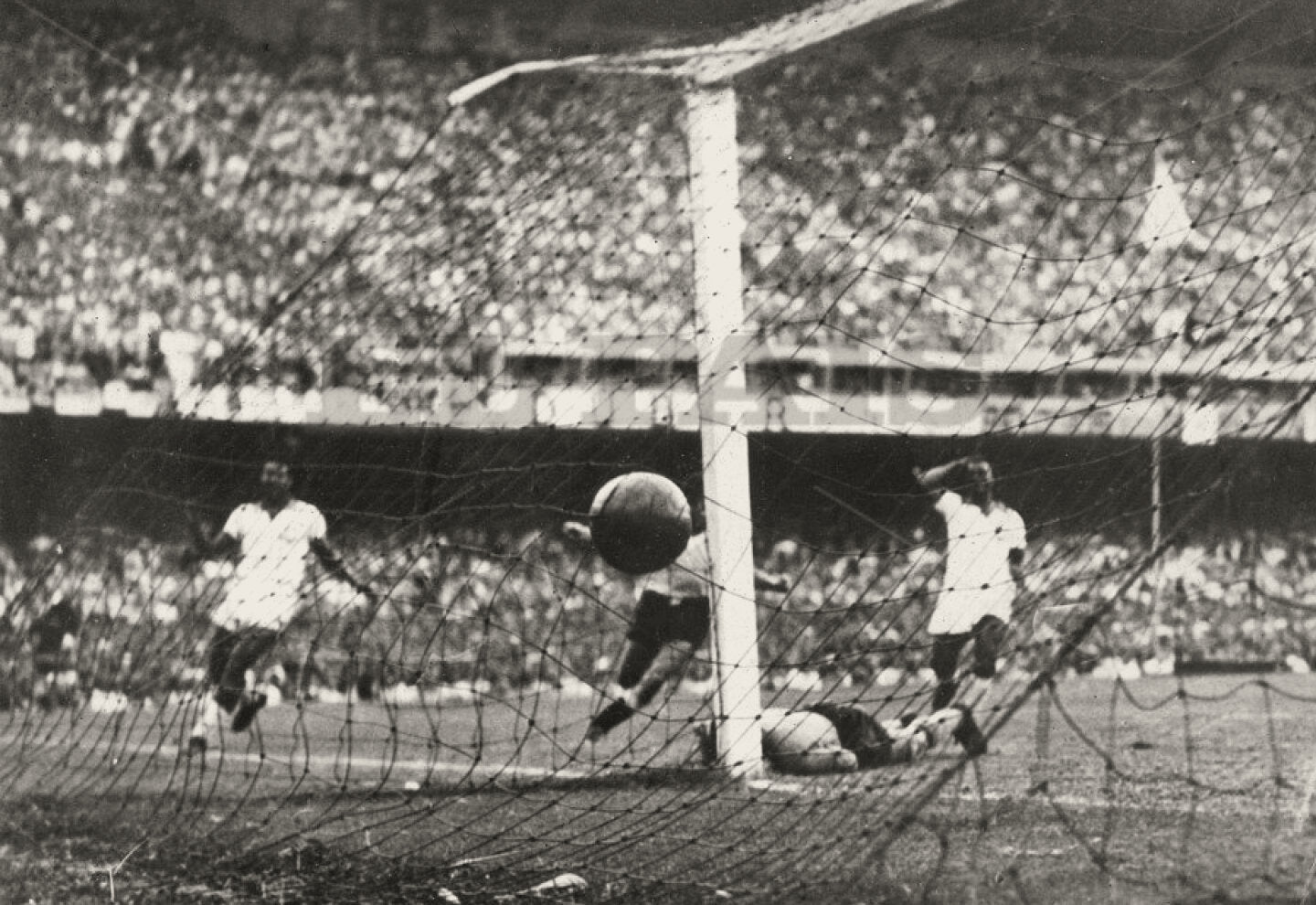
Uruguay 2, Brazil 1, 16 July 1950. Brazil needed only a draw.
No final
The 1950 World Cup was decided by a final group of four rather than a knockout final. Brazil went into the last fixture needing one point, having beaten Sweden 7-1 and Spain 6-1.
The preparations
The Rio newspaper O Mundo published a photograph of the Brazil team on the morning of the match captioned as the world champions.
Twenty-two gold medals had been struck with the names of the Brazilian players. Jules Rimet, president of FIFA, had prepared a speech in Portuguese.
A victory samba had been composed.
The crowd
Official attendance was 173,850. Contemporary estimates including unticketed entry run to roughly 200,000.
It remains the largest attendance at a football match.
The match
Friaca scored for Brazil in the 47th minute.
Obdulio Varela, the Uruguay captain, delayed the restart by several minutes disputing an offside decision with a referee who did not speak Spanish. He stated afterwards that his purpose was to let the crowd noise subside.
Juan Alberto Schiaffino equalised in the 66th minute.
In the 79th minute Alcides Ghiggia beat Bigode on the right and shot low at the near post past Moacir Barbosa.
The silence
Every surviving account from inside the ground describes the same phenomenon: the noise of the largest crowd in the history of the sport stopping.
Rimet later wrote that the planned ceremony did not take place. He walked onto the pitch and handed the trophy to Varela without an announcement, because no arrangement existed for a Uruguayan victory.
Ghiggia's remark, that only Frank Sinatra, the Pope and he had silenced the Maracana, is his own and is frequently quoted.
Afterwards
Brazil abandoned the white shirt, which was held responsible. A newspaper competition produced the yellow shirt with green trim, first worn in 1954.
Moacir Barbosa was blamed publicly for decades. In 1993 he was refused access to the Brazil squad's training camp on the grounds that he brought bad luck. He said in an interview that the maximum sentence under Brazilian law was thirty years and that he had served forty-three. He died in 2000.
Why it goes on a wall
Because the subject of the picture is an absence. The largest crowd ever assembled for a football match, and what it is remembered for is the sound going out of it.
The stadium went silent.