
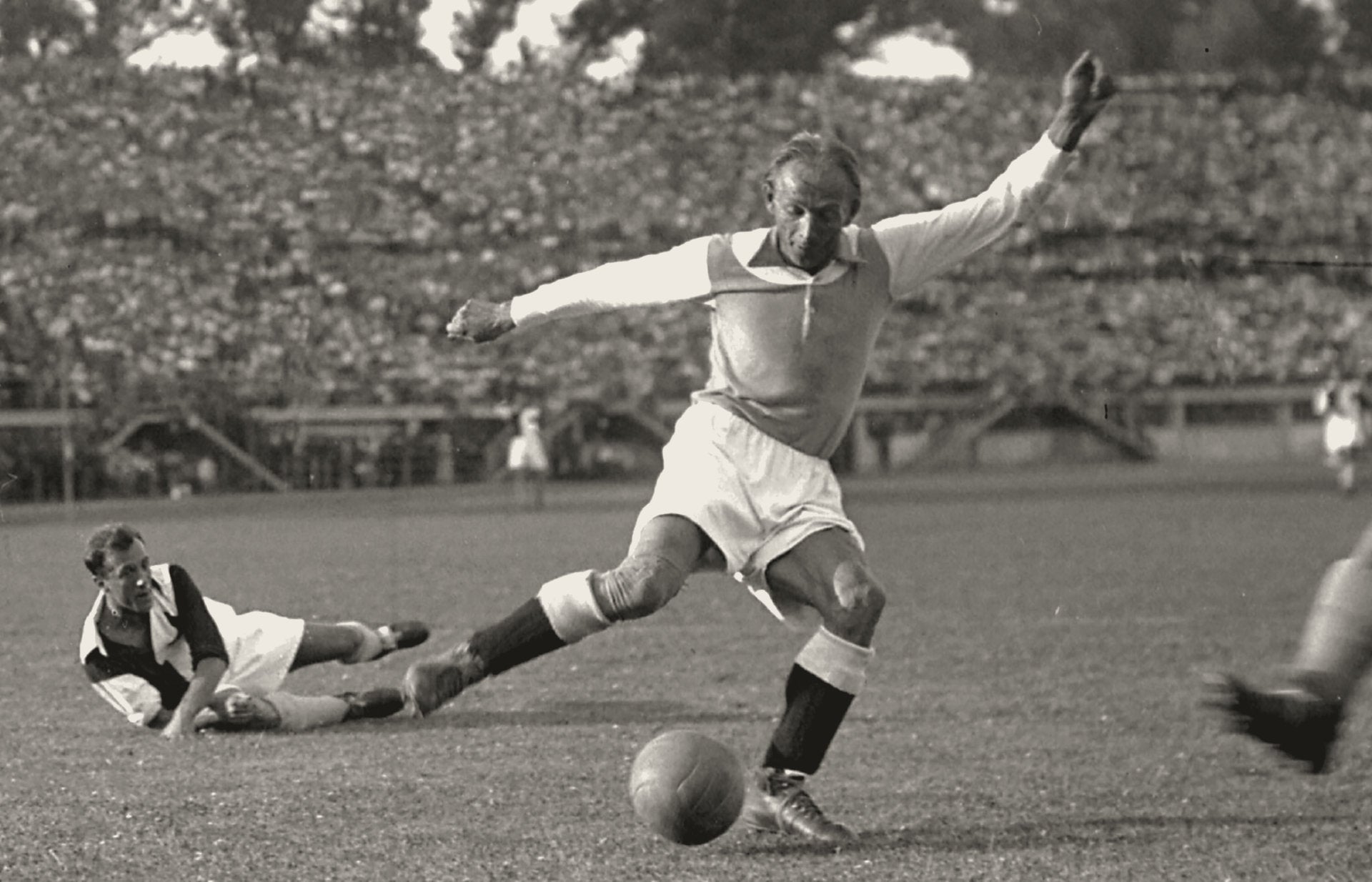
Matthias Sindelar was called der Papierene because of how he looked on the pitch: thin, light, apparently fragile, and impossible to knock down. He was the centre forward of the Austrian Wunderteam and, by common consent, the best player in Europe in the early 1930s.
The team that no longer exists
The Wunderteam beat Scotland, beat Germany heavily twice, drew with England at Stamford Bridge in a match they were widely thought to have deserved to win, and reached the semi-final of the 1934 World Cup. It played a passing game built around Sindelar dropping deep, which is now standard and was then close to unheard of.
In March 1938 the country it represented stopped existing. Austrian football was absorbed into the German federation and the national side was dissolved.
The refusal
The best Austrian players were expected to turn out for the combined German team heading to the 1938 World Cup. Sindelar said he was too old and his knee was bad.
Both things were true. Neither was the reason, and everyone understood that.
3 April 1938
A match was staged in Vienna between Austria and Germany to mark the union. The understanding was that it would end in a draw.
By the accounts that survive, Sindelar spent the first half squandering chances in a way that read as deliberate. In the second half he scored, and then celebrated directly in front of the box holding the officials of the new regime. His teammate Karl Sesta added a second. Austria won 2 to 0.
No salute was given.
The cafe, and the flat
Later that year Sindelar bought a cafe from a Jewish owner who was being forced out under Aryanisation. He paid what the place was worth rather than the nominal sum such transfers usually involved.
On 23 January 1939 he and his partner Camilla Castagnola were found dead in his apartment. The stated cause was carbon monoxide poisoning from a blocked chimney. The inquiry was wound up rapidly and parts of the record are missing. Accident, suicide and murder have all been argued, and none has been proved.
Why it goes on a wall
Because the story is not about a goal. It is about a man who was offered a comfortable, celebrated place inside something and said no, repeatedly, in ways that could not be misread, in a city where saying no had become dangerous.
He scored, he danced in front of them, and ten months later he was dead at thirty-five.