
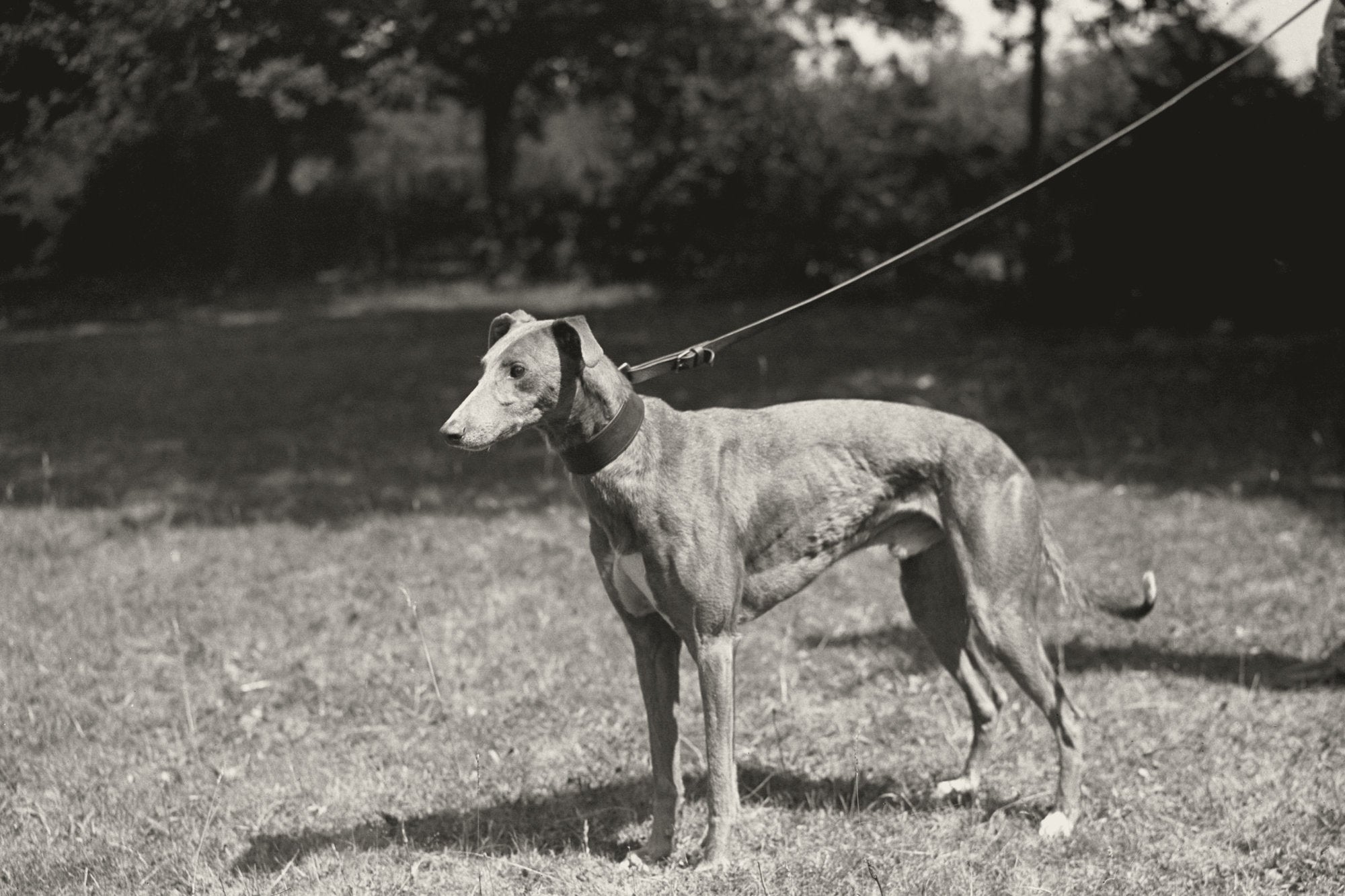
Nineteen consecutive victories, in a sport where the draw, the traps and the traffic in the first bend make long winning runs close to impossible.
The runt
Mick the Miller was whelped in June 1926 at the parish house in Killeigh, County Offaly, the smallest of twelve. Father Martin Brophy kept him and named him after the local miller.
He survived distemper as a puppy, which many did not, and did not begin racing until he was over two years old.
What British greyhound racing was
The first modern track opened at Belle Vue in Manchester in 1926, the same year he was born. Within a few years the sport had become an urban phenomenon: cheap, in the evenings, in the middle of cities, accessible to people who could not afford much else.
During the Depression, individual meetings drew crowds in the tens of thousands and the sport was among the best attended in Britain.
The Derbys
He won the English Greyhound Derby at White City in 1929 and retained it in 1930. He also took nineteen races in a row and set world records over more than one distance.
The 1931 final
He crossed the line first in the 1931 Derby final, but the race was declared void because of fighting among the runners and ordered to be re-run. He did not take part in the re-run.
Whether that constitutes a third Derby is a question British racing has never agreed on.
The celebrity
He appeared as himself in the 1934 film Wild Boy. His retirement was covered in the national press. He was, for several years, better known than most human athletes in the country.
Afterwards
He died in 1939 at the age of thirteen. He was preserved and is displayed at the Natural History Museum at Tring.
Why it goes on a wall
Because the smallest dog in the litter, kept more or less by accident, became the biggest draw in a sport that was itself the entertainment of people with nothing.
Nineteen in a row.