
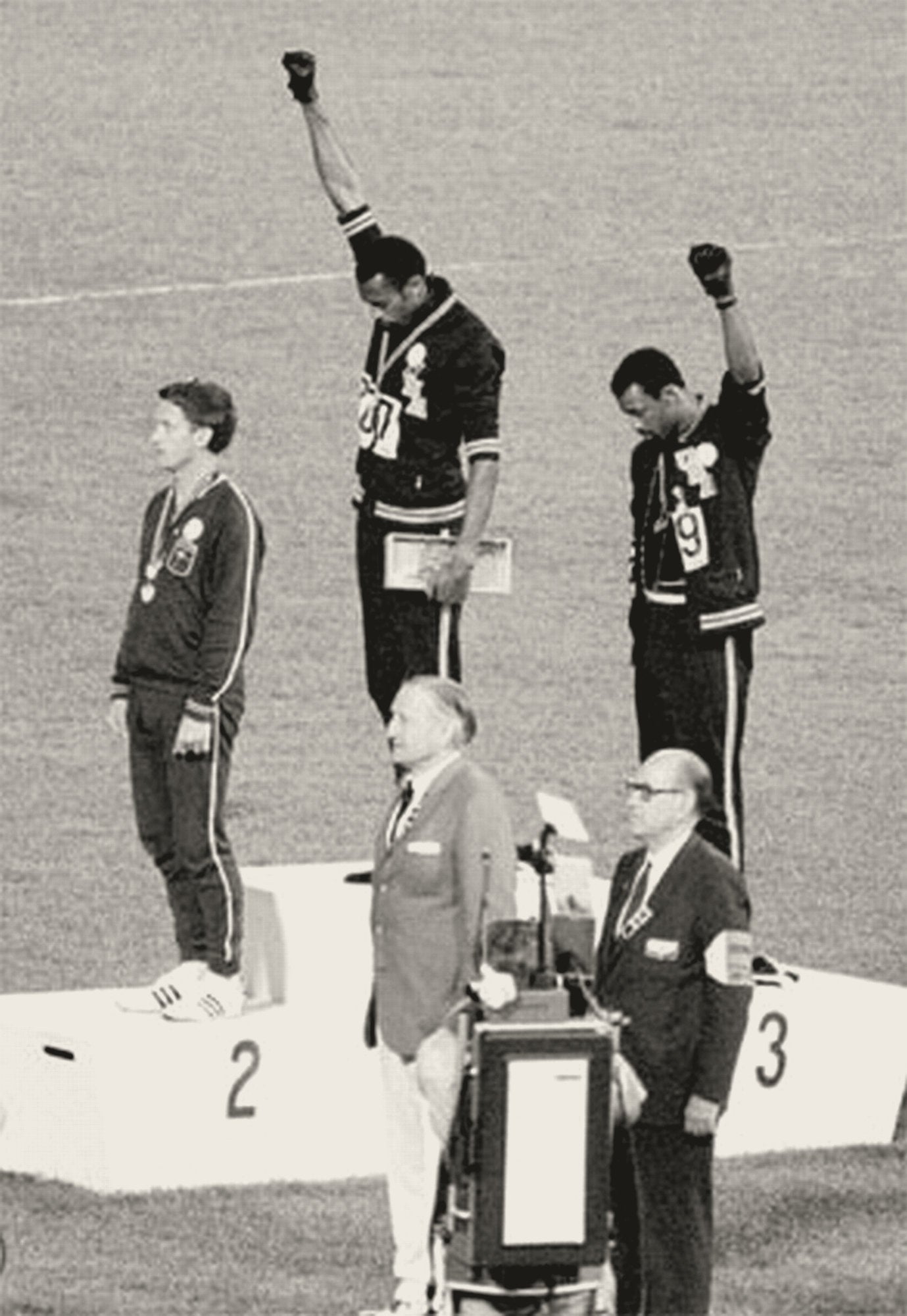
The image is famous enough to need no description. Mexico City, October 1968, two raised fists on an Olympic podium. What people forget is that there are three men in it, and the one at the front, on the second step, is a white Australian named Peter Norman.
He is not a bystander in the photograph. He is a participant, and it cost him more than it cost either of the others.
How he got there
Norman was not a passenger in that final. He ran 20.06 seconds and finished second, beating John Carlos to the silver by inches. It was, and remains, the Australian record for the 200 metres.
That is the detail that should stop you. The record was set in 1968. It has survived every Australian sprinter since, on faster surfaces, in better shoes, with better training. More than half a century later it has not been touched.
The badge
Before the ceremony Norman found out what Smith and Carlos intended to do. He was given the chance to stand apart from it and did not take it. He asked for a badge of the Olympic Project for Human Rights and wore it on the podium.
It is a small object. In the photograph it is a smudge on his chest, easy to miss. It is also the reason his life divided into a before and an after.
The cost
Australia in 1968 still ran an explicitly race-based immigration policy. Norman came home to a hostile reception and never recovered his place in the sport.
He was not formally banned. He was simply not selected. For the 1972 Games he ran the qualifying standard on multiple occasions and was left out, and Australia entered no male 200 metres sprinter at all. He worked outside athletics for the rest of his life. When the Games came to Sydney in 2000, he had no official role.
Thirty-eight years later
Norman died in October 2006. Tommie Smith and John Carlos travelled to Melbourne for the funeral, spoke at the service, and carried the coffin.
In 2012 the Australian parliament passed a motion apologising to him and recognising what he had done. He had been dead for six years.
Why it goes on a wall
Because the story is usually told as a photograph of two men, and it is a photograph of three. Because the third one had the least to gain and paid the longest. And because the record he set on the way to that podium is still standing, unbeaten by the country that spent decades pretending he was not there.
Twenty point zero six, and a badge the size of a coin.