
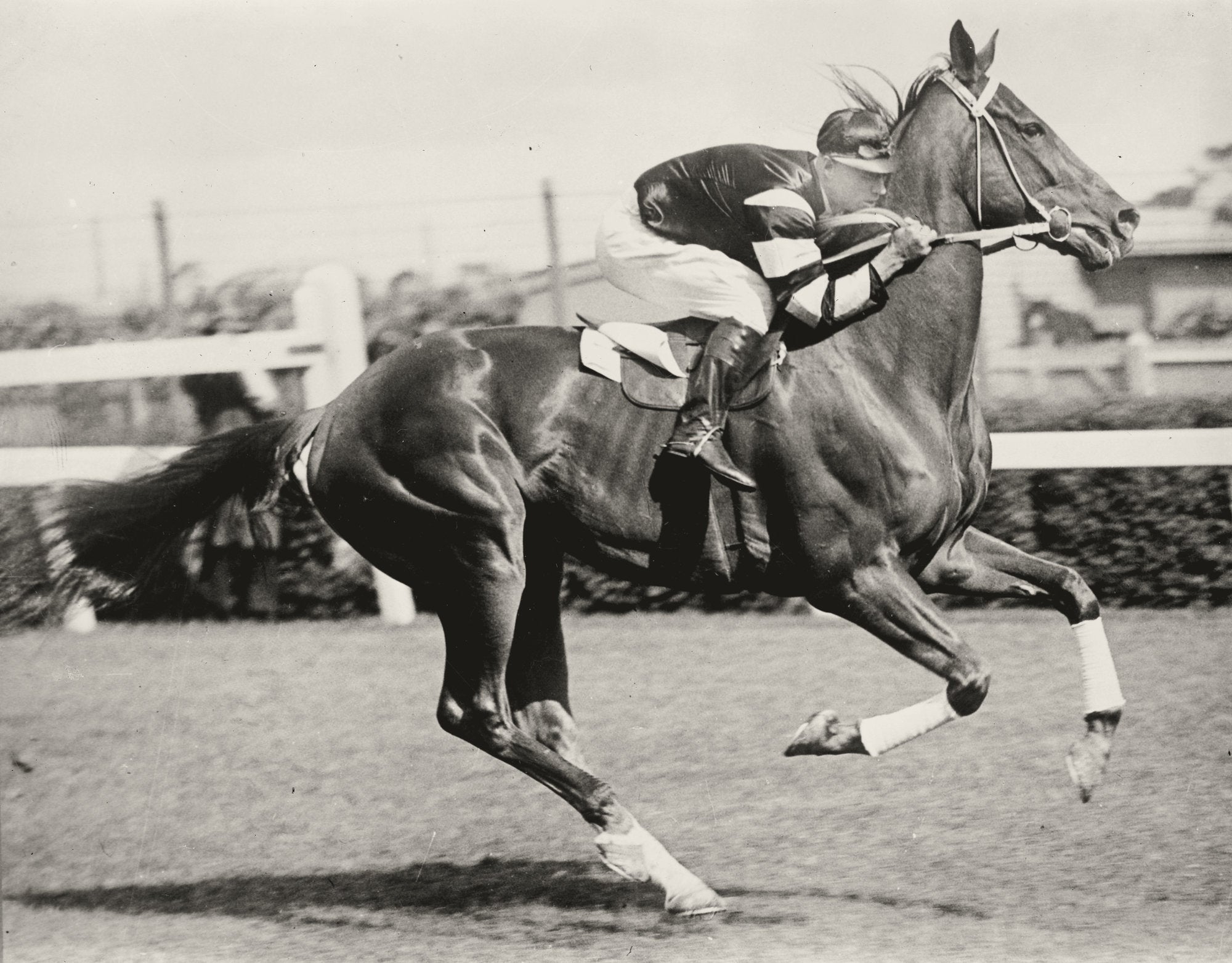
Thirty-seven wins from fifty-one starts, across a career of a little over three years.
Bought for nothing
Phar Lap was bred in New Zealand and bought at auction for around 160 guineas by the trainer Harry Telford, acting for the Sydney businessman David Davis, who had not seen the horse.
On arrival he was tall, awkward and covered in warts. Davis was sufficiently unimpressed that Telford ended up leasing the horse himself to cover the training costs.
He was unplaced in his first four starts.
What he became
From 1929 he began winning and continued at a rate that has few parallels. Fifty-one starts, thirty-seven wins, including a run of fourteen consecutive victories.
Why Australia cared so much
The timing is inseparable from the story. Australia was in the depths of the Depression, with unemployment around thirty per cent and a great deal of public misery.
A cheaply bought, unfashionable horse beating the best in the country every week became a national fixation in a way that is difficult to reconstruct now.
The weight and the gun
Handicappers responded by piling on weight. In the 1930 Melbourne Cup he carried 9 stone 12 pounds as a four-year-old, the heaviest burden ever carried to victory in the race by a horse of that age, and won.
Days before that Cup an attempt was made on him. A car drew alongside during morning work and a shotgun was discharged. His strapper Tommy Woodcock pulled him clear and the shot missed. He won the Melbourne Stakes that same afternoon.
North America
In 1932 he was shipped to race at Agua Caliente in Mexico, then the richest race on the continent. He won it at the first attempt, in track record time, reportedly with a damaged hoof.
Sixteen days later, at a ranch near San Francisco, he died after a short and severe illness. He was five years old.
The unresolved part
The post mortem found extensive inflammation. Australian opinion assumed poisoning at the time and a substantial part of it still does.
Subsequent investigations have proposed acute arsenic poisoning, a bacterial infection of the intestine, and arsenic again through routine tonics of the era. No account has settled the matter.
His remains were divided. The mounted hide went to Melbourne, the skeleton to Wellington, and the heart, weighing about 6.35 kilograms against a typical 3.2, to Canberra.
Why it goes on a wall
Because a horse nobody wanted won thirty-seven races in three years, survived a shooting, carried impossible weight, won the richest race in North America and then died at five in circumstances nobody has ever explained.
Thirty-seven from fifty-one.