
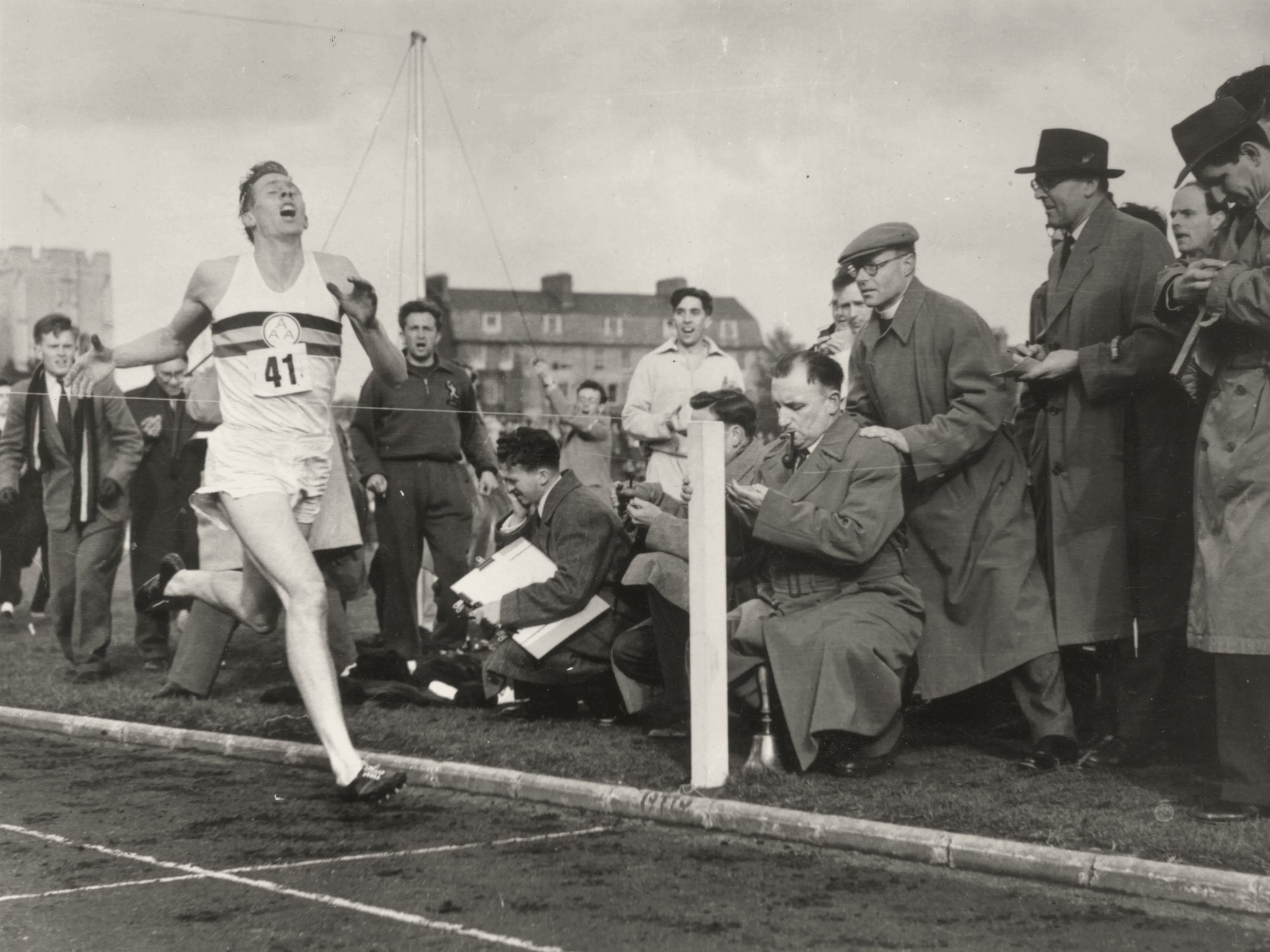
Forty-six days after Roger Bannister broke the four minute mile, someone else broke it too. That gap is the whole point of the story, and it is the part that usually gets left out.
What the wall was made of
Before 1954 the four minute mile was not treated as a difficult target. It was treated as a limit. Coaches and physiologists explained why it lay beyond human capacity. Popular articles suggested the attempt could be fatal.
The world record had been 4:01.4 since 1945, held by Gunder Hagg. Nine years without a hundredth of movement is the kind of statistic that hardens into belief.
Iffley Road, 6 May 1954
The conditions were bad. Cold, a crosswind around fifteen miles an hour, and a cinder track, which is appreciably slower than a modern synthetic surface. Bannister considered postponing. The wind eased in the early evening and he went.
Chris Brasher paced the first two laps, Chris Chataway the third. Bannister took the lead with roughly three hundred yards remaining and collapsed into the arms of officials past the line.
3:59.4.
The announcement
Norris McWhirter, on the microphone, drew it out deliberately: a new meeting record, track record, English Native, British National, British All-Comers, European, British Empire and World Record. The time was three.
The crowd took the rest. The 59.4 was never heard.
Who he was
Bannister was a twenty-five year old medical student. He trained around thirty minutes a day, in his lunch hour, because that was the time medical school left him. He had no sponsor, no full-time coach, no support staff.
He retired from athletics later that year to concentrate on medicine and became a distinguished neurologist. He always maintained that his contribution to neurology mattered more than the mile.
What happened next
John Landy ran 3:57.9 in Turku on 21 June, forty-six days later.
Within a year several more had gone under four minutes. Within three years, more than a dozen. Today over seventeen hundred men have done it and the world record sits below 3:44.
Why it goes on a wall
Because it is the cleanest demonstration on record that a limit can be an idea rather than a fact. Nothing about human physiology changed in the summer of 1954. Only what people believed was possible.
Forty-six days, and the wall was gone.