
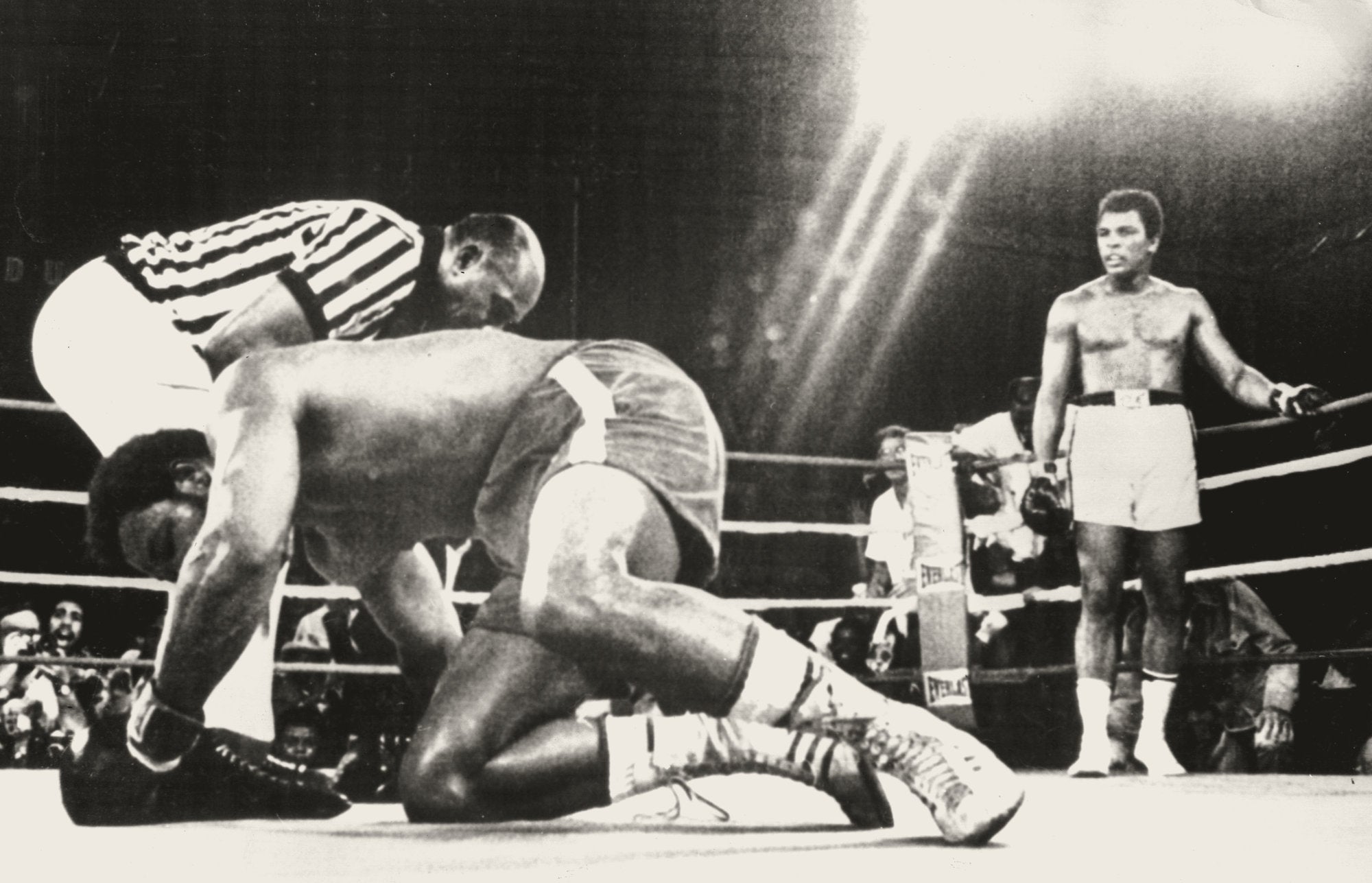
Eight rounds. That is how long it took, and seven of them were spent being hit on purpose.
The mismatch
George Foreman came to Kinshasa unbeaten in forty professional fights, thirty-seven of them knockouts. He had taken the title from Joe Frazier by knocking him down six times inside two rounds, and he had removed Ken Norton in two. Both men had beaten Ali.
Ali was thirty-two, and had lost three and a half years of his athletic peak to the ban imposed after he refused induction into the United States Army in 1967.
Most of the press expected Foreman to win inside three rounds. A significant number of people were genuinely worried Ali would be badly hurt.
Kinshasa
The fight was staged in Zaire by Don King and financed by Mobutu Sese Seko to the tune of ten million dollars. It started at four in the morning local time so that it would land in American prime time. Around sixty thousand people were in the Stade du 20 Mai.
It had been postponed six weeks after Foreman was cut in sparring, which left Ali in Zaire long enough to become, in effect, the local fighter.
The plan, and what he did instead
The agreed plan was movement: stay off the ropes, circle, make Foreman chase.
In the second round Ali went to the ropes and stayed there. Angelo Dundee shouted at him to get off. Ali covered up, leaned back over ropes that had been deliberately loosened, and let Foreman hit his arms and body.
He also talked. He told Foreman the punches were weak, that he had expected more. Foreman confirmed afterwards that the commentary got to him.
The turn
Foreman was visibly tiring by round five. By the seventh his punches had lost structure. In the eighth, with about thirty seconds left in the round, Ali came off the ropes and landed a combination finishing with a straight right. Foreman went down and was counted out.
Ali regained the heavyweight title seven years after it had been taken from him outside the ring.
What it cost
The rope-a-dope is usually told as cunning. It was also a decision to accept an enormous quantity of head and body damage as a tactic.
Ali fought for another seven years after Kinshasa. He was diagnosed with Parkinson's syndrome in 1984, at forty-two. The relationship between the punches he chose to take and what followed is not something anyone can prove precisely, and not something anyone seriously doubts.
Why it goes on a wall
Because the cleverest tactic in the history of boxing was not really a tactic. It was a man deciding that his own capacity to be hit was the resource he had most of, and spending it.
Seven rounds on the ropes, and the eighth.