
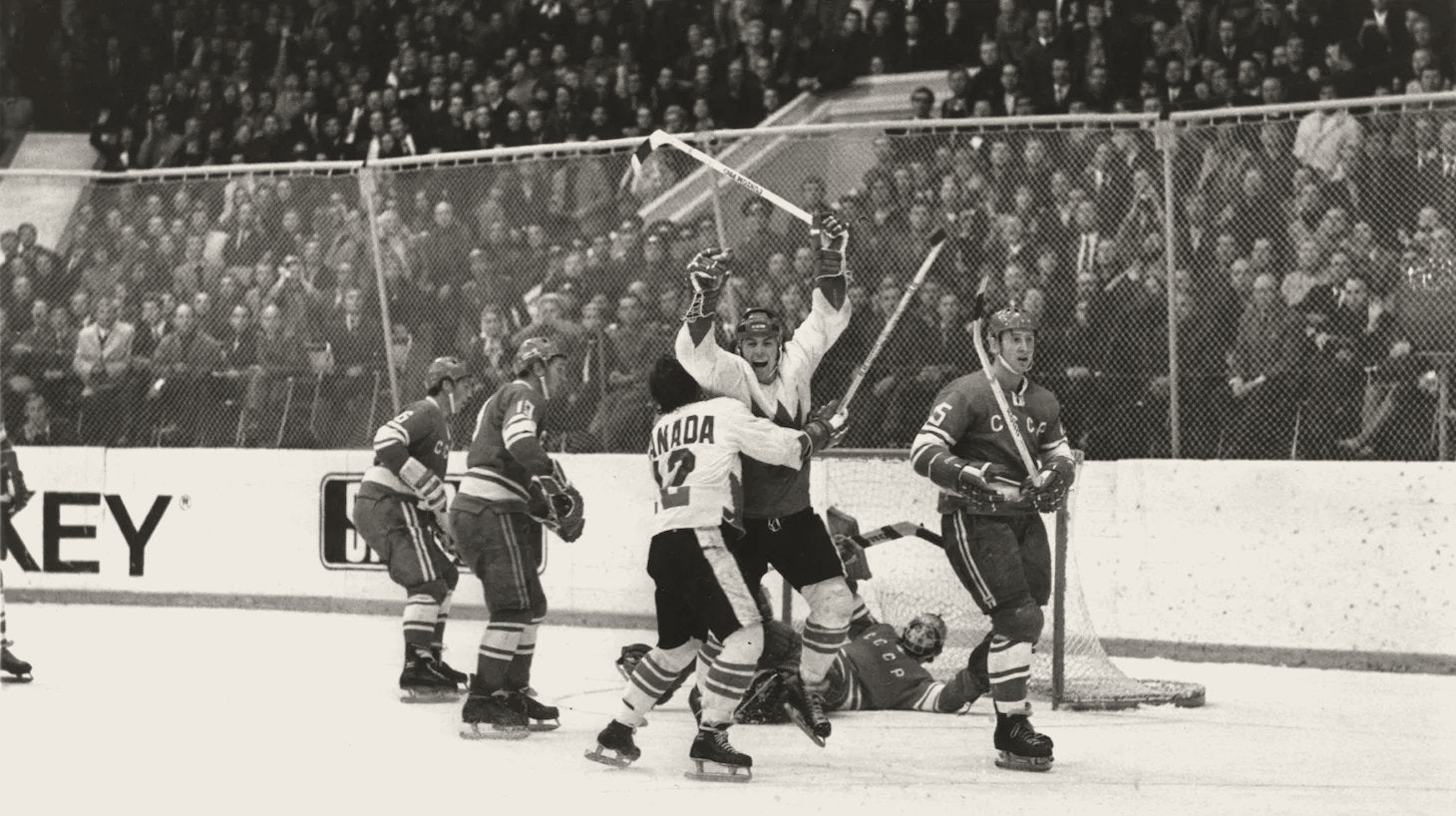
The seconds remaining in game eight when Paul Henderson scored the goal that won the series.
The premise
Until 1972 Canada's best professionals had never played the Soviet national side. Olympic and world championship competition was nominally amateur, and the Soviets, who were nominally amateur and actually full-time, had dominated it.
The series was eight games: four in Canada in early September 1972, four in Moscow later that month.
Canadian expectation, in the press and among the players, was close to a sweep.
Game one
Montreal Forum, 2 September. Canada led 2-0 within seven minutes. The Soviet Union won 7-3.
The Canadian leg
Canada won game two in Toronto, drew game three in Winnipeg, and lost game four in Vancouver, where the home crowd booed the team off the ice.
Phil Esposito's post-game interview, delivered on the ice while still in his equipment, is one of the best known pieces of footage in Canadian sport: a defence of the players' effort and a direct appeal to the public.
Moscow
Canada lost game five in the Luzhniki Ice Palace after leading 4-1, leaving them needing to win the remaining three.
They won game six 3-2 and game seven 4-3, Henderson scoring the winning goal in each.
Game eight
28 September 1972. Canada trailed 5-3 after two periods. A Soviet official had informed the teams that in the event of a series tie the Soviet Union would claim victory on goal difference.
Esposito scored, then Yvan Cournoyer equalised. The goal light did not come on. Alan Eagleson attempted to reach the timekeeper, was intercepted by Soviet police, and was pulled across the boards to the Canadian bench by the players.
With thirty-four seconds left Henderson, who had called Peter Mahovlich off for a change, went to the front of the net. His first shot was stopped, the rebound came back to him, and he scored.
Final score 6-5. Series to Canada, four wins, three losses, one draw.
At home
The game was played in the afternoon Canadian time. Schools brought televisions into classrooms and assembly halls. Workplaces stopped. Estimates put the domestic audience at a large majority of the population.
Tretiak
Vladislav Tretiak was twenty. Canadian scouts had watched him play badly in one game before the series and concluded he was weak. He faced more shots than any goaltender in the series and went on to be regarded as one of the greatest ever, and was inducted into the Hockey Hall of Fame in 1989.
Why it goes on a wall
Because the sporting result is secondary. What is on the print is a country that expected to win easily, was humiliated in public, turned on its own players, and then had to watch, all at the same time, while the thing was decided.
The country stopped.