
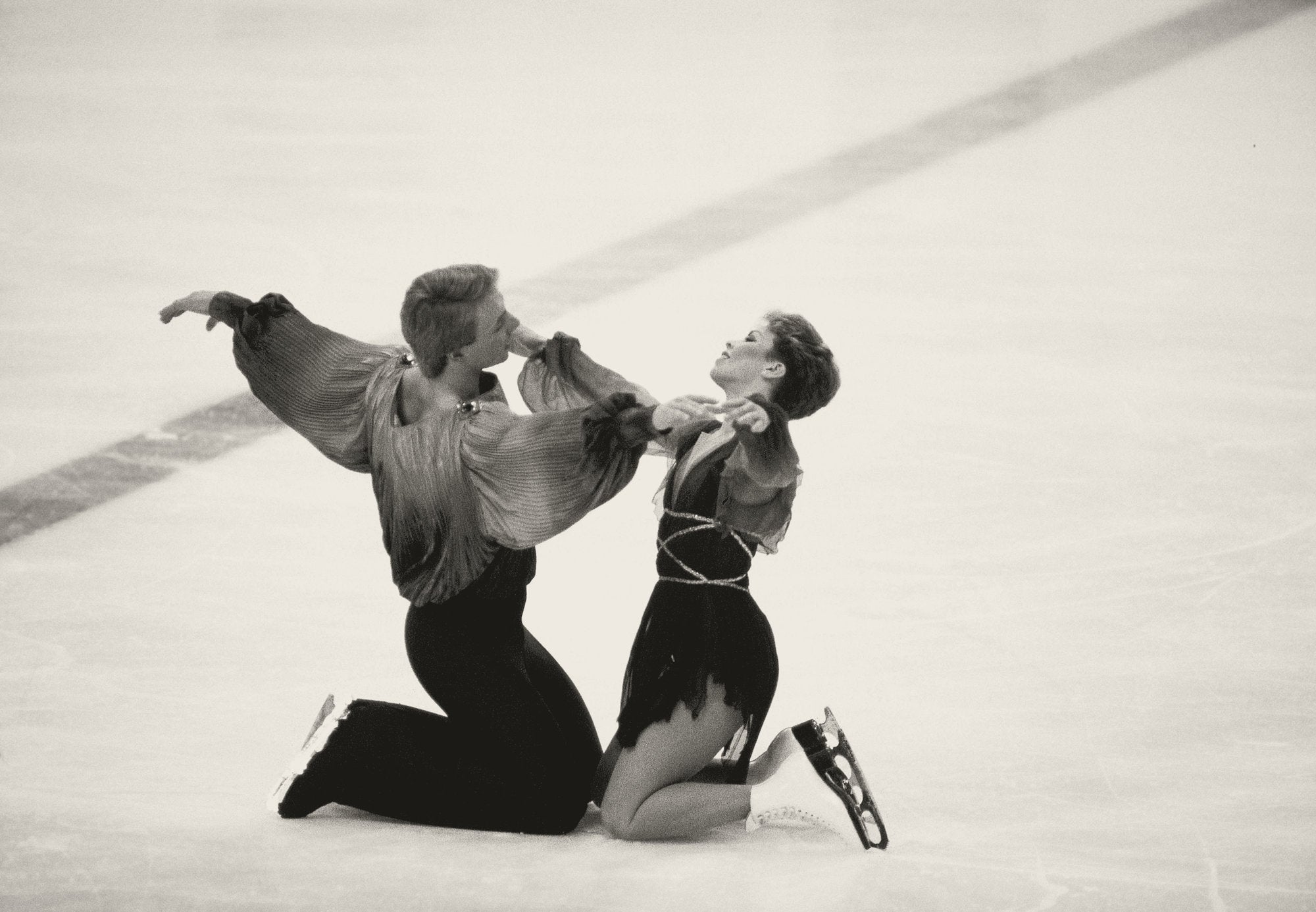
The number of judges, and the number of perfect 6.0 marks awarded for artistic impression. Unanimous, and unrepeated at an Olympic Games.
The timing problem
International Skating Union rules limited the free dance to four minutes and ten seconds, with a ten second tolerance.
Ravel's Bolero runs roughly seventeen minutes and is built as a single continuous crescendo, which makes it very difficult to cut.
The arrangement by Bob Stewart came in at four minutes twenty-eight.
The solution
The regulation specified that timing began when the skaters' blades touched the ice.
Torvill and Dean opened the programme kneeling on the ice, in contact through their knees rather than their skates, for approximately eighteen seconds.
The official clock started when they rose. The routine was inside the limit.
Who they were
Both from Nottingham. Jayne Torvill worked as an insurance clerk at Norwich Union; Christopher Dean served as a police constable with Nottinghamshire Constabulary.
They trained around shift work until Nottingham City Council awarded them a grant of forty-two thousand pounds in 1981, which allowed them to train full time.
14 February 1984
The free dance at Zetra Hall, Sarajevo.
All nine judges awarded 6.0 for artistic impression. Three awarded 6.0 for technical merit.
The closing sequence, in which Torvill sinks to the ice and Dean falls beside her, was choreographed to represent the deaths of two lovers.
The UK television audience is generally estimated at around twenty-four million.
The scoring system
The 6.0 system was abolished after the 2002 judging scandal at Salt Lake City and replaced by the ISU Judging System in 2004.
A unanimous set of perfect artistic marks is therefore not merely unrepeated but no longer possible.
After
They turned professional in 1984, and returned as reinstated amateurs for Lillehammer in 1994, taking bronze in a result that was widely disputed.
Zetra
The hall where they skated was destroyed by shelling during the siege of Sarajevo, which began in 1992. Its wooden seating was used for coffins and the surrounding ground was used for burials.
It was rebuilt in 1999 with international assistance.
Why it goes on a wall
Because the most romantic four minutes in the history of the sport began with two people finding a loophole in a timing regulation, and that is not a diminishment of it. It is how the thing got made.
They knelt to stop the clock.