
The number is the story, so it may as well come first. Varenne started seventy-three races and won sixty-two. He was beaten eleven times across five seasons at the top of his sport. Records in racing are usually about a single afternoon: a distance, a margin, a time on a clock. This one is about the absence of bad days.
Harness racing is not the horse racing most people picture. There is no jockey on the animal's back. The driver sits behind, low, in a light two-wheeled sulky, and the horse is required to trot, not to gallop: a gait it must hold under pressure, at speed, for two kilometres or more, with the constant risk that it breaks into a run and is disqualified for it. The discipline is exactly the point. A trotter that cannot keep its head does not win anything, however fast it is.
Vincennes and Solvalla
Two races decide the hierarchy. The Prix d'Amerique is run at Vincennes, in the Bois de Vincennes on the eastern side of Paris, in the last week of January. It is cold, the crowd is enormous, and in France it carries a weight that has nothing to do with the size of the prize. The Elitlopp is run at Solvalla, north west of Stockholm, at the end of May, and it is an invitation race: the field is chosen rather than assembled, which means there is nowhere to hide.
Varenne won the Prix d'Amerique in 2001 and in 2002. He won the Elitlopp in 2001 and in 2002. Doing both in one season is unusual. Doing both twice, in consecutive years, against fields that had a full winter to prepare for him, is the part that stays.
The year three countries agreed
In 2001 he was named horse of the year in Italy, in France and in the United States. These are separate awards, decided by separate bodies, in three racing cultures that rarely coincide on anything. He collected all three in the same season. In 2010 he was inducted into the United States Harness Racing Hall of Fame, which is not a place that fills up with European horses.
A country that does not watch trotting, watching
Italy has racecourses, and it has a trotting tradition that goes back a long way, but it is not a sport that occupies the front of the newspaper. For a few seasons it did. Varenne was on television, on the radio, in conversations held by people who could not have named a second trotting horse if pressed. The driver, Giampaolo Minnucci, became a recognised face. When the big races came round, the audience was not the racing audience.
This is the thing that is difficult to reconstruct afterward, because it leaves no statistic. A minority sport briefly stopped being a minority sport, on the strength of one animal, and then went back to what it had been.
After
He was retired in 2002, at the end of the second Prix d'Amerique and Elitlopp double, and spent the rest of his life as a stallion. He lived to thirty-one, which is old for a horse, and died in August 2026.
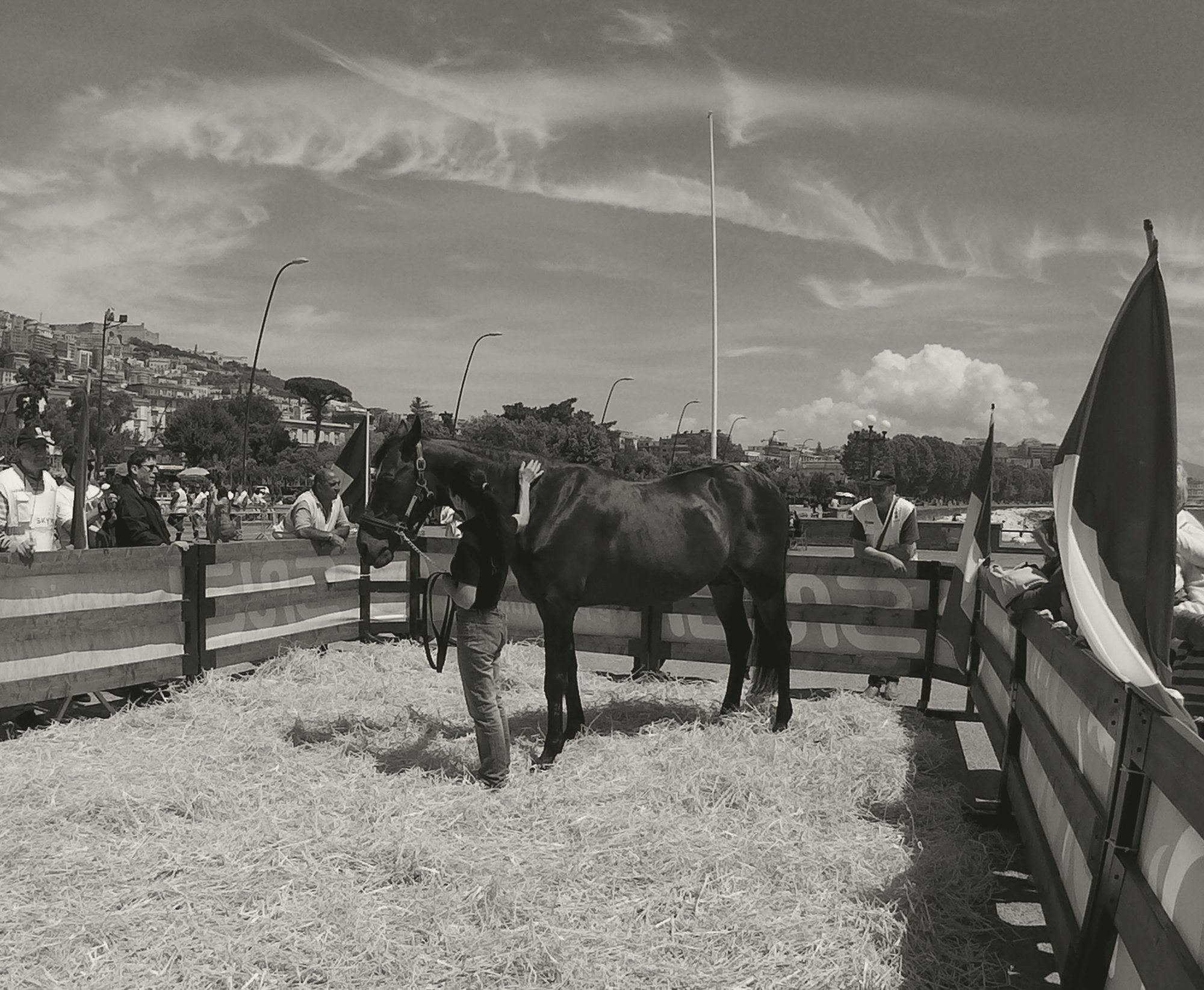
The photograph used for this print is not from a race. It was taken on the thirtieth of April 2016 on via Caracciolo, the seafront road in Naples, where he had been brought out to promote the season at the Agnano racecourse. A pen of wooden rails, a floor of straw laid over the tarmac, the bay of Naples somewhere behind the crowd, and a horse standing still while a city queued to look at him. Fourteen years after his last race.
That is the part worth keeping. Not the trophies, which are countable, but the fact that a country which does not care about trotting turned out on a Saturday morning to see a retired trotter stand in a box on a seafront.
They called him the Captain, and no one ever had to explain why.
Photo: Ruthven / Wikimedia Commons. CC BY-SA 4.0. Adapted for this story.